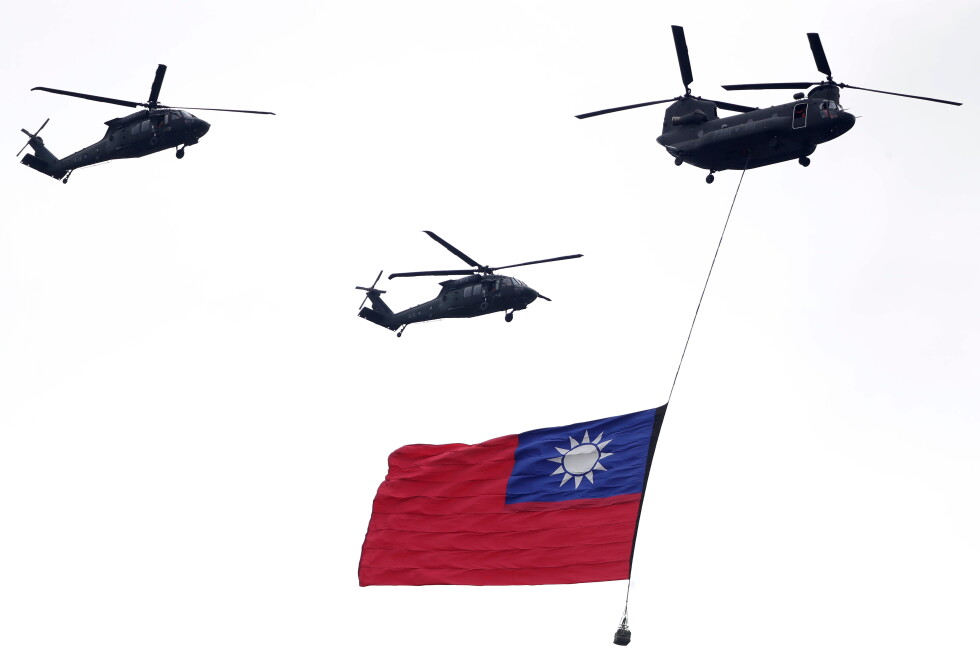
Against a backdrop of steadily growing military and political pressure from Beijing, Taiwan’s ruling administration announced a historic defense budget proposal for 2027 on Thursday, marking a major escalation in the island’s efforts to bolster its deterrence capabilities against potential Chinese aggression.
The planned budget totals 1.12 trillion Taiwan dollars, equivalent to roughly $35 billion — an 18% increase from the 2026 proposed defense allocation, per an official government statement. For the first time, the defense budget will exceed 3% of Taiwan’s projected gross domestic product, putting the island on track to meet the commitment President Lai Ching-te laid out to raise military spending to 5% of GDP by 2030.
Just days before the official budget release, Lai previewed the milestone, stating that crossing the 1 trillion Taiwan dollar threshold for defense spending was fundamentally an investment in long-term cross-strait peace. This proposal comes after years of escalating Chinese activity around the self-governing island: Beijing claims Taiwan as part of its sovereign territory, and regularly deploys fighter jets, coast guard vessels, and military ships to waters and airspace near Taiwan, while holding large-scale military exercises around the island on a recurring basis. Beijing has never formally ruled out the use of military force to seize control of Taiwan.
The budget proposal will now move to Taiwan’s opposition-controlled legislature for review, which must be completed before the end of August. However, the legislative process is expected to face notable hurdles. Last Friday, the legislature only finalized passage of the 2026 central government budget following a record-setting 266-day delay, local Taiwan’s Central News Agency reported.
The push for higher defense spending also aligns with longstanding calls from the United States, Taiwan’s most important informal security partner. Though Washington does not maintain formal diplomatic ties with Taipei, U.S. federal law requires the U.S. to provide Taiwan with the defensive arms it needs to deter aggression. For decades, the U.S. has served as the island’s primary arms supplier and diplomatic backer, a status that has consistently been a major source of diplomatic and military tension between Washington and Beijing.
This latest budget announcement follows a major escalation of Taiwan’s annual Han Kuang military exercises earlier this month, which are designed to simulate responses to a full-scale Chinese invasion. In a break from previous years, the drills incorporated reservists and civilian stakeholders into realistic combat scenarios, and temporarily throttled mobile internet connectivity in parts of the island to text-only speeds to simulate wartime network disruptions. Earlier urban resilience drills in Taipei were far less disruptive and attracted little public attention.
Cross-strait tensions have remained volatile in recent years, with high-level diplomatic moves adding to uncertainty on the island. During a 2017 visit to Beijing by then-U.S. President Donald Trump, Chinese President Xi Jinping warned that mismanagement of the Taiwan issue could lead to direct conflict between the two major powers. After the meeting, Trump sparked widespread anxiety across Taiwan when he described U.S. arms sales to the island as a “very good negotiating chip” to use in talks with Beijing.
Taiwan has operated as an independent self-governing entity since 1949, when the defeated Nationalist Party retreated to the island at the end of the Chinese Civil War, which brought the Chinese Communist Party to power in mainland China.