标签: Oceania

大洋洲

  • ‘Market is cooked’: Housing Minister backs tax changes amid Labor poll shock

    ‘Market is cooked’: Housing Minister backs tax changes amid Labor poll shock

    Australia’s housing market is fundamentally broken and failing to deliver accessible homeownership for ordinary working people, according to the nation’s Housing Minister Clare O’Neil, as the center-left Albanese Labor government pushes forward with high-stakes tax reforms targeting the sector, despite early polling that suggests the move could cost it support to the benefit of right-wing populist party One Nation.

    In an interview with Sky News on Sunday, O’Neil delivered a blunt assessment of Australia’s decades-long housing affordability crisis, stating plainly: “This market is cooked. It’s not serving the Australian people anymore … We want people on normal incomes around our nation to have a fair shot at getting into housing.”

    The federal government’s planned reforms, set to be formally introduced following the release of the 2026-27 May federal budget, roll back the 50% capital gains tax discount for existing properties and restrict negative gearing — a tax break for property investors that allows rental losses to be offset against other income — to only newly constructed housing and properties already held by investors (grandfathered assets). O’Neil emphasized that the changes will not resolve the nation’s housing shortage overnight, but framed them as a critical, balanced step toward redressing systemic housing inequality, paired with a suite of additional policies designed to increase overall housing supply.

    Treasury modelling cited by O’Neil projects the reforms will help roughly 75,000 current renter households transition into first home ownership, by gently cooling the rapid pace of national house price growth. While prices will continue to rise under the policy framework, modelling predicts growth will moderate enough to deliver an average $20,000 reduction in the final purchase price for first-time buyers, striking a balance between inaction on affordability and overly drastic intervention that would disrupt market stability. “We’ve got the balance right,” O’Neil said, noting that demand for reform extends far beyond young aspiring buyers: “I am just as likely to get stopped in the street by a grandparent or a parent who is desperately concerned about their kids and their ability for their kids to set down roots, grow wealth, and raise a family in this country.”

    The government’s priority on expanding first home ownership comes as it faces early political headwinds from the changes. The first major public polling released since the policy was unveiled, conducted by Roy Morgan, shows One Nation has pulled ahead of Labor on primary votes in a key contested area, representing a significant threat to Labor’s electoral standing. Dismissing the poll result, Treasurer Jim Chalmers told the ABC the government did not advance the reforms to earn short-term polling gains, but to deliver long-term progress for younger Australians locked out of homeownership by decades of policy failure.

    Chalmers also defended the government’s decision to apply the capital gains tax changes to shares as well as property, noting that 90% of Australians under 25 hold no equities. He argued the current tax system is distorted, overfavoring investment in existing housing while underinvesting in new supply and other asset classes. The reforms will create a far fairer, more neutral capital gains tax regime, he said, correcting a broken status quo that has locked millions out of the market. “Some people will pretend that the current arrangements in the housing market and the tax system are working just fine. We don’t agree. We think the status quo is broken and that’s why we’re fixing it,” Chalmers said.

    To pass the Senate, the government will need support from either the center-right opposition Coalition or the left-wing Greens, neither of which have signaled they will back the changes. Opposition Leader Angus Taylor has already announced the Coalition would scrap most of Labor’s core housing policies if elected, and has proposed a new policy that would peg annual net overseas migration levels directly to the number of new housing completions each year. Taylor criticized Labor for setting migration targets without accounting for existing housing supply, public services, and infrastructure, telling Sky News: “This must change, and what we’re proposing here is each year the housing minister would say we’ve built this many houses and so the immigration number, the net overseas migration number, can be X.”

  • ‘Price you pay’: Immigrants facing citizenship ‘choice’ under Coalition benefits plan

    ‘Price you pay’: Immigrants facing citizenship ‘choice’ under Coalition benefits plan

    Australia’s federal opposition leader, Angus Taylor, has sparked fierce political debate by announcing a hardline new immigration policy that would bar permanent residents who do not pursue Australian citizenship from accessing the National Disability Insurance Scheme (NDIS) and 17 other key social welfare programs. Under the plan, Taylor confirms, there is a tangible consequence for permanent residents who choose not to take up citizenship.

    The proposal formed a core plank of Taylor’s budget reply speech delivered to Parliament Thursday, where the Liberal-National Coalition also outlined two other flagship policies: linking annual net overseas migration levels directly to national housing construction completion rates, and indexing Australia’s two lowest income tax brackets to inflation to offset bracket creep. If the Coalition wins the upcoming federal election, the citizenship-linked benefit restrictions will go into effect.

    Appearing on SkyNews Sunday, Taylor pushed back against criticism that the policy would coerce long-term permanent residents – some of whom have lived in Australia for decades – into naturalizing. He framed the change as a matter of personal choice, not coercion. “It is their choice to become an Australian citizen,” Taylor said. “But if you don’t want to become a citizen, there is a price you pay for that. Australian citizenship has to matter. We live in one of the greatest countries in the world, and those who come here and decline citizenship still reap enormous benefits from being part of this nation.”

    The policy has drawn particular concern from Chinese Australian and Indian Australian communities, whose home countries do not recognize dual citizenship. For permanent residents from these nations, taking up Australian citizenship would require them to renounce their original citizenship, a step many are unwilling to take. Taylor rejected claims the policy targets any specific national group, noting that Australia itself permits dual citizenship, and restrictions on dual nationality are choices made by other governments that Canberra cannot control.

    “Other countries make choices about that, we don’t control that. That is up to them. But we must attach privileges to Australian citizenship. That’s what we’re proposing here,” Taylor said. He added that while Australia will continue to recognize dual citizenship for those who are eligible, some permanent residents from non-dual citizenship countries will ultimately have to decide whether they want to access full social benefits and commit to Australia.

    Taylor also dismissed suggestions the policy shift was a response to surging support for the right-wing One Nation party, arguing the Coalition’s agenda is driven by anger at the incumbent Labor government’s policy failures, not a panic over competing right-wing parties. “We are upset and deeply, deeply concerned by the failures of this Labor government. That’s the real issue,” he said.

    Beyond the citizenship policy, key details of the Coalition’s immigration and fiscal plans remain undisclosed. Taylor has yet to confirm a specific numerical target for net migration, nor has he released full costings for the proposed social benefit changes. He did confirm the policy changes would generate “many billions of dollars” in savings, and pledged to release full costings before the election in line with standard political convention, per Australia’s pre-election transparency norms.

    On migration levels, which the Coalition will tie directly to how many new homes are completed each year, Taylor said the plan would cut net migration by at least 70 percent from the peak levels recorded under the Labor government, pushing annual numbers well below 200,000. Responding to concerns that lower overall migration would worsen existing skilled labor shortages in the trades sector, Taylor argued the Coalition’s policy would focus not just on cutting total numbers but also on raising quality standards to ensure migrants bring the skills Australia actually needs.

    In a move that avoids immediate parliamentary conflict, Taylor confirmed the Coalition will not oppose Labor’s proposed $250 Working Australians Tax Offset in the Senate, guaranteeing the legislation will pass through both houses of parliament and become law.

    Treasurer Jim Chalmers, the incumbent Labor government’s top finance minister, has lambasted Taylor’s budget reply as the “least responsible” he has ever witnessed in Australian politics. Chalmers argued that indexing the lower tax brackets to inflation, the Coalition’s signature fiscal proposal, would add a quarter of a trillion dollars in cumulative national debt over a 10-year period. He criticized the plan for injecting massive new stimulus into the Australian economy at a time when inflation remains elevated, warning it would drive up cost of living pressures further.

    Chalmers countered that the Labor government is already committed to addressing bracket creep – the phenomenon where inflation pushes workers into higher tax brackets even as their real wage growth stalls – noting the recent federal budget created fiscal space to deliver relief in the future in a responsible and economically sustainable way.

  • ‘Momentum is building’: Labor leader Steven Miles’ boast after claiming knife-edge victory in Stafford by-election

    ‘Momentum is building’: Labor leader Steven Miles’ boast after claiming knife-edge victory in Stafford by-election

    Queensland’s political landscape has been left reeling after a tight and high-stakes by-election in the northern Brisbane seat of Stafford, where the state opposition Labor party has claimed a narrow victory despite a substantial swing toward the incumbent Liberal National Party (LNP) government.

    The contest, triggered by the sudden passing of former member Jimmy Sullivan in April 2024, was widely framed as an early test of leadership for new Labor opposition leader Steven Miles, coming just months after Labor suffered a bruising defeat at the 2024 Queensland state election. Sullivan, a 44-year-old who had been sitting on the crossbench after expulsion from Labor’s caucus over personal scrutiny, died of non-suspicious causes at his Brisbane home earlier this year, vacating the seat that Labor has held almost continuously since 2015.

    Latest official data from the Queensland Electoral Commission shows Labor candidate Luke Richmond holds a slim two-party-preferred lead of 51.2 per cent over LNP challenger Fiona Hammond, a former Brisbane City Councillor, who trails on 48.8 per cent. After all preferences are distributed, just over 700 votes separate the two front-running candidates. While the result still leaves Richmond ahead, the LNP secured a 4.1 per cent swing away from Labor in the historically safe Labor seat, which only fell to the LNP once before, during the party’s 2012 state landslide victory.

    Despite the narrow margin, LNP Premier David Crisafulli publicly conceded defeat to a gathering of party supporters in Brisbane’s Fortitude Valley on Saturday night. Acknowledging the result would leave the government “agonisingly short”, Crisafulli nonetheless celebrated the swing his party achieved, noting the outcome exceeded internal party expectations. “If you had said to me at the start of this that we will be here with a result like this, I think it is probably beyond all of our dreams,” he told attendees.

    For Labor, however, the narrow win is being framed as a sign of growing momentum ahead of the 2028 state election. In a victory statement Saturday night, Miles drew clear battle lines for the next statewide poll, pointing to the massive grassroots campaign Labor ran to hold the seat. “We have seen that momentum right here on the ground in Stafford, and tonight has drawn the battle lines for the 2028 election,” Miles said. He went on to note that the campaign marked the largest grassroots organising effort in Queensland Labor history, with volunteers knocking on more than 34,000 doors and making more than 27,000 direct voter calls.

    Miles also highlighted unusual context that benefited the LNP in the by-election, noting the party gained its modest swing after the government spent hundreds of thousands of dollars in taxpayer funds on political advertising, and struck a deal with One Nation that saw the right-wing party avoid running a candidate and openly endorse Hammond. Miles also praised Hammond for running what he called a respectful campaign.

    The seat of Stafford covers Brisbane’s inner-northern suburbs including Stafford, Chermside and Kedron, and has been held by Labor continuously since Anthony Lynham reclaimed it for the party in the 2015 state election. Sullivan succeeded Lynham as the member in 2020, before his expulsion from the Labor caucus and subsequent death earlier this year. While official formal declaration of the result is still pending, both major parties have already positioned the razor-thin outcome as a sign of shifting political tides in Queensland ahead of the next state poll.

  • Eagle-eyed motorists helping NSW clampdown on unfair fuel pricing

    Eagle-eyed motorists helping NSW clampdown on unfair fuel pricing

    A sweeping compliance crackdown on deceptive fuel pricing in New South Wales (NSW), Australia, has uncovered a stark pattern: regional service stations account for a disproportionate majority of penalties for violating state pricing transparency rules, with public tip-offs playing a key role in catching offending operators.\n\nLaunched by the NSW government, the FuelCheck initiative was designed to empower motorists by giving them real-time access to up-to-date fuel price data across the state. Under the scheme, all service station operators are legally required to update and submit accurate pricing information to the platform, which must match the actual rates charged to customers at the pump. Operators found to misrepresent their prices face official fines for non-compliance.\n\nNewly released data from NSW Fair Trading shows that to date, inspectors have completed more than 4,600 on-site inspections and follow-up reinspections across the state, resulting in more than 270 fines for pricing mismatches. Nearly one-third of these penalties came from tips submitted by vigilant motorists who noticed discrepancies between the prices listed on FuelCheck and the actual charges they faced at the bowser.\n\nOfficials note that public participation has been a transformative asset to the enforcement effort. “FuelCheck is a crucial tool that puts power back in the hands of motorists,” said Natasha Mann, Commissioner of NSW Fair Trading. “Our inspectors have been working around the clock in every corner of the state checking for compliance in petrol stations to stamp out price mismatches.”\n\nThe data reveals a clear gap between compliance rates in metropolitan and regional areas: while roughly the same number of inspections have been carried out in Sydney and rural NSW, 70 percent of all fines have been issued to regional operators, meaning non-compliance is far more common outside the capital. One service station in the state’s Murray region was even found to have a 24-cent per litre difference between the price it reported to FuelCheck and the actual rate charged to drivers, a significant overcharge for consumers.\n\nAmong all regional regions, the Southern Tablelands and South Coast recorded the highest number of violations, with 33 total fines for pricing mismatches. The Riverina followed closely with 30 penalties, while the Central West notched 21 fines. Repeat offenders have also been identified across multiple locations, including Cooma, Lismore, Kelso, Newcastle, Goulburn and Port Kembla.\n\nNSW Fair Trading Minister Anoulack Chanthivong emphasized the state government’s commitment to protecting motorists from deceptive pricing practices, noting that fair pricing for fuel relies on transparency and honest behavior from operators. “The sheer number of fines issued shows that the Minns Labor government will not back down” on enforcing fair pricing rules, he said. The ongoing compliance effort will continue to pair inspector-led audits with public reporting to root out pricing mismatches across the state.

  • Svitolina sees off Gauff to win Italian Open, Sinner in men’s title showdown

    Svitolina sees off Gauff to win Italian Open, Sinner in men’s title showdown

    The 2025 Italian Open delivered two days of dramatic, rain-interrupted tennis on Saturday, capped by Elina Svitolina capturing her third WTA 1000 Rome title and Jannik Sinner extending his historic Masters 1000 winning streak to book a spot in the men’s championship match.

    Ukraine’s Svitolina, the tournament’s seventh seed, outlasted American star Coco Gauff in a topsy-turvy three-set clash, finishing the match 6-4, 6-7 (3/7), 6-2 to lift the trophy. Remarkably, the champion’s last WTA 1000 title also came at the Foro Italico, eight years prior, making Saturday’s win a full-circle moment for the veteran.

    Gauff, a two-time Grand Slam champion and pre-tournament favorite who fell just short of the title last year, entered the match aiming to become the first American woman to claim the Rome crown since Serena Williams in 2016. But the serving errors that have long plagued her game reemerged at the worst possible time on the tournament’s centre court. Gauff was broken three times en route to dropping the opening set, hampered by four double faults – two of which came in the pivotal game that gave Svitolina a permanent lead. At 4-5 down on set point, Gauff produced an unusual misstep, hitting a second serve into the wrong half of the court before gifting Svitolina the set with another double fault.

    A visibly frustrated Gauff struck her own head with her racket before storming off court, though she returned shortly after for a heated discussion with coach Jean-Christophe Faurel. The pep talk appeared to work: Gauff sorted out her serve to force a tense second set filled with dynamic, crowd-pleasing rallies, and clawed back to level the match with a tiebreak win. But Svitolina’s steady, consistent play – a hallmark of her run through the entire tournament – proved too much. Two more breaks of Gauff’s serve in the deciding set sealed the champion’s 20th career tournament title, and dashed Gauff’s hopes of claiming her first trophy of the season just one week ahead of her French Open title defense.

    In the men’s semi-final action, world No. 1 Sinner closed out a rain-paused clash against Daniil Medvedev to secure a spot in Sunday’s final. The match was halted overnight on Friday due to Rome’s wet, volatile weather, after the Italian fell ill mid-clash – even vomiting on court and requiring medical treatment for a tight right thigh, as Medvedev pushed him to his toughest test of the entire tournament.

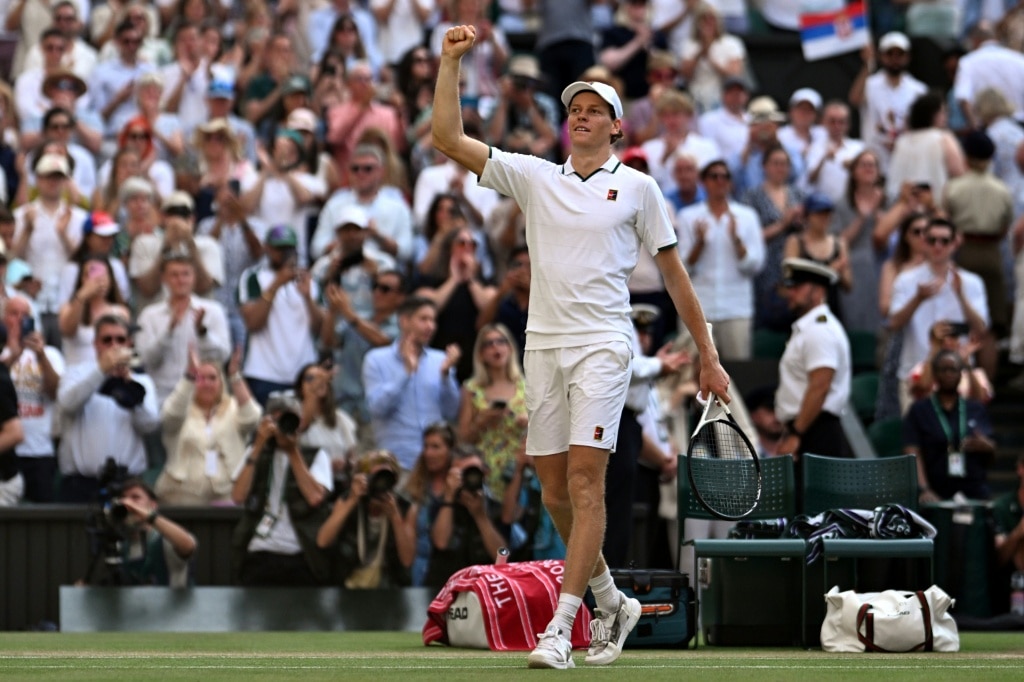
    When play resumed on Saturday, delayed an extra hour by new rainfall and a preceding men’s doubles semi-final, Sinner looked refreshed: he joked and played casual football with his coaching staff during warm-ups under newly emerged spring sun, and carried his momentum through to the finish. Sinner held onto his 4-2 third-set lead from the paused match, closing out a 6-2, 5-7, 6-4 win after two and a half hours of high-stakes play that stretched across two days. The win marked Sinner’s 33rd consecutive victory in Masters 1000 competition, and puts him in position to claim a record-extending sixth straight Masters 1000 title on Sunday.

    Speaking to reporters after the match, Sinner acknowledged his physical struggles from the day prior. “I think it’s normal that not every day we feel 100 percent,” he said. “I tried to play with the best possible energy I have. Yesterday brought me to a point where I was up today. Today I’m very happy that I finished it.”

    Sinner will face Norway’s Casper Ruud in the final, after Ruud delivered a dominant 6-1, 6-1 semi-final win over Luciano Darderi – a match also cut short and restarted due to heavy rain. The 2025 Rome final gives Ruud a chance at revenge: last year at the Foro Italico, Sinner delivered one of the most lopsided wins in tournament history, beating Ruud 6-0, 6-1 in the quarter-finals. Ruud has yet to win a single set across his four career matches against Sinner, but will climb back into the world’s top 20 in the ATP rankings on Monday regardless of Sunday’s result.

  • Semenyo’s magic moment fires Man City to FA Cup final win over Chelsea

    Semenyo’s magic moment fires Man City to FA Cup final win over Chelsea

    The 2025 FA Cup final at Wembley Stadium delivered one of the competition’s most memorable individual moments on Saturday, as Ghanaian winger Antoine Semenyo’s audacious late back-flick handed Manchester City a hard-fought 1-0 win over Chelsea, securing the club’s eighth FA Cup title.

    For much of a cagey, scrappy encounter that reflected both sides’ underwhelming domestic campaigns, neither side could find a breakthrough. Chelsea set up in a deep five-man defensive block, ceding long spells of possession to Pep Guardiola’s side while threatening only on rare counter-attacks. Before half-time, the Blues felt hard done by when referee waved away their penalty appeal after forward Joao Pedro was brought down in the box by City defender Abdukodir Khusanov.

    City carved out several promising chances in the first half, all squandered. Erling Haaland, who would later set up the winning goal, fired wide from a tight angle after stealing possession on the edge of the 18-yard box, and saw a stinging first-half strike parried away by Chelsea keeper Robert Sanchez. Just after the break, Semenyo missed a golden opportunity to open the scoring, heading over from six yards out after meeting a well-placed cross from Nico O’Reilly. Chelsea came close to taking the lead just before the hour mark, when Moises Caicedo’s goalbound header was cleared off the line by City holding midfielder Rodri after keeper James Trafford fumbled a corner.

    The match’s decisive magic arrived in the 72nd minute. Haaland made a sharp run down the right flank of the Chelsea penalty area, cutting a low cross back to the edge of the six-yard box. There, Semenyo improvised a sublime, instinctive back-flick that caressed the ball past Sanchez and into the far corner, capping one of the most iconic goals in FA Cup final history.

    The result is especially poetic for Semenyo: the 26-year-old, signed in a January transfer window move from Bournemouth, was born just minutes from Chelsea’s Stamford Bridge stadium in west London. His match-winning strike places him alongside legends of the competition including Ricky Villa, Michael Owen, Roberto Di Matteo and Steven Gerrard in the ranks of players who have scored iconic FA Cup final goals.

    For Guardiola, the title adds another entry to his already legendary tenure at the Etihad Stadium. This is the third FA Cup win of his 10-year reign as City manager, and the 20th major trophy of his time at the club. It also ends City’s two-match losing streak in FA Cup finals, following back-to-back final defeats to Crystal Palace and Manchester United. The FA Cup is also the second piece of silverware City has claimed this season, following a League Cup final win over Arsenal back in March.

    Now, Guardiola turns his attention to the club’s outside shot at a miraculous Premier League title comeback. City have gone 21 consecutive domestic matches unbeaten, but they will sit five points behind league leaders Arsenal if the Gunners beat relegated Burnley at home on Monday. A win for City against former club Bournemouth in their penultimate league fixture on Tuesday would cut the gap back to two points, but Arsenal can secure their first top-flight title since 2004 with a win away at Crystal Palace on May 24.

    The result adds another disappointing chapter to a turbulent campaign for Chelsea. Under interim manager Calum McFarlane, the Blues put up a battling performance but ultimately lacked cutting edge in front of goal, a reflection of a season that has seen them win just one of their last seven Premier League matches. Currently sat ninth in the league table, Chelsea have all but locked out their chances of qualifying for next season’s Champions League. Frustrated fans protested against club owners BlueCo before kick-off, chanting “we want our Chelsea back” to voice their discontent with the team’s recent form.

    Off the pitch, uncertainty continues to surround Guardiola’s long-term future at City. The 55-year-old has just 12 months remaining on his current contract, and has yet to confirm whether he will stay at the club beyond the end of this season. Ahead of his 24th trip to Wembley with City, the Catalan manager joked he was “so disappointed” he has not yet had a stand named after him at the home of English football. If this cup triumph proves to be one of the final chapters of his tenure, Semenyo’s moment of magic has ensured Guardiola will leave with at least one more unforgettable golden memory.

  • No vaccine for latest Ebola outbreak, DRC warns as as toll hits 80

    No vaccine for latest Ebola outbreak, DRC warns as as toll hits 80

    The Democratic Republic of the Congo (DRC) is grappling with its 17th recorded Ebola outbreak, marked by a grim rise in fatalities and a troubling lack of targeted medical countermeasures for the rare strain involved. In a press briefing held in Kinshasa on Saturday, DRC Health Minister Samuel-Roger Kamba issued a stark warning about the unfolding crisis: the currently circulating Bundibugyo strain has no approved vaccine or specific antiviral treatment, and carries a mortality rate as high as 50 percent.

    By Saturday, official death counts from the outbreak had climbed to 80, up from the 65 fatalities reported just 24 hours earlier. Health authorities also confirmed the outbreak has already crossed international borders, claiming one life in neighboring Uganda. The victim, a 59-year-old Congolese national, died in Kampala earlier this week after being admitted to hospital, and genetic testing confirmed he was infected with the Bundibugyo strain— a variant first identified in 2007. His remains were repatriated to the DRC the same day he passed away.

    The outbreak, formally confirmed by African health officials on Friday, is centered in DRC’s northeastern Ituri province, which shares borders with both Uganda and South Sudan. Currently available Ebola vaccines only offer protection against the more common Zaire strain, which was first documented in 1976 and carries an even higher fatality rate of 60 to 90 percent.

    Public health experts warn the risk of widespread transmission is particularly high in this region, due to frequent and unregulated cross-border population movement between the DRC, Uganda, and South Sudan. As of Saturday, DRC health authorities reported 246 suspected cases of infection across the affected area. Patient zero, the index case for this outbreak, was a nurse who first sought care at a health facility in Bunia, the capital of Ituri province, on April 24 after developing classic Ebola symptoms: fever, hemorrhaging, and vomiting.

    Speaking on Friday, Jay Bhattacharya, acting director of the U.S. Centers for Disease Control and Prevention, described the event as a large-scale outbreak that demands urgent international attention. This is the first new Ebola outbreak in the DRC since August 2023, when a smaller outbreak in the country’s central region killed 34 people before being declared eradicated in December. The deadliest Ebola outbreak in DRC history, which ran between 2018 and 2020, claimed nearly 2,300 lives.

    First identified nearly 50 years ago, Ebola is a deadly viral hemorrhagic fever that is thought to originate in bat populations. The virus spreads through direct contact with infected bodily fluids or contaminated blood, and infected individuals only become contagious after they begin showing symptoms. The incubation period can last up to 21 days, making contact tracing and outbreak control particularly challenging. According to the World Health Organization (WHO), historical Ebola outbreaks have recorded mortality rates ranging from 25 percent to as high as 90 percent, depending on the strain and access to care. Overall, the virus has killed roughly 15,000 people across Africa over the past five decades, even with recent advances in vaccine and treatment development.

    The WHO has already moved to respond to the crisis, announcing Friday that it is preparing to airlift five tonnes of critical supplies—including personal protective equipment and infection prevention gear—from Kinshasa to the affected region. However, mounting an effective response poses major logistical challenges. The DRC is home to more than 100 million people, covers an area four times the size of France, and suffers from severely underdeveloped transportation and communication infrastructure that slows the movement of personnel and supplies to remote outbreak zones. In its statement, the WHO highlighted the deep uncertainty surrounding the current outbreak’s trajectory, noting: “Given the uncertainties and severity of the illness, there is concern about the scale of transmission in affected communities.”

  • Sinner completes Medvedev win and passage into Italian Open final

    Sinner completes Medvedev win and passage into Italian Open final

    In a drama-filled, rain-interrupted semi-final clash that stretched across two days at Rome’s Foro Italico, home favorite Jannik Sinner delivered a gritty performance to defeat Daniil Medvedev 6-2, 5-7, 6-4 on Saturday, booking his spot in the Italian Open men’s singles final. The world No. 1 will face Norway’s Casper Ruud in Sunday’s title match, where he will chase a historic sixth Masters 1000 crown, a feat that would extend his existing record for the most titles in the elite ATP series this season.

    The semi-final encounter, which spanned two and a half hours of on-court action, had already delivered unprecedented tension on Friday night. During the opening session of the match, Sinner was forced to receive medical attention for a tight right thigh, and even suffered a bout of vomiting mid-match, as Medvedev pushed the Italian to his toughest test of the entire tournament. When persistent rain forced play to be suspended, Sinner held a 4-2 lead in the deciding third set.

    After days of erratic weather, warm spring sunlight finally broke through in Rome on Saturday, but further delays disrupted the schedule. The restart, originally scheduled for 3:00 pm local time, was pushed back an hour by a final late rain shower and the conclusion of the men’s doubles semi-final, which was won by Sinner’s Italian compatriots Simone Bolelli and Andrea Vavassori. When play finally resumed, Sinner looked far fresher than he had on Friday: he had joked and played casual football with his coaching staff during his pre-restart warm-up in the underground spaces of the centre court arena, his good spirits a stark contrast to his physical struggle the previous night.

    Though Medvedev claimed the seventh game of the third set to cut Sinner’s lead, the Italian dominated from that point onward, taking the next game without dropping a point on his own serve before closing out the match in under 20 minutes. The win marks Sinner’s 33rd consecutive victory in ATP Masters 1000 events, extending his incredible unbeaten run in the top-tier tour.

    In the other semi-final held Saturday, Ruud produced a stunning 6-1, 6-1 demolition of Italian wildcard Luciano Darderi, a result that also was interrupted by heavy rain. For Ruud, the final presents a rare opportunity for revenge: he has never taken a single set off Sinner in four previous head-to-head encounters, including a humiliating 6-0, 6-1 defeat in the 2025 Italian Open quarter-finals, one of the most one-sided matches in the venue’s history.

    The women’s singles final will follow the men’s decider on Sunday, with 2024 runner-up Coco Gauff of the United States aiming to go one step further and claim her first Italian Open title against Ukraine’s Elina Svitolina. Gauff, who is preparing to defend her French Open crown at Roland Garros next month, fell short against Italy’s Jasmine Paolini in last year’s Rome final.

  • Nicolas Maduro, locked in US prison, fades from Venezuelan life

    Nicolas Maduro, locked in US prison, fades from Venezuelan life

    In early January 2026, a lightning special forces raid by the United States in central Caracas stunned the world: Venezuela’s long-ruling leftist former president Nicolas Maduro was taken into custody alongside his wife Cilia Flores, and immediately extradited to New York to face federal drug trafficking charges. Four months on, the once-ubiquitous face of Maduro — which for years dominated Venezuelan public life, appearing on everything from nightly state television broadcasts and street murals to public construction signage and even children’s toys — is rapidly being erased from the national landscape.

    The interim government led by former Chavismo figure Delcy Rodriguez, which took power following Maduro’s ouster, has overseen this gradual removal of Maduro’s image from public spaces as it pursues a dramatic geopolitical realignment with Washington. To mark its first 100 days in office, Rodriguez’s administration adopted the unapologetic slogan “The beginning of a new chapter” — a clear signal of its break with the Maduro era.

    Under intense pressure from the United States, which has threatened further military intervention if its demands are not met, Rodriguez has prioritized sweeping policy changes aligned with U.S. interests: landmark reforms opening Venezuela’s lucrative hydrocarbon and mining sectors to foreign investment, alongside a broad amnesty program that has released hundreds of political opponents imprisoned under Maduro. She has also purged dozens of Maduro-appointed senior ministers from government, systematically weakening the former leader’s remaining ties to state institutions.

    Eduardo Valero Castro, a professor of political science at Venezuela’s Central University, explained the deliberate nature of this shift. “We have seen how the figure of former president Nicolas Maduro has been gradually retired from public spaces,” he told AFP. “There is a new intentionality in Venezuelan politics, fully aligned with the new geopolitical alliance frameworks between Caracas and Washington.”

    Rodriguez has pushed back hard against accusations of betraying her former mentor, who she insists she remained loyal to “until the last second.” Speaking at a public event in April, she dismissed her critics’ claims as petty and irrelevant. “Those who, out of pettiness, out of irrationality, say what they say about me, I’m going to tell them something: It’s irrelevant compared to what it means to defend Venezuela,” she said.

    But the shift has exposed deep internal fractures within the Chavismo movement that Maduro led. Senior former Chavismo figures have openly condemned Rodriguez’s alignment with Washington. “I communicated this internally: we have become a lowly protectorate of the United States,” former pro-Maduro lawmaker Mario Silva wrote in an open letter to Diosdado Cabello, Venezuela’s powerful interior minister and one of Maduro’s closest remaining allies. “No pressure can justify collaborating with an aggressor,” Silva added.

    Cabello, who remains in his post under the interim government, recently faced public criticism on his weekly television show over what critics called a “weak campaign” to secure Maduro’s release. He reaffirmed the movement’s official stance: “Our goal from the very beginning, our main objective, is for Cilia and Nicolas to come back.”

    Silva’s public critique sparked fierce pushback from other Chavismo members, who deemed his comments out of line — a clear reflection of the growing rifts between hardline pro-Maduro factions and those who have accepted the new political order. Even among rank-and-file Chavismo supporters, many are frustrated that Maduro has largely disappeared from public discourse. At a recent march calling for an end to crippling U.S. sanctions on Venezuela, 64-year-old Chavista Ana Maria Pinto told AFP: “We want people to talk about him more, because that is not happening, he is not being taken into account.”

    Alquimedes Rios, a leader of a Chavismo-affiliated community council, argued that activists have continued to organize to demand Maduro’s return from U.S. custody. “Our interim president Delcy Rodriguez continues negotiating, continues talking in order for our president Nicolas Maduro to return,” he said. “Have they not done enough? That could be, but we have been fighting to make that possible.”

    For many ordinary Venezuelans, the reality of the situation is more nuanced. Juan Garcia, a 21-year-old fisherman from the coastal Sucre state, acknowledged the overwhelming challenges Rodriguez faces. “They’re acting through diplomacy, because we’re not going to bring him back through force,” he said.

    Political analysts say the future of Maduro’s legacy will be tied directly to the success of Rodriguez’s economic agenda. Jesus Castillo-Molleda, a Venezuelan political scientist, noted that Maduro no longer represents a unifying force of stability for the fractured Chavismo movement. The movement, he argued, “is forced to accept this reality” of cooperating with Washington to survive. If Rodriguez can deliver sustained economic improvement for Venezuelans, Castillo-Molleda said, “Maduro will be forgotten more quickly.”

  • Israel strikes south Lebanon day after ceasefire extension

    Israel strikes south Lebanon day after ceasefire extension

    Just one day after Israel and Lebanon agreed to extend a fragile existing truce by an additional 45 days, the Israeli military launched a new wave of airstrikes across southern Lebanon on Saturday, deepening the displacement of thousands of Lebanese civilians and fueling widespread skepticism over whether the negotiated ceasefire can hold.