标签: Oceania

大洋洲

  • Slot in the firing line as Liverpool blown away by PSG

    Slot in the firing line as Liverpool blown away by PSG

    For the second straight season, Paris Saint-Germain sent Liverpool packing from the Champions League on their home soil — but this year’s exit was far more devastating, ending the Merseyside club’s hopes of any trophy this campaign and casting major uncertainty over the future of manager Arne Slot.

    Ousmane Dembele scored both goals in PSG’s 2-0 second-leg win at Anfield on Tuesday, wrapping up a lopsided 4-0 aggregate victory that exposed a yawning gap in quality between the two sides. The French champions did not even need to hit their full stride to eliminate the Reds, a stark contrast to 12 months prior, when Liverpool fell to the eventual tournament winners only on penalties, leaving with their heads held high.

    Slot’s tenure got off to a promising start, with Liverpool claiming the Premier League title in his debut season last year. Buoyed by that success, the club’s ownership launched a historic £450 million ($605 million) summer transfer splurge, aiming to build on the foundation Jurgen Klopp left after his trophy-laden tenure and push for both domestic and European glory. Liverpool broke its own transfer record twice, landing Alexander Isak for an English-record £125 million from Newcastle United and Florian Wirtz for another nine-figure fee, while adding Hugo Ekitike, Jeremie Frimpong and Milos Kerkez to create a new-look squad. It was the biggest single-window spend by any club in history.

    But the campaign was overshadowed by tragedy before it even began: fan favorite Diogo Jota died in a car accident while returning to Merseyside for pre-season training. While the emotional impact of losing a beloved teammate can never be measured, it has hung over the club all season, and on-pitch results have descended into chaos.

    The disappointing campaign has already triggered a raft of high-profile exits. Mohamed Salah, who signed a two-year contract extension just 12 months ago, has cut his time at Anfield short a year early. Tensions between Salah and Slot boiled over in December when the Egyptian winger launched an angry outburst after being dropped from the starting lineup, and he was left on the bench for both legs of the PSG tie. Long-serving full-back Andy Robertson has also confirmed he will leave at the end of the season, meaning only Virgil van Dijk, Alisson Becker and Joe Gomez remain from the Liverpool squad that lifted the Champions League trophy in 2019.

    Key departures of key first-team stars Trent Alexander-Arnold and Luis Diaz left a major hole in the squad, and the rebuild’s thin depth has been stretched even further by a devastating string of injuries. When Slot fielded all five summer signings in the starting XI for the first time against PSG, the experiment lasted less than 30 minutes before Ekitike went down with a suspected ruptured Achilles, an injury that will almost certainly rule him out for the rest of this season and well into the next.

    “It is part of our season,” Slot told reporters after the defeat. “We had Alex, Hugo and Florian together for only 88 minutes before tonight. We added 28 minutes and I would be surprised if we can add a few more minutes to that (this season).”

    Isak, the club’s record signing, made his first start back after a broken leg that kept him sidelined since December. Frimpong’s first season at Anfield has been ruined by recurring muscle injuries, forcing another half-time substitution against PSG. While Wirtz has avoided major injury problems, he has failed to replicate the form that made him the star of Bayer Leverkusen’s Bundesliga title-winning side two seasons ago.

    Liverpool currently sits fifth in the Premier League table, with only one remaining goal for the season: securing a top-five finish to qualify for next season’s Champions League. Holding a four-point lead over sixth-placed Chelsea, the Reds are still favorites to claim that spot — but it remains unclear whether Slot will be the one leading them into it.

    Speculation over Slot’s future has been growing for weeks, with Liverpool fans chanting for former Reds midfielder Xabi Alonso during the club’s 4-0 FA Cup defeat to Manchester City earlier this month. Alonso, who left his role as Real Madrid head coach in January, is widely tipped as the leading candidate to replace Slot if the club’s hierarchy decide to sack the Dutchman just 12 months after he won the Premier League.

  • Peru candidate calls for vote annulment as count tightens

    Peru candidate calls for vote annulment as count tightens

    As vote counting continues for Peru’s contentious first-round presidential election, right-wing ultraconservative candidate Rafael Lopez Aliaga has escalated tensions by formally calling for the entire electoral process to be annulled, basing his demand on unproven allegations of systemic voter fraud.

    Lopez Aliaga, a Christian nationalist and former mayor of Lima who has openly modeled his political brand on former U.S. President Donald Trump, is locked in a razor-thin three-way race for second place in Sunday’s contest. The top two vote-getters will advance to a June runoff election against current frontrunner Keiko Fujimori, daughter of Peru’s controversial former president Alberto Fujimori.

    The first round of voting was marred by widespread logistical failures across the capital city of Lima, where delayed delivery of ballots and other critical electoral materials left tens of thousands of eligible voters unable to cast their ballots on election day. Multiple polling stations were forced to reopen on Monday to accommodate disenfranchised voters, creating widespread disruption and opening the door for unfounded fraud claims to gain traction.

    As of Wednesday, with 80 percent of all ballots counted, Fujimori holds a clear lead with approximately 17 percent of the vote. Lopez Aliaga trails in second place with 12.5 percent, with just 0.9 percentage points separating him from third-place social democratic candidate Jorge Nieto, who holds 11.6 percent. Leftist former minister Roberto Sanchez sits just behind Nieto at 10.7 percent, meaning the final outcome of the race for second place remains too close to call.

    Speaking to reporters on Tuesday, Lopez Aliaga repeated his baseless fraud allegations and called on Peru’s national electoral commission to invalidate the entire first-round process. “I ask [the electoral commission] to act, declare this entire process null and void, or figure out how to resolve this,” he said. In response to questions from Agence France-Presse, Lopez Aliaga confirmed he was seeking full annulment of the vote to select Peru’s ninth president in just 10 years, and urged his supporters to participate in public protests. “Don’t let them steal our future,” he wrote in a post on his official Facebook page.

    Nicknamed “Porky” for his admitted resemblance to the rotund cartoon character Porky Pig, Lopez Aliaga campaigned on a hardline, nationalist platform focused on cracking down on rising violent crime and irregular migration. Among his most controversial policy pledges was a proposal to build maximum-security penal colonies in the Amazon rainforest, surrounded by what he called a “natural fence” of venomous vipers.

    Peru has faced chronic political instability over the past decade, with four presidents impeached or removed from office, and this election fielded a record 35 candidates for the nation’s highest office. The entire campaign season was dominated by voter anger over surging extortion and contract killings, as well as widespread public disillusionment with a political establishment broadly viewed as corrupt and ineffective. No candidate is on track to win the 50 percent of the vote required for an outright first-round victory, confirming that a runoff will be held in June as planned.

    Independent election observers, including a delegation from the European Union, have publicly confirmed that while the first round was plagued by significant logistical dysfunction, there is no concrete evidence to support Lopez Aliaga’s fraud claims. “Her team found no evidence of fraud,” said Annalisa Corrado, head of the European Union’s election observer mission.

    Political analyst Eduardo Dargent, a political scientist based in Peru, told AFP that the widespread logistical failures of the first round handed ammunition to candidates like Lopez Aliaga who are willing to undermine democratic legitimacy to advance their political goals. “The logistics mess has given arguments…to several people who will cry fraud or worse if they are not happy with the result,” Dargent explained.

    The chaos has already eroded public trust in Peru’s democratic process among many voters. “We don’t know if the results are true,” Yeraldine Garrido, a 35-year-old Lima receptionist, told AFP. Luis Gomez, a 60-year-old self-employed Lima resident, called the mishap “a major democratic failure.”

    In response to the logistical collapse, Peruvian police have already detained one local election official and executed a raid on the private contractor blamed for the late delivery of electoral materials.

  • AFL Players’ Association CEO James Gallagher on Lance Collard’s homophobic slur ban

    AFL Players’ Association CEO James Gallagher on Lance Collard’s homophobic slur ban

    A controversial nine-week suspension handed to St Kilda AFL forward Lance Collard for a repeated homophobic slur incident has drawn formal response from the AFL Players’ Association (AFLPA), with the governing body voicing disappointment and pushing for sweeping systemic change to how the sport handles discriminatory conduct.

    Collard received the penalty this week following a hearing into his verbal abuse of a Victorian Football League (VFL) opponent, where he was recorded using an openly homophobic slur during a match against Frankston. The nine-week sentence includes a nine-week playing ban, with two weeks of the punishment deferred to the end of the current season. This marks Collard’s second breach of the league’s anti-discrimination rules: he previously served a six-week suspension in 2024 for an identical offence of using a homophobic slur.

    In addition to this latest penalty, Collard is already serving a separate two-match ban for a high tackle offence committed during the same Frankston match. Throughout the tribunal process, Collard has consistently maintained his innocence, with his legal team arguing that a harsh suspension for the second offence could have irreversible, life-ruining impacts on his young playing career. To date, Collard has appeared in 15 senior AFL matches for St Kilda.

    AFLPA chief executive James Gallagher released an official public statement Wednesday confirming the association’s position, noting that while the entire Australian Football industry shares a unified goal of eliminating homophobia from the sport, the current case underscores deep flaws in the existing approach to addressing discrimination.

    Gallagher explained that the tribunal itself acknowledged that complex issues like homophobia and racism cannot be resolved through polarizing debate centered on whether offending language was used, and that the AFLPA is disappointed the panel did not accept Collard’s consistent claims of innocence. The association will continue to provide full support to Collard and St Kilda Football Club throughout the process, including exploring all possible avenues for an appeal against the suspension.

    “A holistic solution that doesn’t focus solely on punitive measures can only be realised through meaningful engagement with LGBTIQA+ community leaders, education that reflects diverse backgrounds and experiences of players, alongside a disciplinary process that is fit for purpose, minimises and remedies the harms caused and shifts behaviour,” Gallagher said.

    He added that through collective bargaining agreements, the AFLPA has already negotiated a formal shared commitment with the broader AFL to embed equality, inclusion and safety across the sport, and work continues to progress these pledges to make the game welcoming and safe for all participants. Gallagher also acknowledged the far-reaching impact of the entire disciplinary process on multiple affected groups, including the LGBTIQA+ community, First Nations communities, and Collard and his family.

  • Australia’s economy in “weakened state”, Bridget McKenzie says, as IMF delivers recession warning

    Australia’s economy in “weakened state”, Bridget McKenzie says, as IMF delivers recession warning

    As escalating tensions in the Middle East fuel mounting global recession fears, a senior Australian conservative senator has issued a stark warning that the nation enters this period of economic volatility in a significantly weakened position. The warning comes on the heels of a bleak updated economic outlook from the International Monetary Fund (IMF), which cautions that the ongoing energy crisis sparked by Middle East hostilities could push the entire global economy into a sustained downturn.

    In its latest quarterly assessment, the IMF projects that Australia’s inflation rate will remain stubbornly above the Reserve Bank of Australia’s (RBA) target range of 2 to 3 percent for at least two more years. Forecasts put national inflation at 4 percent in 2026, with a gradual cooling to only 3.2 percent by 2027—still above the RBA’s policy goal. The Fund also predicts that Australia’s inflation-adjusted real gross domestic product (GDP) growth will decelerate sharply to just 2 percent in 2026, before sliding further to 1.6 percent in 2027.

    The international financial body emphasized that the ongoing Middle East conflict has created unprecedented new stress tests for interconnected global economies. Beyond the devastating humanitarian toll and destruction of critical regional infrastructure, the conflict has severely disrupted key global shipping lanes and air transit routes, the IMF noted, with spillover effects that will push commodity and consumer prices upward across every major region.

    Appearing on Seven Network’s morning current affairs program *Sunrise* alongside federal Housing Minister Clare O’Neil, Nationals Senator Bridget McKenzie framed the current economic landscape as deeply worrying. “We have entered this new global crisis already stuck in a high inflation, low growth scenario, which has left us in a far weaker position to absorb new shocks,” McKenzie argued. She echoed the IMF’s implicit call for fiscal discipline, stating that the Fund’s outlook confirms what opposition figures have argued for months: the current federal government must rein in its runaway spending to shore up the nation’s resilience.

    “The defining test for Treasurer Jim Chalmers in the upcoming May federal budget will be whether he makes the tough, necessary fiscal decisions that the Australian economy needs—decisions he has failed to make in three years in office—to protect our country from the worst impacts of this global crisis,” McKenzie added.

    Minister O’Neil pushed back on the criticism, acknowledging the profound uncertainty facing Australian households but outlining the federal government’s approach to balancing urgent relief for struggling families with responsible fiscal management. O’Neil pointed to Prime Minister Anthony Albanese’s recent diplomatic outreach across Asia as proof the government is already taking proactive steps to secure critical fuel supplies and insulate Australia from global energy market disruptions.

    “You’ve seen the Prime Minister travel across Asia, hold discussions with world leaders to guarantee our supply security and ensure Australia is prioritized for energy exports when markets are strained,” O’Neil said. She added that supporting Australian households is the government’s top priority heading into the budget, noting that many families were already facing severe cost-of-living pressures long before the latest outbreak of Middle East conflict pushed fuel prices higher.

    The IMF’s sobering report arrives just one day before Treasurer Chalmers departs for Washington D.C., where he is set to join G20 finance ministers and central bank governors for emergency talks focused on addressing spreading global economic uncertainty. When asked Wednesday whether the IMF’s projections align with internal forecasts from the Australian Treasury, Chalmers acknowledged the gravity of the moment.

    “This is an extraordinarily dangerous period for the global economy,” Chalmers told the Australian Broadcasting Corporation. “The IMF is forecasting prolonged slow growth and persistent high inflation, and our own internal forecasts match that outlook. We will reflect these global developments in our official budget projections when we hand down the budget in May.”

    Chalmers emphasized that the IMF’s warning is a clear alarm bell for the most severe downside scenarios of the ongoing conflict. “What this tells us, over and over, is that an end to this war cannot come soon enough. We need a durable, lasting ceasefire, and we need the Strait of Hormuz—one of the world’s most critical energy shipping lanes—to be fully reopened,” he said. “Even once the conflict ends, we have to accept that many of its economic consequences will be felt around the world, including here in Australia, for months to come. Australians did not create this war, but they are already paying a heavy price for it.”

    In its report, the IMF urged advanced economies around the world to implement fiscal restraint, noting that many governments have run overly loose budgetary policies in recent years, worsening inflationary pressures. Critics, including dozens of prominent Australian economists, have argued that the Albanese government’s expansive spending agenda is itself a key driver of domestic inflation.

    Chalmers pushed back against that criticism Wednesday, noting that the IMF acknowledges different countries face different economic contexts. “We have already made substantial progress on budget repair over the past three and a half years,” he said. “We acknowledged even before the Middle East conflict broke out that more work needs to be done, and Australians will see the results of that work in the upcoming budget.”

    He acknowledged that the outbreak of hostilities in the Middle East has shifted budget priorities, but confirmed the May 12 budget will center on two core pillars: building economic resilience to external shocks and delivering targeted structural economic reform. Chalmers also left the door open to a potential extension of temporary fuel excise cuts if energy prices continue to climb in the coming months, stopping short of ruling out the policy change.

  • Paris engineer wins Picasso painting at charity auction

    Paris engineer wins Picasso painting at charity auction

    On a livestreamed ceremony hosted by iconic auction house Christie’s in Paris Tuesday, a 58-year-old Paris-based engineer walked away with a priceless original Pablo Picasso artwork as the grand prize of a high-profile charity fundraiser dedicated to Alzheimer’s disease research.

    Ari Hodara, a self-described art enthusiast, only purchased his raffle ticket a few days before the draw over the weekend, beating out more than 119,999 other participants from 52 countries around the globe. The piece up for grabs, titled *Tête de femme* (translated to Woman’s Head), is a 1941 gouache portrait in moody shades of ink gray and blue, depicting Dora Maar — one of Picasso’s most famous muses and creative partners. The work is valued at over one million euros, and was acquired specifically for the raffle from private art dealer Opera Gallery.

    When auction house representatives called to notify Hodara of his win, the shocked engineer initially questioned if the announcement was an elaborate prank. This is the third such charity raffle organized since 2013, led by French journalist Peri Cochin with official backing from the Picasso family and the Picasso Foundation. The first two events, held in 2013 and 2020, awarded the iconic artist’s work to a 25-year-old from Pennsylvania, United States, and an Italian accountant from Ventimiglia who received her ticket as a Christmas gift from her son, respectively.

    Each of the 120,000 sold tickets was priced at 100 euros (equivalent to roughly $118), generating a total of 12 million euros in proceeds. All funds will be donated to the Alzheimer’s Research Foundation to accelerate critical research into the neurodegenerative condition.

    Olivier de Ladoucette, head of the Alzheimer’s Research Foundation, emphasized the urgent need for broader investment in Alzheimer’s work during Tuesday’s ceremony. He noted that current funding for research into the disease remains severely inadequate, even in wealthy developed nations, arguing that the public has yet to recognize Alzheimer’s as a pressing public health crisis that demands collective action. “This Picasso initiative is one more building block so that one day Alzheimer’s will be nothing more than a bad memory,” he added.

  • New Bunnings dog hoodies to raise funds for pets needing forever homes

    New Bunnings dog hoodies to raise funds for pets needing forever homes

    Australian hardware retail giant Bunnings Warehouse is stepping outside its core business to launch an unexpected limited-edition canine clothing line, part of a new charity campaign aimed at supporting the country’s stretched pet rescue sector, which is currently facing its highest rate of animal abandonment in two decades.

    This year marks another iteration of Bunnings’ annual Stores for Paws initiative, a long-running collaboration with national pet adoption platform PetRescue that has already delivered transformative results for animal welfare across Australia. Since the campaign launched, it has raised more than AU$500,000 for local animal welfare organizations and helped more than 700 vulnerable pets find permanent, loving homes. This year’s three-day event, scheduled to run from April 17 to 19, will center on the nationwide tradition of Bunnings sausage sizzle fundraisers, with all proceeds going to support local pet shelters.

    For the first time in the campaign’s history, the event will feature the launch of a limited-edition Bunnings-branded hoodie designed exclusively for dogs. The streetwear-style garment, which comes in sizes ranging from small to XX-large, is priced at AU$10, with AU$2 from every single sale donated directly to PetRescue. Beyond the new pet apparel and sausage sizzles, participating Bunnings locations across the country will host a range of complementary activities, including in-store pet adoption days, interactive pet-themed DIY workshops for children, and meet-and-greets with adoptable rescue animals.

    The campaign arrives at a critical juncture for Australia’s pet rescue sector. New data released by PetRescue shows that the number of abandoned pets currently waiting for adoption is at a 20-year high, with more than 8,300 animals listed on the platform awaiting forever homes. The surge in abandonments has been linked to ongoing financial pressures, housing instability, and major life shifts impacting Australian households, factors that have left rescue organizations stretched far beyond their operational capacity.

    Patima Tantiprasut, chief executive officer of PetRescue, explained that the organization and its partner shelters spend an estimated AU$280,000 every day just to cover basic care for the cats and dogs in their networks. “The rescue community is completely stretched,” Tantiprasut said. “They’re getting put in the impossible position of deciding which pets they can save versus which they don’t have the capacity to take in. This initiative comes at such a crucial time, it’s important for the rescue sector to have this kind of support behind them and the recognition.”

    Funds raised through the 2024 Stores for Paws campaign will go directly toward covering essential care costs for pets waiting for adoption, including housing, daily food, and urgent veterinary care. Michelle Walter, head of community at Bunnings Warehouse, noted that the initiative builds on the longstanding culture of customers bringing their own dogs into Bunnings stores, turning that shared love of pets into tangible support for rescue animals. “At Bunnings, we love pets. Our customers love bringing their dogs into our stores, and Stores for Paws is about turning that love into real support for rescue pets,” Walter said. “This initiative celebrates the incredible work local rescue groups do, while helping more pets find safe, loving homes.”

    Tantiprasut added that even a small increase in adoption rates would have an extraordinary impact on the current backlog of homeless pets: if just one percent of Australian households chose to adopt, every pet currently in PetRescue’s care would have a home for the next three and a half years. To date, more than one million vulnerable pets have found permanent homes through PetRescue’s national adoption network.

  • Middle East conflict to fuel higher inflation in Australia, IMF warns

    Middle East conflict to fuel higher inflation in Australia, IMF warns

    Global economic watchdog the International Monetary Fund (IMF) has issued a stark, long-term forecast for Australia’s economy, warning that skyrocketing cost of living pressures will continue plaguing household budgets until the end of 2027, driven largely by volatile oil prices stemming from ongoing military conflict in the Middle East.

    In its most recent regional economic outlook, the IMF projects that Australia’s inflation will stay well above the Reserve Bank of Australia (RBA)’s 2-3% target band for more than two years. Forecasts put national inflation at 4% in 2026, with only a gradual cooling to 3.2% by 2027. Alongside persistent price growth, the fund also predicts a marked slowdown in real GDP growth, which strips out inflation to measure underlying economic expansion. Real output is expected to dip to 2% in 2026 before falling further to 1.7% in 2027.

    The root cause of this extended economic pressure, officials and analysts agree, is the disruption to global oil markets triggered by the Middle East conflict between US-aligned Israel and Iran, which has threatened traffic through the Strait of Hormuz — a strategic chokepoint that carries roughly one-fifth of the world’s daily oil supply. Six weeks before the conflict began, global crude traded at roughly US$56 (AU$80) per barrel; today, prices hover around US$100 (AU$143) per barrel. For Australian motorists, every US$10 per barrel increase in crude translates directly to an extra 10 cents per litre at the petrol pump, squeezing household budgets that are already stretched thin.

    Treasurer Jim Chalmers has framed the crisis as an imported external shock, noting that Australian households are paying a steep price for instability thousands of kilometers away. “The costs and consequences of the conflict in the Middle East will be felt for some time, in Australia and around the world,” Chalmers said. Outlining the federal government’s policy response, he added: “We’re taking decisive action to address this global fuel challenge, by halving the fuel excise to help with the cost of living, holding petrol companies to account, working to secure more fuel and get it to where it’s needed in our economy, and engaging internationally.”

    The IMF’s warning extends far beyond Australia, emphasizing that the conflict has already tested the resilience of the global economy that has only just begun recovering from a series of overlapping shocks in recent years. “The global economy has, to date, withstood a series of shocks, yet another one — this time a military conflict engulfing the Middle East since the end of February — is testing this resilience,” the fund said in its report. “The conflict has already inflicted humanitarian costs, damaged critical infrastructure, and severely disrupted maritime and air traffic in the affected region.”

    For global economies including Australia, the spillover effects come through multiple channels: direct upward pressure on commodity prices, secondary ripple effects that push up long-term inflation expectations (which are particularly sensitive to shifts in energy and food prices), and market volatility triggered by risk-off investor sentiment.

    Domestically, the RBA has signaled that the oil price shock could derail progress on taming inflation, forcing potential adjustments to interest rates that would add further pressure to Australia’s 1.5 million mortgage holders. RBA deputy governor Andrew Hauser acknowledged that policymakers lack high confidence that current interest rate settings are sufficiently restrictive to bring inflation down to target. “I wouldn’t say we have high confidence that we’ve set interest rates at the right level because you never do have that high confidence. But we’re going to have to monitor this new shock pretty carefully,” Hauser said. “I think it is easy to see that upside inflation pressure. More important for us now is to think through what the medium-term impact might be.” Hauser added that the current energy price spike from the Gulf conflict amounts to a “big income shock for Australia”, at a time when inflation is already “too high”.

    Before the conflict erupted on February 28, Australia’s inflation had shown early signs of easing, with the Consumer Price Index falling to 3.7% in February, down 0.1 percentage point from January. But that progress is now at risk, and already the shock has gutted economic sentiment across both households and businesses. Two of Australia’s largest four banks have released new surveys showing dramatic drops in confidence in the weeks since the conflict began.

    The monthly Westpac-Melbourne Institute Consumer Confidence Index plummeted 12.5% to 80.1 in April, a reading deep in pessimistic territory — any score below 100 signals that more consumers hold negative expectations for the future than positive. National Australia Bank’s (NAB) monthly business survey found an even starker drop: business confidence fell 29 points to minus 29 index points, marking the second largest monthly fall in the survey’s 37-year history. Only the 2008 Global Financial Crisis and the 2020 onset of the COVID-19 pandemic have seen steeper one-month drops in business confidence.

    Gareth Aird, head of Australian economics at NAB, noted that while the shock has so far had limited impact on actual business activity, the collapse in sentiment signals significant uncertainty ahead. “The outbreak of the conflict in the Middle East saw business confidence fall 29 points to minus 29 index points, the second largest monthly fall in the survey’s history, with falls of this magnitude previously only seen in the GFC and the onset of Covid,” Aird said. “Business conditions fell only one point to six index points in March, reflecting that while the global news backdrop has impacted sentiment, it is still early days in terms of the flow through to activity.”

  • Lebanon, Israel to hold direct talks as Trump blockades Iran

    Lebanon, Israel to hold direct talks as Trump blockades Iran

    Decades of frozen diplomatic relations between Israel and Lebanon are set to see a rare breakthrough this Tuesday, as the two neighboring Middle Eastern nations prepare to sit down for their first direct in-person talks since 1993, hosted in Washington. The high-stakes meeting comes against a backdrop of spiraling regional turmoil, anchored by the Trump administration’s newly imposed naval blockade of Iranian ports that has raised the stakes of the ongoing U.S.-Iran standoff at the Strait of Hormuz.

    Ahead of the talks, Israeli Foreign Minister Gideon Saar struck a cautiously constructive tone, stating that Israel remains committed to pursuing peace and full normalization with Lebanon. However, he doubled down on the government’s longstanding position that the Iran-aligned militant group Hezbollah is the core obstacle to any lasting agreement. The decades-long technical state of war between the two countries erupted into open conflict after Hezbollah launched attacks on Israeli territory, pulling Lebanon into the broader regional crisis. The subsequent Israeli ground incursion and airstrikes—including a massive April 8 strike on central Beirut—have killed more than 2,000 people and forced over a million Lebanese residents to flee their homes, according to casualty and displacement figures.

    Lebanese President Joseph Aoun has voiced hope that the Washington meeting will produce a workable truce agreement and pave the way for full formal negotiations between the two states, though expectations of a major breakthrough remain muted. Hezbollah’s leader Naim Qassem has already rejected the talks outright, labeling them a futile exercise and calling for them to be canceled before they even convene. The U.S. Secretary of State Marco Rubio will mediate the discussions, which will feature the Israeli and Lebanese ambassadors to the United States as the lead negotiators.

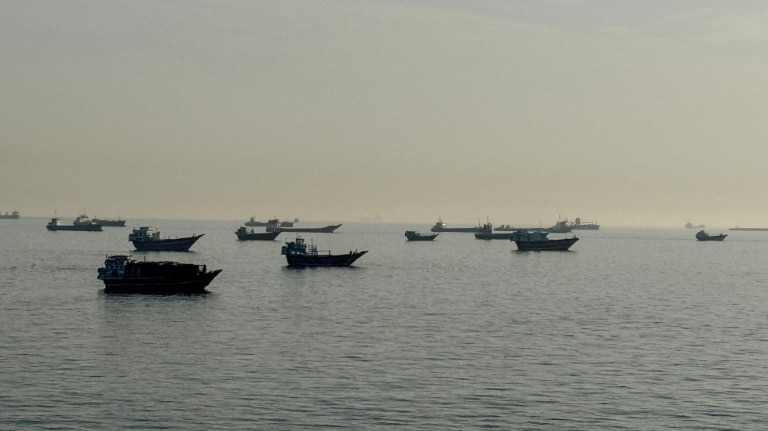
    While the international community turns its attention to the Israel-Lebanon border crisis, the Trump administration has ramped up pressure on Tehran with a strict naval blockade covering all vessels entering or exiting Iranian ports and coastal areas along the Strait of Hormuz. The strategic waterway, which carries roughly one-fifth of the world’s global oil supply during peacetime, had already been effectively closed to commercial traffic by Iranian military actions prior to the U.S. blockade, disrupting global shipping networks.

    Despite the sweeping announced restrictions, maritime tracking data from analytics firm Kpler shows that at least two vessels operating out of Iranian ports successfully transited the strait on Monday, suggesting gaps in the enforcement of the new blockade. Iranian military leaders have condemned the U.S. move as an act of outright piracy, issuing a stark warning that if the security of Iranian harbors is threatened, all ports across the Persian Gulf and Arabian Sea will no longer be safe. Security analysts note that the blockade is intended to cut off critical oil export revenue for Iran while also pressuring China—Tehran’s largest crude oil buyer—to leverage its influence to force Iran to reopen the Strait of Hormuz. The Chinese government has already issued a sharp rebuke, calling the blockade dangerous and irresponsible, particularly after Trump threatened to sink any vessel attempting to enter or leave Iranian ports.

    Surprisingly, the heightened standoff at the strait has not shaken global market confidence: Asian equity markets rallied this week, and global oil prices have continued a downward trend, defying widespread expectations of a price spike from supply disruptions. France and Britain have announced plans to co-host a video conference this Friday for nations willing to contribute to a purely defensive security mission to reopen and secure navigation through the Strait of Hormuz.

    Notably, the fragile two-week ceasefire between the U.S. and Iran that took effect last Wednesday remains intact despite the escalation, even after an initial round of U.S.-Iran talks hosted in Pakistan failed to produce any breakthrough. President Trump told reporters outside the Oval Office that Iranian representatives have reached out to Washington since the inconclusive Islamabad meeting, claiming that Tehran is very eager to reach a new deal. Pakistani Prime Minister Shehbaz Sharif confirmed Monday that full diplomatic efforts are ongoing to secure a lasting end to hostilities, and senior Pakistani sources told AFP Tuesday that Islamabad is working to arrange a second round of direct talks between U.S. and Iranian negotiators.

    Speaking in a phone call with French President Emmanuel Macron, Iranian President Masoud Pezeshkian reiterated that Tehran will only continue diplomatic negotiations within the framework of international law. Macron for his part urged both Tehran and Washington to restart stalled talks to end the U.S.-Iran war, which Trump launched after accusing Iran of pursuing a nuclear weapons program—an allegation Iran has repeatedly denied. Trump has insisted any final agreement must permanently block Iran from acquiring a nuclear device.

    Recent media reports have shed light on the gaps in the nuclear negotiation position: U.S. negotiators have proposed a 20-year full suspension of Iran’s uranium enrichment program, while Iran has only offered a five-year pause, a proposal U.S. officials have already rejected. Diplomatic activity is also picking up among other global powers: Russian Foreign Minister Sergey Lavrov met with Chinese counterparts in Beijing on Tuesday, just hours after he held talks with his Iranian counterpart. Moscow has put forward a proposal to store Iran’s enriched uranium on Russian territory as part of any potential nuclear deal, while Chinese President Xi Jinping has vowed that Beijing will play a constructive role in advancing peace talks across the Middle East.

  • War in the Middle East: latest developments

    War in the Middle East: latest developments

    Escalating tensions and shifting diplomatic moves across the Middle East have dominated global headlines this week, as multiple parallel efforts to de-escalate conflict face critical tests amid new military clashes and economic disruptions.

  • Zelensky in Germany for military talks amid drone boom

    Zelensky in Germany for military talks amid drone boom

    Ukrainian President Volodymyr Zelensky touched down in Berlin on Tuesday for high-stakes military talks with German Chancellor Friedrich Merz, with drone production collaboration set as a core agenda item. The trip comes as Germany has solidified its position as Kyiv’s largest military backer, following a drawdown in security assistance from the United States, and Berlin is eager to leverage Ukraine’s hard-won frontline experience with unmanned aerial systems. This diplomatic engagement also unfolds against a backdrop of stalled U.S.-brokered peace negotiations between Ukraine and Russia, where Kyiv has rejected any proposals that would require it to cede sovereign territory to Moscow. Adding to broader transatlantic tensions, U.S. President Donald Trump has publicly criticized European NATO allies for declining to join the U.S.-Israeli campaign against Iran and take on patrol duties in the Strait of Hormuz.

    In a follow-up event scheduled for Wednesday, the Ukraine Defence Contact Group—bringing together defense ministers from nations supporting Kyiv and NATO Secretary General Mark Rutte—will convene in Berlin to continue coordinated planning for Ukraine’s defense needs. The ongoing full-scale Russian invasion of Ukraine is now in its fifth year, and the battlefield landscape has shifted dramatically as low-cost, highly effective drones with extended ranges have emerged as indispensable tactical weapons. Over years of frontline combat, Ukraine’s armed forces have built unparalleled practical expertise in developing, deploying, and countering these systems.

    The concurrent conflict in the Middle East has opened a new opportunity for Kyiv to demonstrate its capabilities: Zelensky has already deployed anti-drone specialists to nations targeted by attacks from Iran, a key Russian military ally, and personally visited those affected regions. For Germany, which has allocated hundreds of billions of euros to revitalize its armed forces to deter potential Russian aggression, harnessing Ukraine’s hands-on drone expertise is a strategic priority.

    This cooperation is already well underway. Back in February, Zelensky toured a Munich-based drone manufacturing facility operated by a German-Ukrainian joint venture that produces equipment for Ukraine’s military. The joint venture, named Quantum Frontless Industries (QFI), was launched in December by Germany’s Quantum Systems and Ukraine’s Frontline Robotics. On Tuesday, Quantum Systems announced it would unveil two new joint projects with Ukrainian manufacturers during Zelensky’s Berlin visit.

    Matthias Lehna, managing director of QFI, highlighted the speed and impact of the existing partnership: “Our existing joint venture QFI demonstrates that production capacity in Germany can be established within weeks, with operational systems delivered to Ukraine. We are convinced that this cooperation will form the core of Europe’s future defence capabilities.” The initiative is part of a broader push to scale up European defense manufacturing for Ukraine and long-term regional security.

    Beyond military collaboration, the talks come as new momentum has emerged for unlocking the European Union’s long-blocked €90 billion ($105 billion) aid package for Ukraine. The proposed loan, agreed by EU leaders in December, had been held up by Hungarian nationalist Prime Minister Viktor Orban’s veto. But Orban’s unexpected election defeat last weekend to conservative challenger Peter Magyar has cleared a path for the package to move forward. German government spokesman Stefan Kornelius signaled Berlin’s urgency on Monday, stating he hoped the aid would be made available to Ukraine “very quickly.”

    Beyond defense and funding, the visit also addressed the ongoing humanitarian situation for Ukrainians who have fled the war. Germany has already welcomed hundreds of thousands of Ukrainian refugees since the full-scale invasion began. To kick off Tuesday’s schedule of engagements, Ukrainian Social Minister Denys Uliutin met German Interior Minister Alexander Dobrindt at a new support center branded the “Unity Hub.”

    In an official statement, the German Interior Ministry explained the hub’s dual mission: it will serve as a centralized point of contact for Ukrainians who have resettled in Germany, providing guidance on employment search and integration into German society. At the same time, the center will also work to encourage refugees to return to Ukraine once conditions allow them to do so safely.