标签: Oceania

大洋洲

  • Rome summons Russian ambassador over insults against Meloni

    Rome summons Russian ambassador over insults against Meloni

    Diplomatic tensions between Italy and Russia escalated sharply this week after Rome summoned Moscow’s top envoy to formally protest a series of vicious, unprovoked insults directed at Italian Prime Minister Giorgia Meloni by a prominent Russian state television host, Italian Foreign Minister Antonio Tajani confirmed Tuesday.

    The incident unfolded when pro-Kremlin presenter Vladimir Solovyov launched a brutal personal attack against Meloni live on air, switching between Italian and Russian to deliver his remarks. In Italian, Solovyov labeled Meloni a “disgrace to the human race”, a “wild beast”, a “certified idiot” and a “nasty little woman”. He continued his tirade after switching to Russian, claiming the Italian leader was a “fascist creature” who had betrayed her own voters and even former U.S. President Donald Trump, a claim that echoes longstanding misinformation pushed by Russian state media about European leaders.

    In a public post to social platform X, Tajani announced he had called Russian Ambassador Alexey Paramonov to the Ministry of Foreign Affairs to deliver a formal démarche over what he described as the “extremely serious and offensive remarks.” In a rare show of cross-partisan unity, even Italian opposition parties joined the government in condemning Solovyov’s aggressive comments, highlighting how the attack united Italian political factions against the external provocation.

    Meloni herself responded to the incident publicly, pushing back against the verbal assault and reaffirming her government’s policy commitments. “These caricatures certainly won’t make us change course,” she wrote on X. “Our compass remains one and only: the interest of Italy. And we will continue to follow it with pride, much to the chagrin of propagandists far and wide.”

    The diplomatic clash comes amid months of already strained relations between Rome and Moscow, driven by Meloni’s unwavering, staunch support for Ukraine in its war against Russian invasion. The incident also follows a recent shift in Meloni’s relationship with Donald Trump: the two once shared friendly ties, but relations have soured after Meloni defended the Vatican against verbal attacks from the former U.S. president.

  • US tells Afghans to choose Taliban home or DR Congo: activist

    US tells Afghans to choose Taliban home or DR Congo: activist

    A human rights advocate has issued a damning revelation about the Trump administration’s latest immigration policy, which forces more than 1,100 former Afghan allies stranded in Qatar to pick between resettlement in conflict-ravaged Democratic Republic of the Congo (DRC) or forced return to Afghanistan under Taliban control. These are the same Afghans who aided U.S. military forces before the 2021 American withdrawal that saw the collapse of the Western-backed Afghan government, and who have waited in Qatar for years to gain entry to the United States, fearing violent persecution from the new Taliban regime for their cooperation with Washington.

    The camp where these evacuees reside, a decommissioned U.S. military base in Qatar, faces an immediate March 31 shutdown ordered by the Trump White House, which has centered its second term agenda on sweeping new restrictions to legal immigration into the country. Shawn VanDiver, a U.S. military veteran and leader of AfghanEvac — an advocacy organization dedicated to supporting former Afghan allies seeking safe resettlement — confirmed he received official briefings outlining the administration’s stark ultimatum for the camp’s residents.

    VanDiver argues the choice is intentionally designed to pressure Afghans into returning to Afghanistan, noting that the DRC is already grappling with its own prolonged humanitarian and refugee crisis, marked by ongoing armed conflict that has spilled over from neighboring Rwanda. “You do not relocate vetted wartime allies, more than 400 of them children, from American custody into a country in the middle of its own collapse,” VanDiver said in a formal statement. “The administration knows this. It is the point.”

    U.S. State Department officials have refused to publicly confirm that the DRC is the third-country resettlement option on the table, but confirmed that Washington is pursuing “voluntary resettlement” for the as-Sayliyah camp population. A department spokesperson framed the relocation of the group to a third country as “a positive resolution that provides safety for these remaining people to start a new life outside of Afghanistan while upholding the safety and security of the American people.”

    The policy has drawn fierce cross-party and advocacy criticism, with leading Democratic Senator Tim Kaine calling the plan to send U.S. Afghan allies to the DRC “insane.” “We told these Afghans that we would help ensure their safety after they helped us,” Kaine said. “We have an obligation to follow through on our promise because it’s the right thing to do, and because going back on our word will only make it harder for us to build the kinds of partnerships we may need to advance our national security in the future.”

    The broader context of this policy traces back to the chaotic 2021 U.S. withdrawal from Afghanistan, after which more than 190,000 Afghan evacuees have already been resettled in the United States under a program first launched by former President Joe Biden. That program initially earned bipartisan support, as most Republicans backed the 20-year U.S. military intervention in Afghanistan when it began. However, after a 2024 incident in which an Afghan evacuee with a history of post-traumatic stress disorder who had worked with U.S. intelligence shot two Washington D.C. National Guard troops — killing one — Trump moved to dismantle the wider national refugee resettlement program and suspend all processing for new Afghan arrivals.

  • Mexico pyramid shooter inspired by Columbine attack, pre-Hispanic sacrifices

    Mexico pyramid shooter inspired by Columbine attack, pre-Hispanic sacrifices

    On the 27th anniversary of one of the most infamous mass shootings in United States history, a lone gunman launched a deadly attack at Mexico’s iconic Teotihuacan archaeological site, leaving one person dead and more than a dozen injured before turning the gun on himself. New details emerging from official investigations reveal the 27-year-old attacker, Julio Cesar Jasso Ramirez, drew ideological inspiration from two starkly different sources: the 1999 Columbine High School massacre and ancient pre-Hispanic ritual human sacrifice.

    The violence unfolded on a Monday at the UNESCO-recognized pre-Columbian heritage site, a top global tourist destination located roughly 50 kilometers outside of Mexico City. By the end of the rampage, a Canadian tourist was dead, 13 other people had sustained injuries, and the attacker had died by suicide. In the days following the incident, Mexico State Prosecutor Jose Luis Cervantes Martinez outlined key findings from the ongoing probe, confirming Jasso Ramirez, a Mexico City resident, spent months carefully plotting the attack.

    According to Cervantes, the gunman made multiple scouting trips to the archaeological site in advance, booked stays at nearby hotels to survey the area, and mapped out his violent plan long before the scheduled date of the attack. Investigators quickly uncovered clear, chilling links between the Teotihuacan attack and the 1999 Columbine massacre, which killed 12 students and one teacher and wounded 20 others in Colorado, and fell on the exact same calendar date 27 years before Jasso Ramirez’s attack.

    “The collected evidence reveals a psychopathic profile of the attacker, characterized by a tendency to copy situations that happened in other places at other times by other people,” Cervantes told reporters at a Tuesday press conference.

    Investigators found multiple pieces of evidence tying the gunman directly to the Columbine attackers, Eric Harris and Dylan Klebold. Among Jasso Ramirez’s personal belongings, authorities discovered an AI-generated image depicting the Mexican gunman posing alongside Harris and Klebold. The shirt he wore to carry out the shooting also matched the style of the trench coats worn by the two Columbine perpetrators.

    Witness testimony has also shed light on why the attacker specifically chose the Teotihuacan site for his violence, pointing to a fascination with pre-Columbian ritual sacrifice. Jacqueline Gutierrez, an American tourist who was visiting the pyramids with her family and partner when the shooting broke out, recalled the gunman shouting that the site was a place for sacrifice, not sightseeing photos. He also explicitly referenced that the day marked the Columbine massacre anniversary, Gutierrez told Mexican broadcaster Milenio.

    Gutierrez described the 14-minute attack as a period of unmitigated terror, with visitors trapped on the pyramid structure with no route for escape. “We couldn’t move or we’d fall down the pyramid…if he had wanted to kill us all, he would have,” she said, adding that Jasso Ramirez told witnesses he had spent three years planning the attack.

    Investigators have so far confirmed that Jasso Ramirez acted entirely alone, with no known collaborators or extremist group ties. A search of his belongings turned up a collection of written materials referencing notorious mass attacks and violent figures linked to this type of criminal violence, further supporting the conclusion that the incident was an act of lone-wolf copycat violence.

  • Mexico pyramid shooter planned attack, fixated on US massacre

    Mexico pyramid shooter planned attack, fixated on US massacre

    A deadly premeditated shooting at one of Mexico’s most iconic cultural landmarks has left one international tourist dead and more than a dozen injured, sending shockwaves through the country’s tourism sector just weeks ahead of the 2026 FIFA World Cup. Authorities confirmed Tuesday that the attack, carried out Monday at the UNESCO World Heritage-listed Teotihuacan archaeological site, was planned days in advance and directly inspired by one of the United States’ most infamous mass killings.

    The shooter, identified as 27-year-old Julio Cesar Jasso Ramirez, a resident of Mexico City, took his own life as Mexican military personnel approached to apprehend him. The sole fatality was a Canadian woman in her early 20s who was visiting the site. Thirteen other people were wounded in the attack, which unfolded on the Pyramid of the Moon – the 45-meter-tall ancient monument that draws thousands of global visitors annually. Among the injured were a six-year-old boy, a second Canadian national, a Colombian woman, a Brazilian man, and two American citizens.

    Mexico State Prosecutor Jose Luis Cervantes told reporters at a press briefing alongside Mexican President Claudia Sheinbaum that the attacker had carried out extensive pre-attack preparation. “He made multiple visits to the pyramids, stayed in hotels near the site ahead of time, and from there planned his violent acts,” Cervantes said. Investigators recovered a backpack at the shooting scene that contained a loaded firearm, a knife, 52 additional rounds of ammunition, and printed materials and images directly connected to the 1999 Columbine High School massacre in Colorado, according to Cervantes.

    The 1999 Columbine attack, carried out by two teenaged students who killed 12 classmates and one teacher before dying by suicide, has become a twisted inspiration for dozens of copycat mass shootings around the globe in the decades since. Jacqueline Gutierrez, an American visitor who survived Monday’s attack, told Mexican newspaper Milenio that the shooter explicitly referenced the attack’s 27th anniversary, which fell on April 20. He also made comments tying the Teotihuacan site to its history of pre-colonial ritual sacrifices, Gutierrez added.

    President Sheinbaum confirmed that investigators have found no links between the shooting and organized crime, noting that the perpetrator “had psychological problems” and “was influenced by events that had occurred abroad.” She called the attack an unprecedented event for Mexican archaeological sites and pushed for immediate policy changes to strengthen safety protocols at tourist destinations across the country. “We need to have better security to make sure someone can’t enter an archaeological site, a tourist site, with a firearm,” Sheinbaum said.

    Teotihuacan, the ancient capital of a pre-Aztec civilization that built its massive step pyramids between the 1st and 7th centuries AD, is Mexico’s second most-visited archaeological site, drawing millions of visitors every year. Until Monday, the site had no history of violent mass attacks. Prior to the shooting, visitors entered the site without any security screenings for weapons, Juan Carlos Mejia, executive director of local tourism agency Estur, told AFP. “Previously they never check you,” before entering, Mejia said.

    In response to the attack, authorities have closed the site temporarily to adjust safety measures, with a scheduled reopening on Wednesday that will introduce enhanced security protocols. The shooting comes just three weeks before Mexico is set to host multiple matches in the 2026 FIFA World Cup, including the tournament’s opening match on June 11 in Mexico City – just 50 kilometers from the Teotihuacan site. President Sheinbaum’s call for tighter gun controls at tourist sites has drawn broad support from tourism industry leaders, who say the changes are critical to protecting both visitors and Mexico’s reputation as a top international travel destination.

  • NDIS savings to be redirected to scrapping aged-care co-payments

    NDIS savings to be redirected to scrapping aged-care co-payments

    Ahead of the 2024 Australian federal budget, the Albanese government is set to roll out sweeping reforms to the National Disability Insurance Scheme (NDIS), redirecting projected savings from the overhaul to eliminate out-of-pocket costs for essential aged care services for older Australians. The policy shift will be detailed by Health, Ageing and NDIS Minister Mark Butler during a highly anticipated address to the National Press Club on Wednesday, marking one of the most significant social policy changes ahead of the budget release next month.Starting October 1, core personal care supports including assistance with showering, dressing and continence care will be reclassified under the Clinical Care category of the government’s Support at Home aged care program, fully scrapping all required co-contributions that older Australians previously paid. Aged Care Minister Sam Rae emphasized that these basic daily care supports are non-negotiable for dignified ageing, noting the policy change directly responds to community feedback from older people, their families and aged care providers.

    “Showering, dressing, continence care – these aren’t optional extras, they’re the basics of ageing with dignity and no older Australian should miss out because of cost,” Rae said. “Older Australians, their families and providers told us these services needed to be protected. We’ve listened and we’re acting.”

    First launched by the Gillard Labor government in 2013, the taxpayer-funded NDIS was designed to deliver essential support to Australians living with permanent and severe disability. Today, the scheme carries an annual price tag of $50 billion, with independent projections showing that spending could double to $100 billion within the next decade without intervention. The rapid unsustainable growth of NDIS expenditure has placed the scheme at the center of federal government efforts to rein in public spending, with Treasurer Jim Chalmers confirming the scheme is a core focus of pre-budget negotiations. Chalmers has stressed the government remains fully committed to the NDIS mission, but acknowledges the urgent need for structural change to secure its long-term future.

    Government officials have defended the reform push, arguing inaction is not a viable option. Labor MP Josh Burns told media that without changes, the NDIS would eventually become the single most expensive government program in Australia, a financial trajectory that is unsustainable. “The reason why we have to [reform] is because the NDIS is there for people with a severe disability, a permanent disability, and it needs to be there for the future,” Burns said. “If we don’t do anything, if we let it just grow, it’s going to be the biggest government program, the most expensive thing government does in Australia, and it’s just not sustainable, so it needs to be there for the future.”

    While opposition figures have agreed that the NDIS requires structural repair, they have pushed back against what they warn could become a cost-shifting exercise, arguing the reform must address deep-rooted design flaws in the program. Nationals Senator Bridget McKenzie, the opposition’s spokesperson on the issue, said the NDIS’s challenges stretch beyond unsustainable spending, pointing to widespread concerns about unregistered providers, compliance gaps and systemic rorting. McKenzie noted that even NDIS internal estimates find 10 percent of claims are non-compliant, totaling $5 billion in misspending annually.

    “The NDIS was suffering from a ‘design problem’ and must be addressed as more than just a ‘cost-shifting exercise’,” McKenzie said. The opposition is open to cross-party collaboration to get the scheme “under control” to guarantee its long-term sustainability for disabled Australians, she added, but warned: “It can’t just be a cost-shifting exercise from the government back onto states. It needs to fix the problem at its heart, which is around design.”

    The peak body for Australia’s disability sector has already alerted providers to expect sweeping changes when the federal budget is released next month, as the government looks to lock in the savings needed to fund the aged care policy overhaul.

  • Young talent time: Maroons name five rookies for women’s Origin opener as life begins without the legendary Ali Brigginshaw

    Young talent time: Maroons name five rookies for women’s Origin opener as life begins without the legendary Ali Brigginshaw

    The Queensland Maroons are entering an unprecedented new chapter of women’s State of Origin rugby league, headlined by the selection of five first-time contenders for next week’s opening series clash in Newcastle. The major squad shake-up comes as the side adapts to life without Ali Brigginshaw, the legendary playmaker who defined a generation of Maroons football and retired from the Origin circuit this offseason, compounded by a season-ending knee injury to star half Tarryn Aiken that forced new head coach Nathan Cross to make sweeping, high-stakes selection calls.

    Stepping into the critical playmaking roles left vacant by Brigginshaw are experienced utility Lauren Brown and exciting young rookie Chantay Kiria-Ratu, tasked with steering Queensland’s charge to reclaim the State of Origin shield. Brown, who stepped into the halfback role for the third and final match of last year’s series, retains the number seven jersey – a position she has already delivered iconic results in, slotting a match-winning field goal in wet, challenging conditions during 2024 to secure a critical victory for the Maroons. Her veteran leadership will be paired with Kiria-Ratu, who turned heads with a standout 2024 NRLW season for the Cronulla Sharks and now faces the biggest test of her fledgling professional career on rugby league’s biggest women’s state stage.

    Cross’ appointment itself marks a break from the Maroons’ recent past, taking over from long-serving coach Tahnee Norris after Queensland surrendered the series title to New South Wales last year. Along with the new-look playmaking duo, four other new faces will get their chance to shine: winger Phoenix-Raine Hippi is named in the starting 17 for her Origin debut, while forward Otesa Pule will make her first Queensland appearance from the interchange bench. Young talents Ivana Lolesio and Destiny Mino-Sinapati round out the five rookies, earning spots in the 20-person extended squad as the side chases an upset to end NSW’s growing dynastic ambitions.

    Star power remains at the core of the Maroons’ lineup, with Brisbane Broncos standouts Tamika Upton and Julia Robinson named in the starting side, forming a dangerous attacking edge that looms as the primary threat to NSW’s hopes of back-to-back series titles. The full Queensland squad will assemble for pre-match camp this Thursday, as Cross and his group look to prove that a youth-focused rebuild can deliver immediate results on the Origin stage. The full 20-person squad for game one is: 1. Tamika Upton, 2. Julia Robinson, 3. Rory Owen, 4. Shenae Ciesiolka, 5. Phoenix-Raine Hippi, 6. Chantay Kiria-Ratu, 7. Lauren Brown, 8. Makenzie Weale, 9. Jada Ferguson, 10. Jessika Elliston, 11. Sienna Lofipo, 12. Romy Teitzel, 13. Keilee Joseph, 14. Emma Manzelmann, 15. Otesa Pule, 16. Chelsea Lenarduzzi, 17. Brianna Clark, 18. Ivana Lolesio, 19. Destiny Brill, 20. Destiny Mino-Sinapati.

  • Trump’s Fed chair pick vows to safeguard independence at confirmation hearing

    Trump’s Fed chair pick vows to safeguard independence at confirmation hearing

    As U.S. President Donald Trump’s nominee to head the Federal Reserve, Kevin Warsh opened his Senate confirmation hearing Tuesday with a public pledge to safeguard the critical independence of America’s central bank, even as he faces intense political pressure from the commander-in-chief to push for aggressive interest rate cuts.

    “I’m committed to ensuring that the conduct of monetary policy remains strictly independent,” Warsh stated in his opening remarks delivered before the Senate Banking Committee. Beyond his promise to protect institutional autonomy, he also reaffirmed the Fed’s core commitment to taming persistent inflation.

    The hearing represents a major milestone for Warsh, who has been tapped to replace outgoing Chair Jerome Powell when his current term expires on May 15. Every step of the confirmation process is being closely scrutinized by policymakers, economists, and global markets, as the outcome will shape U.S. monetary policy for years to come.

    Tensions have been running high around the nomination well before the hearing gavel fell. Trump has ramped up repeated public criticism of the Fed in recent weeks, attacking the central bank for refusing to implement deeper, faster interest rate cuts. Early Tuesday, the president told CNBC he would be disappointed if his nominee did not move quickly to lower borrowing costs, and renewed his baseless attacks on Powell over minor renovation costs at the Fed’s Washington D.C. headquarters. “We should have the lowest interest rate in the world,” Trump insisted.

    Partisan friction has further complicated Warsh’s path to confirmation. All 11 Democratic members of the Banking Committee called last week for a full delay of the nomination vote until two separate ongoing investigations into outgoing Chair Jerome Powell and Fed Governor Lisa Cook are concluded. Even a fellow Republican has broken ranks to oppose moving forward: Senator Thom Tillis, a member of the GOP-led panel, has pledged to block all Fed nominees — including Warsh — until the Justice Department probe involving Powell is fully resolved.

    With Republicans holding a narrow 13-seat majority on the 25-member committee, Tillis’ defection could create a dangerous deadlock that derails Warsh’s confirmation entirely. Beyond the procedural fights, the nominee also faces the prospect of sharp, targeted questioning on a range of controversial issues, from his extensive personal wealth and past professional ties to the late convicted sex offender Jeffrey Epstein, to his core policy stances on U.S. economic growth and inflation.

    For Warsh, the hearing is his first major opportunity to prove he can serve as a credible, independent steward of the nation’s monetary policy, according to analysts. “It will be his first chance since he was nominated by the president to demonstrate that he intends to be a credible, independent central banker,” David Wessel, senior fellow at the Brookings Institution, told AFP. Wessel noted the delicate balancing act Warsh must pull off: “He has to be really careful to not anger Trump, but he also has to avoid the impression that he’s weak or subject to political pressure.”

    In his opening remarks, Warsh pushed back against concerns that political interference would skew Fed decision-making, arguing that elected officials sharing their views on interest rates does not inherently threaten institutional independence. “I do not believe that independence of monetary policy is threatened when elected officials state their views on rates,” he said. He emphasized that addressing inflation is ultimately the Fed’s responsibility, adding that the central bank must “stay in its lane” when it comes to setting economic policy. The committee’s chairman, Republican Tim Scott, framed the hearing as an “opportunity to refocus” the Fed on its statutory dual mandate: delivering price stability and keeping unemployment low.

    But the top Democrat on the panel, Senator Elizabeth Warren, raised urgent alarms that the ongoing investigations into Powell and Cook are a deliberate political tactic designed to pressure Fed policymakers into falling in line with Trump’s policy demands. She warned that the nomination risks putting “a sock puppet” of the president in charge of the world’s most powerful central bank.

    Economists say the biggest policy question hanging over the hearing is just how closely aligned Warsh is with Trump’s push for steep rate cuts. During Warsh’s previous tenure as a Fed governor from 2006 to 2011, he was widely viewed as a hawk, a policymaker who prioritized controlling inflation by keeping interest rates relatively high. But ING chief economist James Knightley told AFP that Warsh appears to have shifted his policy stance in recent years. Knightley pointed out that Warsh has emerged as a vocal advocate for expanded tech investment and artificial intelligence innovation, which many economists argue could boost U.S. potential growth without spurring the same level of inflation seen in past economic expansions.

    Still, immediate headwinds stand in the way of aggressive rate cuts: rising gasoline prices driven by ongoing conflict in the Middle East have created new near-term inflation pressures that the Fed cannot ignore. If Warsh pushes for overly rapid rate cuts in the near term, it could erode the Fed’s hard-won credibility on inflation, Knightley warned. For the nominee, the path forward requires acknowledging the immediate impact of near-term price shocks while making the case that these temporary disruptions are unlikely to turn into long-term persistent inflation.

  • Oil and stocks steady as US-Iran truce expiry looms

    Oil and stocks steady as US-Iran truce expiry looms

    Global financial markets traded in a narrow range on Tuesday, with crude oil prices dipping slightly and most equities posting modest gains, as investors clung to cautious optimism that Washington and Tehran would reach a breakthrough to de-escalate tensions and reopen the strategically critical Strait of Hormuz, even as a two-week truce is set to expire on Wednesday. As of Tuesday, Iran had not yet deployed a negotiating delegation to Pakistan, the venue for the new round of US-Iran peace talks, while the US side has confirmed it is ready to proceed with discussions, leaving Tehran’s participation in the negotiations unclear.

    The international benchmark Brent North Sea crude held largely steady after a sharp rally the previous session triggered by Iran’s temporary closure of the Strait of Hormuz, falling just 0.3 percent to $95.22 per barrel by 1330 GMT. US West Texas Intermediate crude similarly edged down 0.2 percent to $87.23 per barrel, with both benchmarks holding below the psychologically important $100 per barrel threshold that has historically stoked broad inflation fears.

    Equity markets painted a mixed but broadly upbeat picture across major global hubs. On Wall Street, all three main indices opened higher, with the Dow Jones Industrial Average rising 0.5 percent to 49,706.29 points, the S&P 500 gaining 0.2 percent to 7,125.89, and the Nasdaq Composite adding 0.3 percent to 24,467.29. The gains were supported by stronger-than-expected March retail sales data, which showed a 0.6 percent month-on-month rise even when stripping out volatile gasoline purchases, defying concerns that spiking energy costs would drag down consumer spending. In Europe, London’s FTSE 100 dipped 0.4 percent and Paris’ CAC 40 fell 0.5 percent, while Frankfurt’s DAX closed flat. Most major Asian markets finished the trading day higher: Japan’s Nikkei 225 gained 0.9 percent to close at 59,349.17, Hong Kong’s Hang Seng Index added 0.5 percent, and Shanghai’s Composite Index edged up 0.1 percent.

    Market analysts note that investors have so far refused to price in a worst-case scenario of intensified conflict, with widespread expectations that the current ceasefire will be extended beyond its Wednesday expiry. “There is a reluctance for investors to price in the worst-case scenario for the conflict in the Middle East, and there is optimism within the market that the US/Iran ceasefire will be extended,” explained Kathleen Brooks, research director at global trading group XTB.

    US President Donald Trump expressed confidence in the US’ negotiating position during a Tuesday interview with CNBC, as his administration prepared envoys for the Pakistan-hosted talks. The White House confirmed that Vice President JD Vance is prepared to return to Pakistan for the new round of negotiations aimed at ending the standoff, which has already driven crude prices higher and reignited global inflation concerns.

    Despite the market optimism, significant uncertainty remains over the outcome of the talks. Iran has already accused Washington of violating the fragile truce through its blockade of Iranian ports and seizure of an Iranian vessel, while Trump has similarly accused Tehran of truce violations over the harassment of commercial vessels transiting the Strait of Hormuz, the chokepoint that carries roughly one-fifth of all globally traded oil.

    Russ Mould, investment director at UK-based asset management firm AJ Bell, noted that while sub-$100 oil prices signal market optimism that conflict will not escalate, prolonged elevated prices carry significant economic risks. “However, the longer oil remains in the 90s (dollar per barrel) range… the higher the chance of an inflationary shock and a wobble to global economic activity,” Mould said.

    The solid March retail sales data has reinforced views of a resilient US consumer, a key pillar of American economic growth. “The data echoes what we heard from the big banks last week, with management teams largely pointing to a resilient consumer despite soaring gas prices and a barrage of geopolitically charged headlines,” said Bret Kenwell, US investment analyst at fintech platform eToro. Kenwell added that US stocks, which have already recovered all pre-conflict losses and are trading near record highs, reflect not just hopes for de-escalation in the Middle East but also growing optimism around upcoming corporate earnings. If US companies deliver solid first-quarter results, he said, it could reinforce investor confidence that the current market rally still has room to run.

    Beyond geopolitics, investors are also closely watching the confirmation hearings for Kevin Warsh, former Federal Reserve governor and US President Donald Trump’s nominee to lead the central bank. Warsh’s testimony is expected to offer clear signals about the future path of US interest rates, at a time when the world’s largest economy is navigating persistent inflation risks and slowing growth headwinds.

  • Downing Street exerted pressure to OK Mandelson: sacked UK official

    Downing Street exerted pressure to OK Mandelson: sacked UK official

    A fired top British Foreign Office official has levelled serious accusations against Downing Street, claiming Prime Minister Keir Starmer’s office exerted unrelenting pressure on civil servants to fast-track the appointment of Peter Mandelson as UK ambassador to the United States while sidelining critical security concerns.

    Olly Robbins, who served as the Foreign Office’s most senior civil servant until his dismissal last week, delivered explosive testimony to a parliamentary oversight committee on Tuesday, pulling back the curtain on the chaotic vetting process that has plunged the Starmer government into its worst political scandal in months.

    The controversy centers on Mandelson, a veteran Labour Party grandee who was tapped for the prestigious Washington post in December 2024, just weeks before Donald Trump’s second presidential inauguration, and took up the role in February 2025. Mandelson was ultimately forced out of the post in September 2025, seven months into the job, after new details emerged of his long-documented close personal ties to the late convicted sex offender Jeffrey Epstein, who died in a New York prison in 2019 while awaiting trial on sex trafficking charges.

    In his opening remarks to the committee, Robbins laid out how Downing Street’s urgent push for a quick appointment created a dismissive culture around mandatory security vetting. When he took the top Foreign Office role in January 2025, he said, there was a “very strong expectation coming from Number 10 that [Mandelson] needed to be in post and in America as quickly as humanly possible.” That urgency translated to unending pressure on his team, he added: “My office, the foreign secretary’s office, were under constant pressure, there was an atmosphere of constant chasing.”

    Contradicting earlier public claims from Starmer, who has insisted all “due process” was followed during the appointment, Robbins confirmed that independent vetting officials had ultimately recommended against granting Mandelson security clearance. He clarified that the case was deemed “borderline,” with vetters leaning toward a denial, but that internal Foreign Office security analysts concluded the identified risks could be managed. Critically, he added, the risks flagged did not stem from Mandelson’s relationship with Epstein – UK media has previously reported the concerns centered on ties between Mandelson’s now-closed lobbying firm and Chinese entities.

    Robbins also acknowledged that denying clearance would have created major political headaches for Starmer and the foreign secretary, and could have damaged early UK-US relations under the new Trump administration, but he insisted those factors did not drive the final decision to approve the appointment.

    The confirmation that independent vetters recommended rejecting clearance, first reported by *The Guardian* last Thursday, has sparked renewed opposition demands for Starmer’s resignation. The prime minister has pushed back against calls to step down, blaming civil servants for deliberately concealing the recommendation from him and denying he misled Parliament in earlier statements about the scandal. Critics, including former senior civil servants, have accused Starmer of scapegoating Robbins to deflect from his own responsibility for the botched appointment.

    The scandal has even drawn comment from former US President Donald Trump, who waded into the controversy this week via his Truth Social platform. Trump, who has previously criticized Starmer over what he sees as insufficient UK support for his actions in Iran, agreed that Mandelson “was a really bad pick” for the Washington post, though he added a brief optimistic note: “Plenty of time to recover, however!”

    Beyond the appointment controversy, Mandelson, 72, is also facing separate scrutiny: UK police are currently investigating allegations of misconduct in office from his time as a Labour minister more than 15 years ago. He was arrested and released earlier this year in connection with the probe, and has not been charged, repeatedly denying any criminal wrongdoing.

    On Tuesday, following testimony from Robbins, UK Parliament was set to hold an emergency debate on the scandal, requested by opposition Conservative Party leader Kemi Badenoch, who said there remain “serious questions about what [Starmer] knew and when.” In response to the growing outcry, Starmer announced Monday that he has launched a full review of the UK’s government security vetting process to prevent similar breakdowns in the future.

  • No Iran delegation sent to US talks yet as truce expiry nears

    No Iran delegation sent to US talks yet as truce expiry nears

    As a fragile two-week temporary ceasefire in the Middle East edges toward its expiration date, fresh tensions have erupted between Iran and the United States after Tehran confirmed Tuesday that no Iranian delegation has departed for planned new peace talks hosted in Islamabad, Pakistan. The escalating standoff has cast deep uncertainty over efforts to prevent a full-scale resumption of hostilities, with both sides already trading accusations of violations of the existing truce, which is scheduled to end this week.

    This round of talks was meant to follow up on high-level discussions held earlier this month in Pakistan, the most senior diplomatic engagement between the two long-time adversaries since the establishment of the Islamic Republic of Iran in 1979. Analysts had previously viewed the senior composition of both delegations in that first meeting as a promising signal that both sides were serious about reaching a negotiated settlement. However, those initial talks collapsed without any agreement, triggering immediate retaliatory steps: Iran reimposed restrictions on shipping through the strategic Strait of Hormuz, a critical global oil chokepoint, while former U.S. President Donald Trump announced a full blockade of Iranian ports.

    In an official statement carried by Iranian state television, Tehran pushed back against media reports claiming a delegation was already en route to Pakistan. “So far, no delegation from Iran has departed for Islamabad, Pakistan; whether it is the main or subsidiary delegation; primary or secondary,” the statement read. Iranian officials have publicly pushed back against what they call bad faith negotiating tactics from the Trump administration, rejecting what they describe as excessive American demands. Iran’s parliament speaker emphasized that the country would never agree to hold talks “under the shadow of threats” from the U.S. leader, warning that Tehran would “show new cards on the battlefield” if hostilities resume.

    The Trump administration has hit back with its own set of accusations: Trump claims Iran fired on commercial vessels transiting the Strait of Hormuz, while Tehran counters that the U.S. blockade and the recent seizure of an Iranian vessel constitute clear breaches of the ceasefire agreement. Washington is also pressing Iran to make major concessions on its contested nuclear program, with Trump confirming that the port blockade will remain in place until a final deal is reached.

    Confusion has even emerged over the exact timing of the truce expiration: while the agreement is technically set to end overnight Tuesday, Trump told Bloomberg it would expire Wednesday evening Washington time, and added that an extension of the ceasefire is “highly unlikely.” Speaking to PBS News, Trump noted that Iran was “supposed to be there” at the Pakistan talks, and warned that “if the ceasefire expires then lots of bombs start going off.” Despite the rising tensions, Trump has pushed back against media reports that he faces urgent pressure to strike a deal. In a post on his Truth Social platform, he wrote: “I read the Fake News saying that I am under ‘pressure’ to make a Deal. THIS IS NOT TRUE! I am under no pressure whatsoever, although, it will all happen, relatively quickly!”

    Foreign policy experts say Iran’s decision to hold off on sending a delegation is a calculated move to put pressure on Washington, with Iranian leadership still wary of negotiating after U.S. strikes against Iranian targets last year that took place in the middle of ongoing diplomatic efforts. “The current standoff between the United States and Iran is no longer a clash of capabilities but rather a struggle of political endurance and bargaining leverage,” wrote Daniel Byman, a senior fellow at the Center for Strategic and International Studies, in a recent analysis.

    For ordinary Iranian citizens, the uncertain truce has already brought deep economic hardship. In interviews with AFP journalists in Tehran, residents described worsening living conditions squeezed by the combined impact of government policies and the ongoing conflict. “This cursed ceasefire has broken us. There is no light at the end of the tunnel,” said 39-year-old Saghar. “The situation is terrible. I don’t know anyone around me who is doing well.”

    Despite the ongoing brinkmanship between the two countries, global markets reacted positively to lingering hopes for a diplomatic breakthrough on Tuesday: international oil prices fell, while global stock markets posted modest gains on the optimism.

    In preparation for the possible talks, Pakistani authorities have deployed heavy security across Islamabad’s government quarter, which has been largely shut down. The Serena Hotel, which hosted the first round of negotiations, asked guests to vacate the premises in recent days, and authorities have bolstered police presence across the city. Many schools and universities have shifted to remote learning for the week, and truck and heavy vehicle entry into the city has been banned.

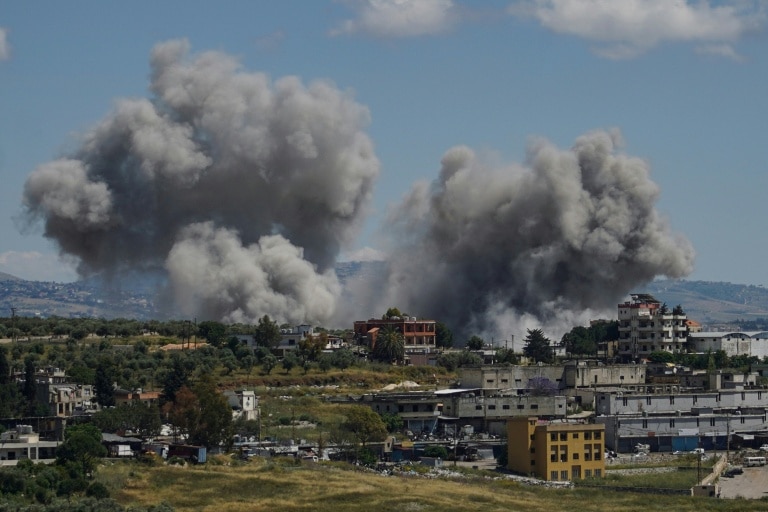
    In a separate development tied to the broader regional conflict, a new 10-day ceasefire between Israel and Lebanon went into effect Friday, bringing a pause to cross-border violence that drew Lebanon into the war after the Iran-aligned militant group Hezbollah launched rocket fire in support of Tehran. A U.S. State Department official confirmed to AFP that a second round of peace talks between Israel and Lebanon, which have no formal diplomatic relations, will be held in Washington this Thursday. Sporadic violence has continued along the border despite the truce, and the Israeli military has warned Lebanese civilians against returning to dozens of villages in southern Lebanon, claiming ongoing Hezbollah activities violate the ceasefire terms. According to the latest count from a Lebanese government body, Israeli attacks on Lebanon have killed at least 2,387 people since the outbreak of the war.