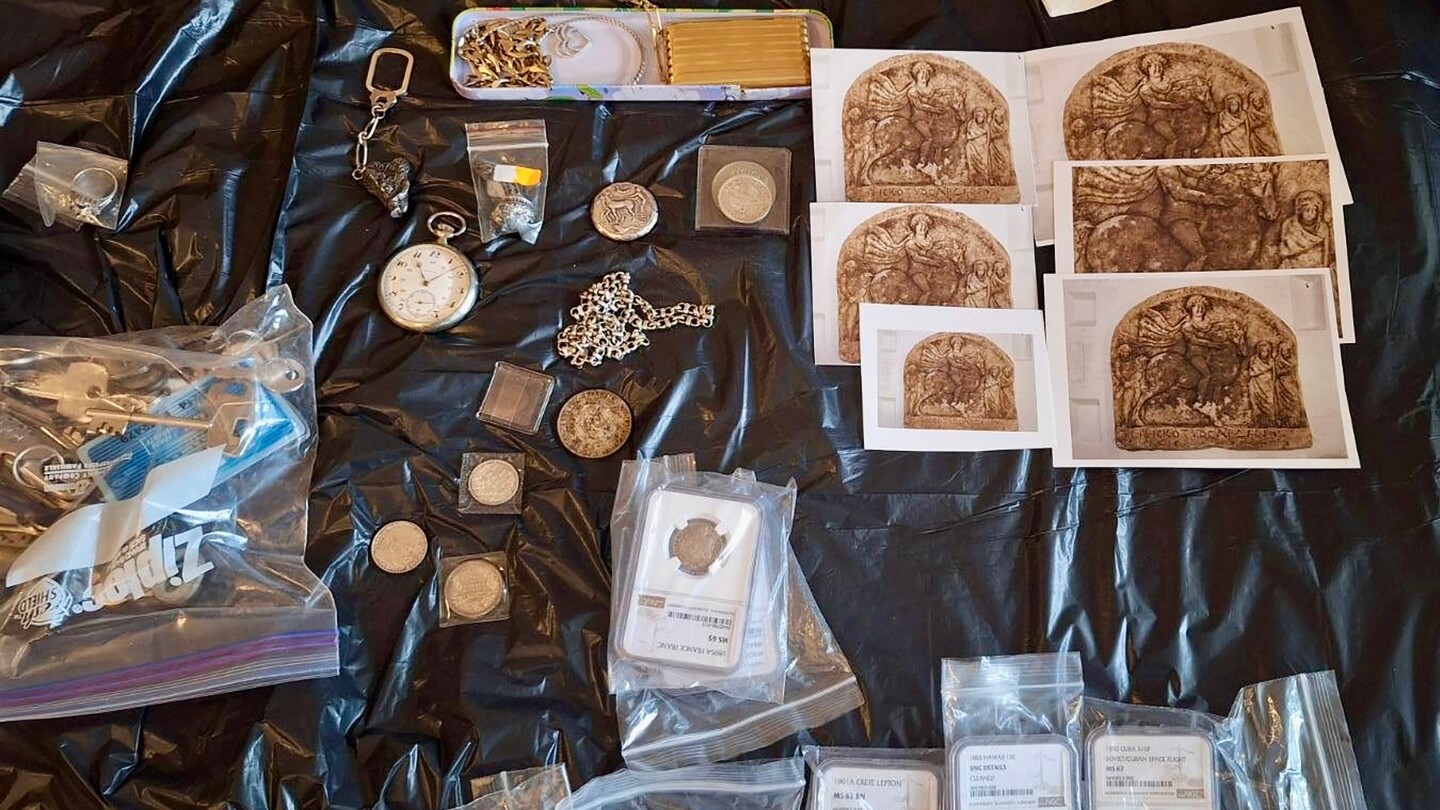
In a groundbreaking international effort, law enforcement agencies from seven countries, in collaboration with Eurojust and Europol, have successfully dismantled a sprawling criminal network involved in the trafficking of stolen cultural artifacts across Europe. Bulgarian authorities announced the operation on Thursday, revealing that 35 suspects have been arrested in connection with the smuggling ring. Among them, 20 individuals are facing charges of antiquities trafficking and money laundering. Bulgarian Prosecutor Angel Kanev disclosed that the group has been active for over 16 years, operating across Western Europe, the Balkans, the United States, and other regions. The investigation has uncovered illicit funds exceeding $1 billion. Coordinated actions were carried out in Albania, Bulgaria, France, Germany, Greece, Italy, and the United Kingdom, resulting in 131 searches of properties, vehicles, and bank safes. Authorities seized over 3,000 artifacts, including ancient golden and silver coins, artworks, weapons, and investment gold, with an estimated total value surpassing €100 million ($116 million). Paolo Befera, deputy head of Italy’s Carabinieri cultural heritage protection directorate, described the operation as the largest of its kind, with 300 historical artifacts recovered in Italy alone. The Balkan region and Italy, rich in Greek and Roman archaeological treasures, have long been targeted by criminal networks despite stringent national laws. The international black market continues to fuel demand for such stolen artifacts.
标签: Europe
欧洲
-

Paris wax museum unveils new Diana figure in ‘revenge dress,’ decades after her death in the city
The Grevin Museum in Paris, one of Europe’s oldest wax museums, unveiled a new life-size figure of the late Princess Diana on Thursday. The figure depicts Diana wearing her iconic black off-the-shoulder cocktail dress, famously known as the ‘revenge dress,’ which she wore to a Serpentine Gallery event in London in 1994. The dress gained notoriety as it was the same night Prince Charles, now King Charles III, publicly admitted to his infidelity with Camilla Parker Bowles. The unveiling holds particular significance for Paris, where Diana tragically died in a car crash in 1997. The city remains a place of pilgrimage for her admirers, who continue to leave flowers and notes at informal memorials. The museum’s director commissioned the figure after being unimpressed with a similar one at Madame Tussauds in London. The timing coincides with the 30th anniversary of Diana’s explosive BBC ‘Panorama’ interview, which significantly impacted the monarchy’s reputation. The figure is positioned away from wax likenesses of her ex-husband and former mother-in-law, emphasizing her independence. The sculpture, complete with high heels, a pearl choker, and a small handbag, captures the essence of Diana’s liberation. French novelist Christine Orban, author of ‘Mademoiselle Spencer,’ noted the dress symbolized Diana’s break from royal norms. The Grevin Museum, known for its collection of political leaders, artists, and pop-culture figures, continues to attract visitors with its star-studded exhibits. Diana’s figure joins another royal who died in Paris, Marie-Antoinette, further cementing her legacy in the city.
-

Christmas market in Germany opens after last year’s deadly attack in the city of Magdeburg
The Christmas market in Magdeburg, Germany, reopened on Thursday, nearly a year after a devastating car-ramming attack claimed six lives and left many injured. The incident, which occurred on December 20, lasted just over a minute and involved a rented BMW X3 speeding through the market at up to 48 kph (30 mph). This year, the market welcomed over 140 merchants offering traditional holiday goods such as candles, wool hats, candied almonds, and mulled wine, alongside attractions like a Ferris wheel and an ice rink. Paul-Gerhard Stieger, managing director of the Magdeburg Christmas Market GmbH, expressed cautious optimism, emphasizing respect for last year’s tragedy while hoping visitors would rediscover the joy of the market. The suspect, Taleb al-Abdulmohsen, a 51-year-old Saudi doctor, is currently on trial for six counts of murder and 338 counts of attempted murder, with sessions scheduled until March. If convicted, he faces life imprisonment. Following concerns about security, the city and organizers invested at least €250,000 ($290,000) in new safety measures, including concrete barriers to prevent vehicle access. The attack had previously sparked criticism of inadequate security at such events, which are deeply rooted in German culture and have been a cherished tradition since the Middle Ages.
-

Spanish court orders Meta to pay nearly half a billion euros in damages to media outlets
In a landmark ruling, a Madrid-based court has ordered Meta, the parent company of Facebook and Instagram, to pay €481 million ($554 million) in damages to 81 Spanish media outlets. The court found that Meta had exploited an unfair market advantage by unlawfully extracting personal data from internet users, violating European Union regulations. This data was allegedly used to enhance its advertising capabilities, significantly harming the advertising revenues of Spanish digital media. The court emphasized that Meta’s actions, which spanned five years until 2023, breached the EU’s General Data Protection Regulation (GDPR), which mandates strict user privacy protections. Meta has announced its intention to appeal the ruling, labeling it as ‘baseless’ and asserting compliance with all applicable laws. This case could set a precedent for similar legal challenges across Europe, including an ongoing case in France. The ruling underscores the ongoing tension between tech giants and European regulators over data privacy and market fairness.
-
As reports of a US-Russia peace plan circulate, Europeans say they and Ukraine must be involved
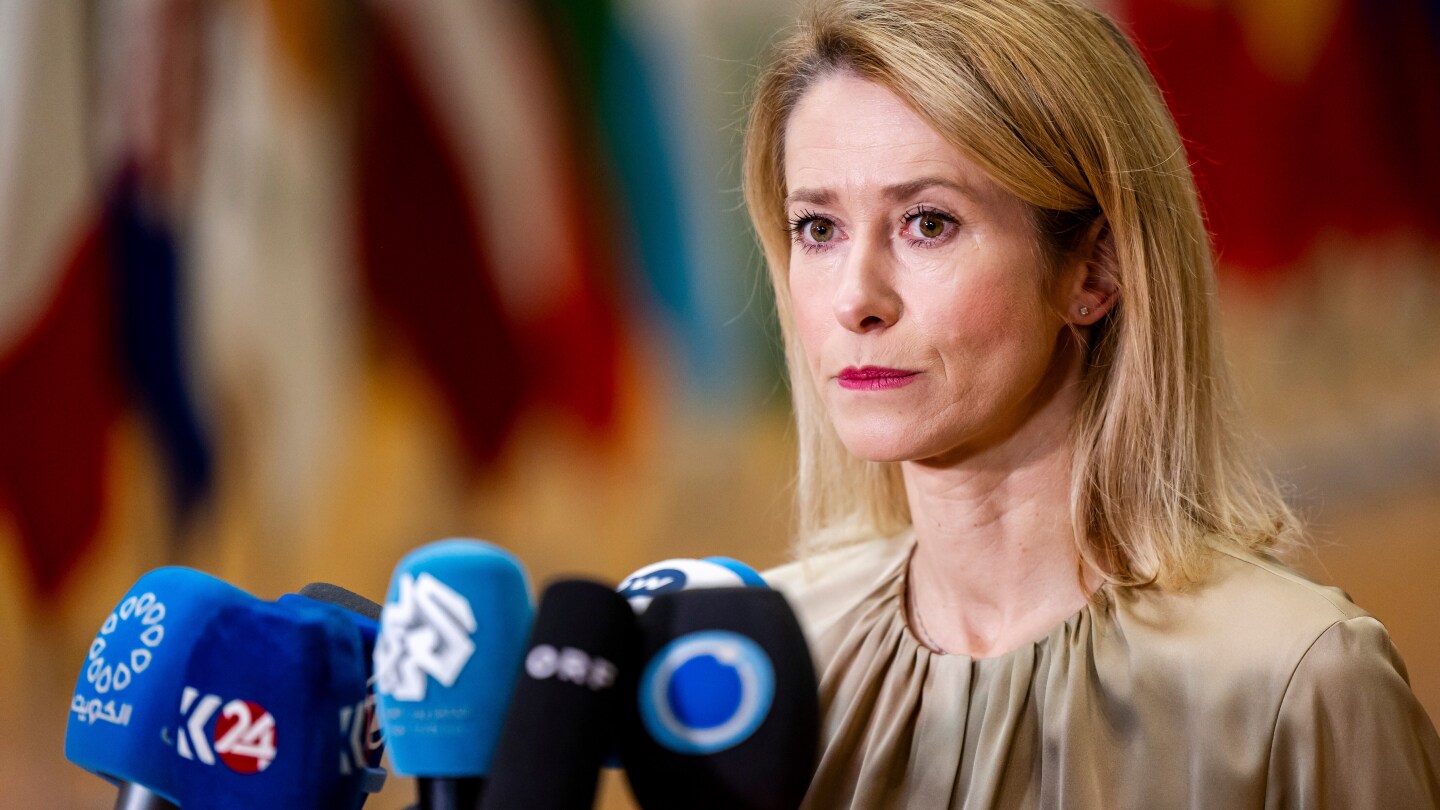
European diplomats have emphasized that Ukraine and Europe must be integral to any discussions aimed at ending Russia’s ongoing invasion of Ukraine. This declaration comes amid reports of a U.S.-Russian peace proposal that reportedly demands significant concessions from Ukraine, including territorial cessions. The proposal, first reported by Axios, has added pressure on Ukrainian President Volodymyr Zelenskyy, who is already grappling with a major corruption scandal and rallying international support for Ukraine’s defense. EU foreign policy chief Kaja Kallas stressed that any viable peace plan must have the backing of Ukrainians and Europeans, a sentiment echoed by German Foreign Minister Johann Wadephul, who asserted that negotiations must involve Ukraine and Europe. The alleged peace plan, drafted by U.S. and Russian envoys, reportedly includes provisions for Ukraine to relinquish control of the Donbas region and scale back certain military capabilities. However, such concessions would be deeply unpopular in Ukraine and unconstitutional. U.S. Secretary of State Marco Rubio hinted at ongoing efforts to develop a lasting peace agreement, while Kremlin spokesman Dmitry Peskov denied active consultations with the U.S. European leaders have expressed skepticism about Russia’s sincerity in seeking peace, accusing Moscow of sustaining its war of attrition. Meanwhile, European nations have stepped up military aid to Ukraine, giving them leverage in peace talks. Polish Foreign Minister Radosław Sikorski reiterated that Europe, as Ukraine’s primary supporter, expects to be consulted in any peace efforts.
-
Brussels hosts talks on Gaza reconstruction, security and governance
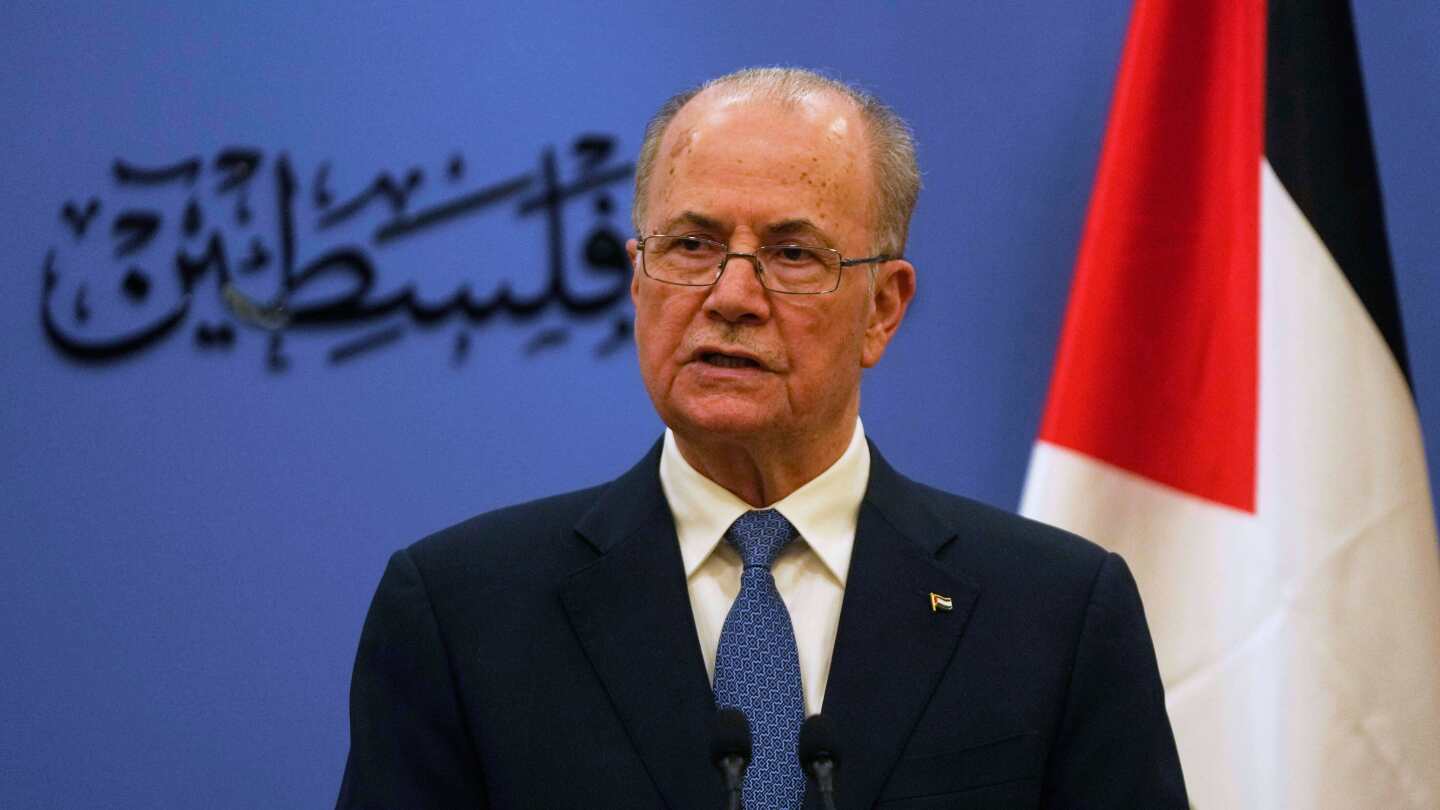
In a significant diplomatic gathering, over 60 delegations convened in Brussels on Thursday to address the pressing issues of reconstruction, governance, and security in the war-torn Gaza Strip, alongside the reform of the Palestinian Authority (PA). The meeting, co-chaired by France and Saudi Arabia under the auspices of the Palestine Donors Group, follows the recent approval of a U.S.-backed peace plan by the United Nations Security Council. The PA, which currently governs semi-autonomous areas in the Israeli-occupied West Bank, is seeking to expand its influence into postwar Gaza. However, its role remains contentious, with Israel outright rejecting any PA involvement in Gaza and the U.S. insisting on substantial reforms before financial support is extended. The European Union, the PA’s largest financial backer, is advocating for its effective governance of Gaza post-reform. Meanwhile, the EU is increasingly asserting its role in shaping Gaza’s future, including plans to train 3,000 Palestinian policemen, with France contributing 100 officers to this initiative. The U.S. peace plan envisions a gradual handover of Gaza’s territory to a mix of these policemen and an International Stabilization Force. The EU is also pushing for the formation of a technocratic, apolitical committee to manage Gaza’s civil services, largely drawn from the PA. However, these proposals face skepticism within Palestinian society, with Hamas denouncing the U.N. resolution as serving Israeli interests. The meeting in Brussels did not seek financial pledges for Gaza’s reconstruction, with a separate event in Egypt planned for this purpose. The reforms demanded by the U.S. and EU include the abolition of the PA’s controversial ‘martyrs’ fund’ and the revision of its educational materials. Despite these efforts, the PA, led by the increasingly marginalized 90-year-old President Mahmoud Abbas, struggles to gain legitimacy and influence in postwar Gaza.
-

Trains collide in the Czech Republic, leaving dozens of people injured
A significant train collision occurred in the southern Czech Republic on Thursday morning, resulting in multiple injuries and disrupted rail services. The incident took place near Ceske Budejovice at approximately 6:20 a.m., involving an express train and another passenger train. According to the regional rescue service, 57 individuals sustained injuries, with two reported to be in serious condition. However, a local hospital in Ceske Budejovice later revised this figure, stating that five of the admitted patients had serious injuries. The collision led to the suspension of rail traffic between Ceske Budejovice and Plzen, with services not expected to resume until the afternoon. Authorities have launched an investigation to determine the cause of the crash, which has raised concerns about rail safety in the region.
-
1,700 years ago, bishops and an emperor wrote a creed. Millions still recite it in church
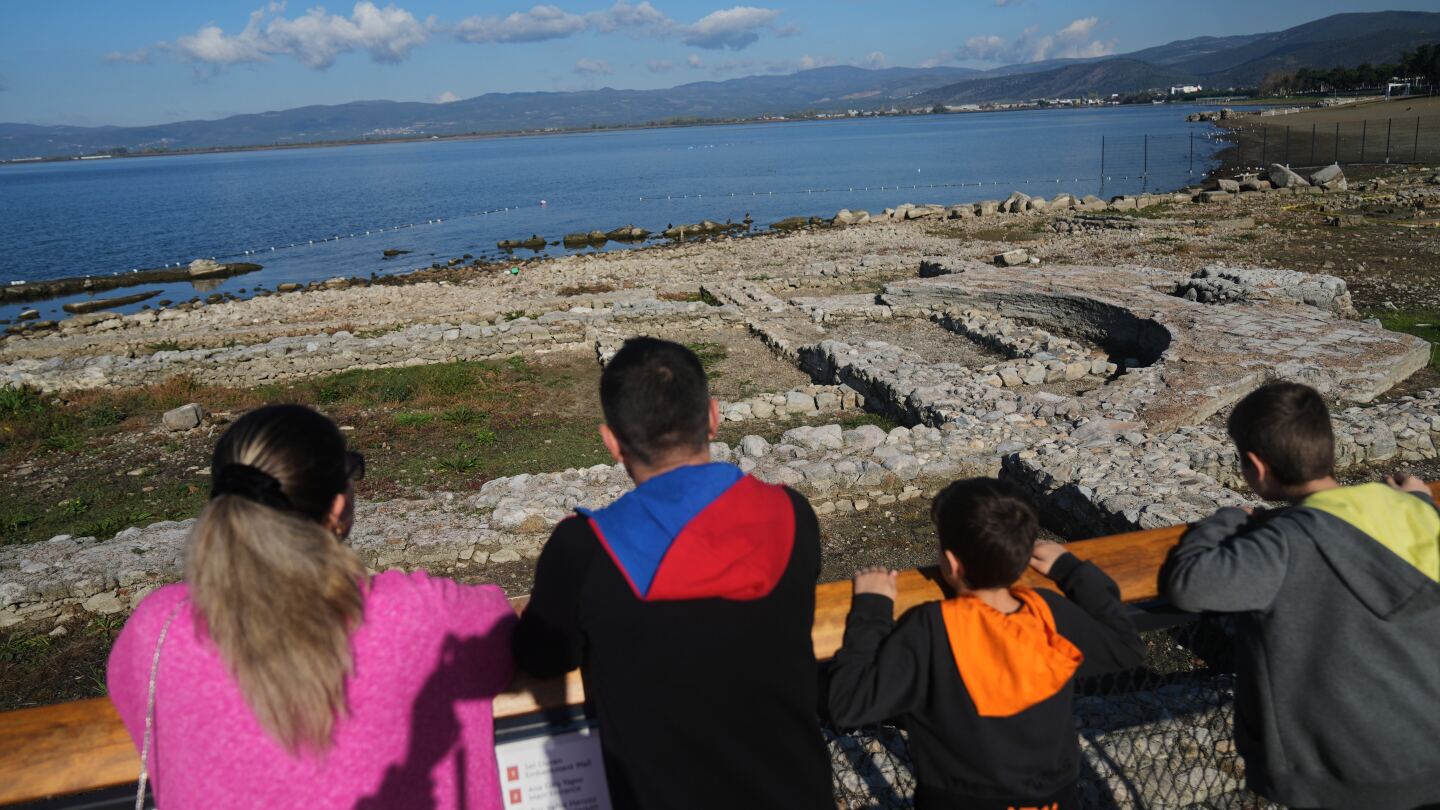
The Council of Nicaea, convened 1,700 years ago in present-day Turkey, remains a cornerstone of Christian history, symbolizing both unity and division within the faith. This historic gathering, orchestrated by Roman Emperor Constantine in 325 AD, produced the Nicene Creed, a foundational statement of Christian belief still recited by millions worldwide. Pope Leo XIV’s visit to the site on November 28, as part of his first major foreign trip, underscores its enduring significance. The council marked the first ecumenical meeting of bishops, addressing theological disputes, particularly the “Trinitarian Controversy,” which centered on the relationship between God the Father and Jesus the Son. Despite later schisms, the Nicene Creed remains a unifying document for Catholic, Orthodox, and most Protestant denominations. The anniversary has been commemorated globally, with events ranging from the World Council of Churches’ celebration in Egypt to local gatherings in the U.S. The council’s legacy, however, is complex. While it achieved theological compromise, it also institutionalized antisemitism and failed to permanently resolve doctrinal conflicts. Arius, whose teachings were condemned at Nicaea, later regained influence, and debates persisted for generations. Subsequent councils, such as the one in Constantinople in 381, expanded the creed, but divisions continued, including the Great Schism between the Catholic and Eastern Orthodox churches in the 11th century. Despite these fractures, the anniversary serves as a reminder of Christianity’s call to unity, offering hope for reconciliation in a divided church.
-

A corruption scandal pressures Ukraine’s Zelenskyy to show greater accountability
Ukrainian President Volodymyr Zelenskyy is under increasing pressure to demonstrate accountability as a corruption scandal threatens to destabilize his government amidst the ongoing war with Russia. The scandal, involving the embezzlement of $100 million from Ukraine’s energy sector, has led to the dismissal of two top officials and sanctions on close associates. However, these actions have failed to quell public outrage, particularly as Ukrainians endure frequent power outages caused by Russian bombardments. Calls are growing for the resignation of Zelenskyy’s chief of staff, Andrii Yermak, who is seen as a central figure in the administration. While neither Zelenskyy nor Yermak have been directly implicated, critics argue that senior leaders must be held accountable to restore public trust and maintain credibility with Western allies. The scandal has intensified scrutiny of Ukraine’s long-standing corruption issues, which Zelenskyy had pledged to eradicate when elected in 2019. Despite the political storm, Zelenskyy has not yet decided to dismiss Yermak, whose influence in the administration remains significant. The situation highlights the delicate balance Zelenskyy must strike between addressing internal corruption and maintaining focus on the war effort.
-
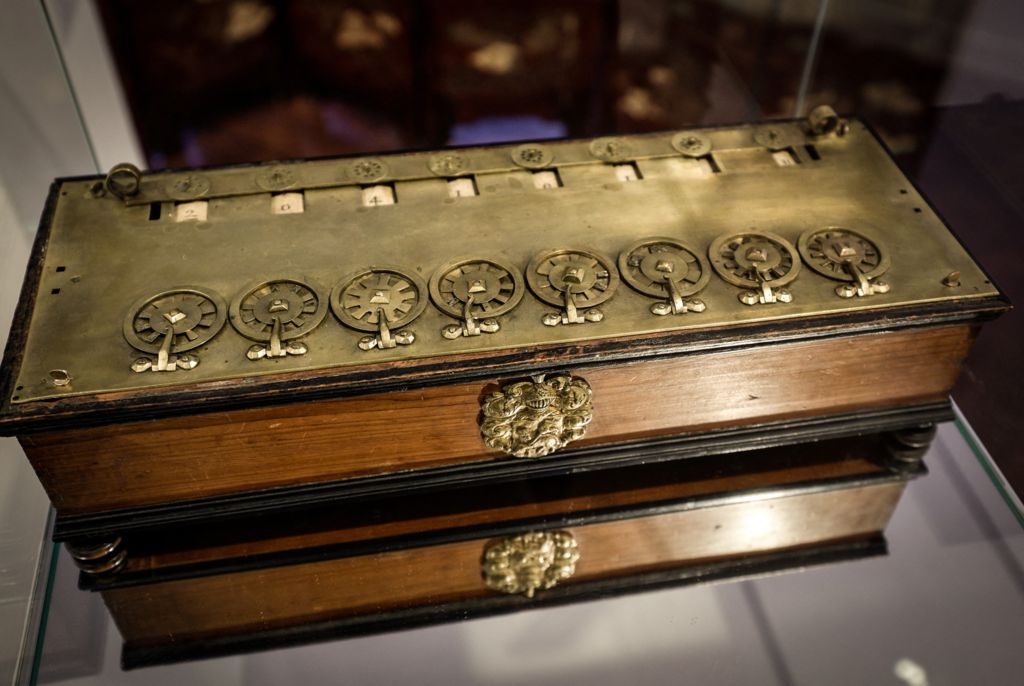
Paris court blocks auction of earliest-known calculator
A Paris court has temporarily blocked the auction of La Pascaline, one of the world’s first mechanical calculators, developed by French mathematician Blaise Pascal in 1642. The device, valued at €2 to 3 million (£1.77m to £2.65m), was set to be sold by Christie’s as part of the library collection of the late Catalonia collector Léon Parcé. However, scientists and researchers petitioned for heritage protections, arguing that La Pascaline should be classified as a ‘national treasure’ due to its historical and scientific significance. The court’s provisional decision cited ‘serious doubts’ over the legality of an export certificate previously issued by France’s culture minister. Christie’s has suspended the sale pending a final judgment. La Pascaline, of which only nine examples remain, is celebrated as the first attempt to mechanize human thought, marking a pivotal moment in scientific history. The device had been exhibited at Christie’s venues in New York and Hong Kong this year. The French heritage group Association Sites & Monuments welcomed the court’s decision, emphasizing the calculator’s importance to France’s cultural and scientific legacy.