标签: Europe

欧洲

  • Trump and Zelensky appear more upbeat – but show little evidence that peace is near for Ukraine

    Trump and Zelensky appear more upbeat – but show little evidence that peace is near for Ukraine

    In an unprecedented diplomatic engagement, former U.S. President Donald Trump and Ukrainian President Volodymyr Zelensky convened for extensive discussions lasting two-and-a-half hours at Trump’s Mar-a-Lago estate in Florida. Both leaders characterized the meeting as exceptionally productive, with Trump describing it as “terrific” while Zelensky praised the “great discussions on all the topics.”

    The summit marked the longest continuous negotiation between the two leaders to date, generating visible optimism despite the absence of concrete breakthroughs. Central to the discussions were two critical issues: potential territorial concessions and future security arrangements. While Zelensky has not publicly acquiesced to demands for territorial compromises—a position Russia supports and the U.S. appears to endorse—he suggested the possibility of a national referendum to ratify any eventual peace agreement.

    Regarding security guarantees, Zelensky claimed “100%” alignment with the U.S., though specific details remain undisclosed. The effectiveness of such guarantees in deterring future Russian aggression remains uncertain.

    The dialogue’s significance is further complicated by Russia’s preemptive rejection of key proposals floated before the meeting, including ceasefire implementation and deployment of multinational monitoring forces. Trump’s continued favorable rhetoric toward Vladimir Putin, whom he described as “serious about peace” and supportive of Ukraine’s success, raises questions about potential pressure asymmetries in future negotiations.

    Ultimately, while the meeting generated positive atmospherics, it provided little evidence that a sustainable resolution to the conflict is imminent, with fundamental disagreements persisting on core issues.

  • Kosovo’s ruling party wins election after months of political deadlock

    Kosovo’s ruling party wins election after months of political deadlock

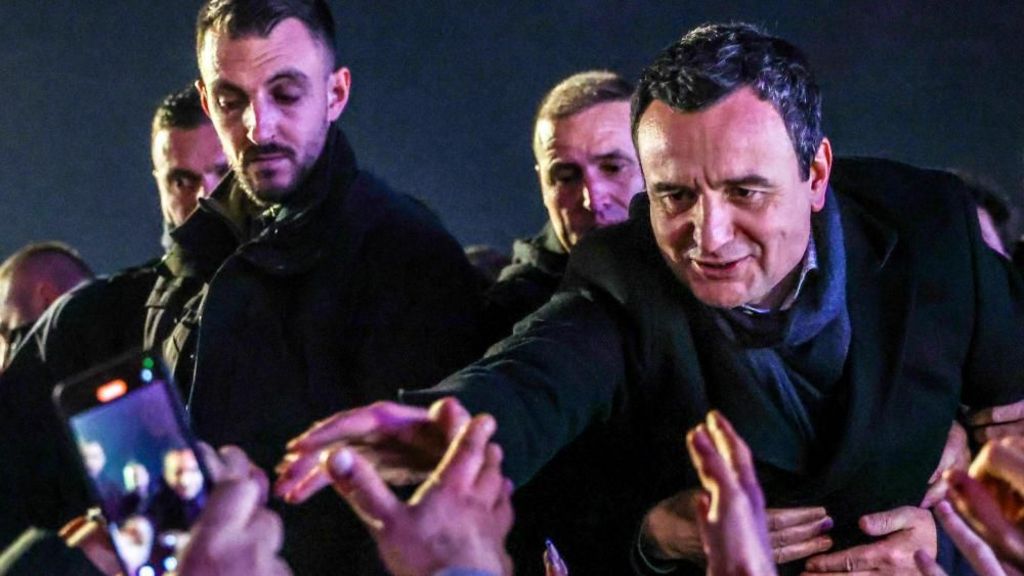
    In a decisive political mandate, Kosovo’s Albanian nationalist Vetevendosje movement has achieved a resounding triumph in parliamentary elections, securing an unprecedented third consecutive term for its leader Albin Kurti. Preliminary results indicate the left-wing party captured 50.8% of votes with 90% counted, marking the fourth successive electoral victory for the ‘Self-Determination’ movement.

    The outcome represents a stark rebuke to the main opposition blocs—the center-right Democratic Party of Kosovo (PDK) at 20.98% and the Democratic League of Kosovo (LDK) at 13.89%—who had maintained a seven-month governmental deadlock following February’s inconclusive polls. This electoral impasse had paralyzed legislative functions and cost Kosovo access to hundreds of millions in EU development funds.

    While falling just short of an absolute parliamentary majority, Kurti’s commanding position enables straightforward coalition building with ethnic minority representatives who hold 20 guaranteed seats in the 120-member National Assembly. The victory margin, described by Kurti as ‘the greatest in the nation’s history,’ signals voter preference for his transformative agenda over established parties linked to Kosovo’s post-independence political establishment.

    Critical challenges await the renewed administration: restoring strained relations with EU and US partners, addressing constitutional concerns regarding minority rights, and resuscitating the frozen normalization dialogue with Serbia. The international community particularly expects pragmatic engagement with Belgrade after Kurti’s previous dogmatic stance exacerbated regional tensions through controversial measures targeting Serb minority institutions.

    Analysts interpret this endorsement of a polarizing figure as reflecting profound disillusionment with traditional alternatives. Despite acknowledged governance shortcomings and diplomatic frictions, voters ultimately perceived opposition obstructionism as more damaging than incumbent policy limitations.

  • ‘Superiority’ concerns over Royal Yacht Britannia visit to Ireland

    ‘Superiority’ concerns over Royal Yacht Britannia visit to Ireland

    Recently declassified documents from Ireland’s National Archives have unveiled significant diplomatic concerns surrounding a proposed 1996 visit by then-Prince Charles to Ireland aboard the royal yacht Britannia. The planned three-day trip, which would have marked Charles’ first official visit to Ireland, was ultimately canceled due to mounting security apprehensions and political sensitivities.

    The records reveal that British Ambassador Veronica Sutherland formally proposed in March 1996 that Charles arrive aboard HMY Britannia in Galway Bay on June 28, 1996. The itinerary included hosting receptions aboard the vessel before it would sail to Kerry and Cork for a private weekend. However, Irish officials quickly expressed concerns about the ‘rather elaborate’ nature of the proposed visit.

    Then-Taoiseach John Bruton voiced particularly strong objections in a handwritten memo, warning that the royal yacht’s arrival would convey problematic symbolism. ‘The yacht suggests opulence and superiority,’ Bruton wrote. ‘It’s not the image that should be conveyed.’ He specifically worried that Britannia’s presence might revive historical debates about British treaty ports in Ireland from the 1930s.

    Bruton advocated for Charles to instead arrive by commercial aircraft, noting this would provide economic benefits to regional airports. He further observed that the yacht was ‘controversial in Britain lately because of its cost,’ adding that ‘Ireland is the last place he should be bringing it.’

    The documents show that by March 19, 1996, Irish officials had conveyed these concerns to British representatives and were anticipating a ‘scaled-down’ revised itinerary. Ultimately, the visit was canceled entirely due to security risks in the absence of an IRA ceasefire, with officials concluding that ‘the risks now seem to outweigh any benefits.’

    In a related 2003 document, the archives reveal that Taoiseach Bertie Ahern similarly rejected a request for the British naval vessel HMS Ark Royal to dock in Dublin. Senior civil servants warned that allowing the ‘symbol of British naval prowess’ would represent a policy shift toward accepting ‘British military displays in our jurisdiction,’ particularly sensitive given the ship’s role in the Iraq War.

  • Plane passes volcanic ash cloud rising from Mount Etna

    Plane passes volcanic ash cloud rising from Mount Etna

    An aircraft was captured on video undertaking a perilous journey through a colossal volcanic ash cloud emanating from Mount Etna, Europe’s most active volcano located on the Italian island of Sicily. The footage showcases the stark contrast between the commercial airliner and the immense, dark plume of ash and smoke violently erupting from the volcano’s crater, highlighting the ongoing natural hazards present in the region.

    The event underscores the complex interplay between modern air travel and active volcanism. Mount Etna, a near-constant state of activity, frequently produces such explosive eruptions, ejecting volcanic material high into the atmosphere. These emissions pose a significant risk to aviation, as volcanic ash can cause severe damage to aircraft engines, potentially leading to total engine failure. The incident serves as a reminder of the critical monitoring and rapid response systems employed by aviation authorities to reroute traffic and ensure passenger safety during such geologic events. While the specific flight and its status remain unidentified, the visual evidence points to the ever-present need for vigilance in geologically active zones.

  • Spaniards hurl flour, eggs and fireworks in mock battle

    Spaniards hurl flour, eggs and fireworks in mock battle

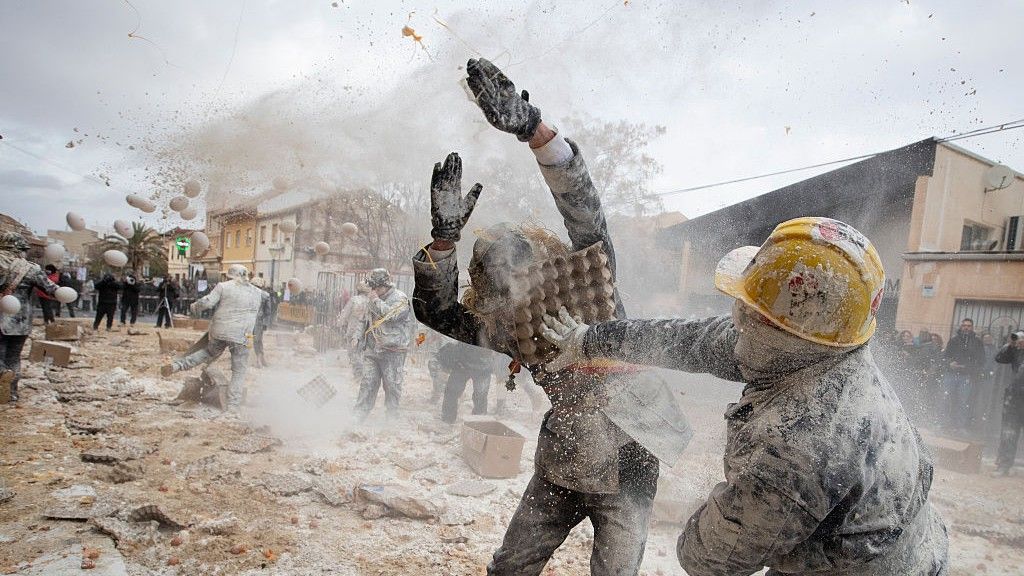
    The historic streets of Ibi, a town in Spain’s Alicante province, were transformed into a spectacular battlefield of culinary projectiles on December 28th as participants engaged in the centuries-old tradition of ‘Els Enfarinats’ (The Floured Ones). This unique festival combines theatrical rebellion with massive food fights, creating one of Spain’s most visually striking cultural celebrations.

    During the meticulously choreographed event, participants divided into two distinct factions: the ‘Enfarinats’ (rebels) who temporarily seize symbolic control of the town, and the opposition forces attempting to restore order. The mock battle reached its climax as combatants hurled thousands of eggs and massive quantities of flour amid the crackle of fireworks and theatrical protests.

    The tradition, dating back approximately 200 years, represents more than mere revelry. It serves as a living cultural artifact that blends satire, historical remembrance, and community bonding. Following the intense hour-long conflict, the ‘rebels’ traditionally impose humorous fines on citizens for supposed infractions, with collected funds donated to local charitable causes.

    Local authorities implemented extensive cleanup operations while residents participated in the joyful task of restoring normalcy. The event continues to attract international attention, drawing visitors fascinated by this distinctive combination of food warfare, historical theater, and philanthropic tradition.

  • UK leader criticized for applauding return of man freed from Egyptian prison as old tweets resurface

    UK leader criticized for applauding return of man freed from Egyptian prison as old tweets resurface

    British Prime Minister Keir Starmer has come under intense political scrutiny following his public celebration of Alaa Abd el-Fattah’s return to the United Kingdom. The prominent human rights activist, who holds dual British-Egyptian citizenship, was recently freed from Egyptian incarceration after spending nearly 14 years imprisoned primarily for his opposition to President Abdel-Fattah el-Sissi’s administration.

    While successive UK governments had consistently advocated for Abd el-Fattah’s release as a matter of diplomatic priority, Starmer’s personal endorsement has ignited a firestorm of controversy. The Prime Minister expressed being ‘delighted’ that the activist had been reunited with his family following the lifting of Egyptian travel restrictions that had confined him to the country since his September release.

    The situation escalated when Robert Jenrick, the Conservative Party’s justice spokesman, publicly challenged Starmer’s stance. Jenrick revealed historical social media posts allegedly authored by Abd el-Fattah that contained violent rhetoric against Zionists and law enforcement personnel. The Conservative MP demanded to know whether the Prime Minister had been aware of these controversial statements before offering his ‘unalloyed endorsement’ and called for both condemnation and retraction of the supportive remarks.

    In response to the growing political tension, the Foreign, Commonwealth and Development Office issued a clarifying statement emphasizing that while securing Abd el-Fattah’s freedom represented a long-standing bipartisan priority, this diplomatic effort should not be interpreted as endorsement of his social media content. The government department explicitly condemned the historic tweets as ‘abhorrent’ while maintaining its commitment to opposing arbitrary detention globally.

    The controversy has highlighted the complex intersection of human rights advocacy, diplomatic priorities, and political accountability. Abd el-Fattah’s case gained international attention partly due to his mother’s extraordinary 10-month hunger strike campaign pressuring British authorities to intensify their efforts for his release. As critics circulate the controversial posts, questions regarding context and authenticity have emerged, with The Times of London reporting that the activist had previously claimed the comments were extracted from private conversations during Israeli military operations in Gaza and misrepresented.

  • French cinema actress Brigitte Bardot dies aged 91

    French cinema actress Brigitte Bardot dies aged 91

    Brigitte Bardot, the French cinematic sensation who redefined 1950s cinema and became an enduring symbol of sexual liberation, has passed away at age 91. Her foundation confirmed the news with profound sorrow, though specific details regarding the time and location of her death remain undisclosed.

    Emerging from Parisian aristocracy in 1934, Bardot’s trajectory from aspiring ballerina to international film icon began with a serendipitous Elle magazine cover appearance. Her breakthrough performance in Roger Vadim’s 1956 masterpiece ‘And God Created Woman’ catapulted her to global stardom, simultaneously scandalizing American audiences and earning praise from intellectual circles, including philosopher Simone de Beauvoir who celebrated her embodiment of ‘absolute freedom’.

    Throughout her illustrious career spanning nearly 50 films, Bardot demonstrated remarkable versatility across genres. From the dramatic intensity of ‘The Truth’ to the artistic sophistication of Godard’s ‘Contempt’ and the comedic brilliance of ‘Viva Maria!’, she established herself as more than a mere screen presence. Her lesser-known works like ‘Love on a Pillow’ and ‘Two Weeks in September’ further revealed her capacity for emotional depth and vulnerability.

    Beyond her cinematic achievements, Bardot revolutionized fashion aesthetics with her signature tousled blonde hair, bold eyeliner, and the eponymous ‘Bardot neckline’ that became a global trend after her iconic 1953 Cannes appearance.

    In a stunning career move, Bardot abandoned Hollywood at the peak of her fame in 1973, declaring: ‘I gave my youth and beauty to men, I give my wisdom and experience to animals.’ This transition marked her transformation into a dedicated animal rights activist, founding the Brigitte Bardot Foundation in 1986 and adopting vegetarianism. Her advocacy extended to dramatic gestures, including a 2013 threat to seek Russian citizenship in protest against proposed euthanasia of elephants in French zoos.

    While President Emmanuel Macron eulogized her as ‘a legend of the century’ and far-right politician Marine Le Pen praised her ‘exceptional talent and courage,’ Bardot’s legacy remains complex. Her later years were marred by multiple convictions for inciting racial hatred, particularly against Muslim communities, and controversial statements about LGBTQ+ communities. Her 2003 book ‘A Cry in the Silence’ and dismissive comments about the #MeToo movement further complicated her public image.

    Bardot’s personal life included four marriages, most notably to businessman Bernard d’Ormale, a former adviser to far-right leader Jean-Marie Le Pen. Her relationship with son Nicolas Charrier remained strained, culminating in legal action following her autobiographical remarks about preferring animal offspring.

    The international community now remembers Bardot as both a cinematic revolutionary who challenged social norms and a controversial figure whose later statements often overshadowed her artistic contributions and animal welfare activism.

  • Three killed in Sweden as major storm sweeps across Nordic countries

    Three killed in Sweden as major storm sweeps across Nordic countries

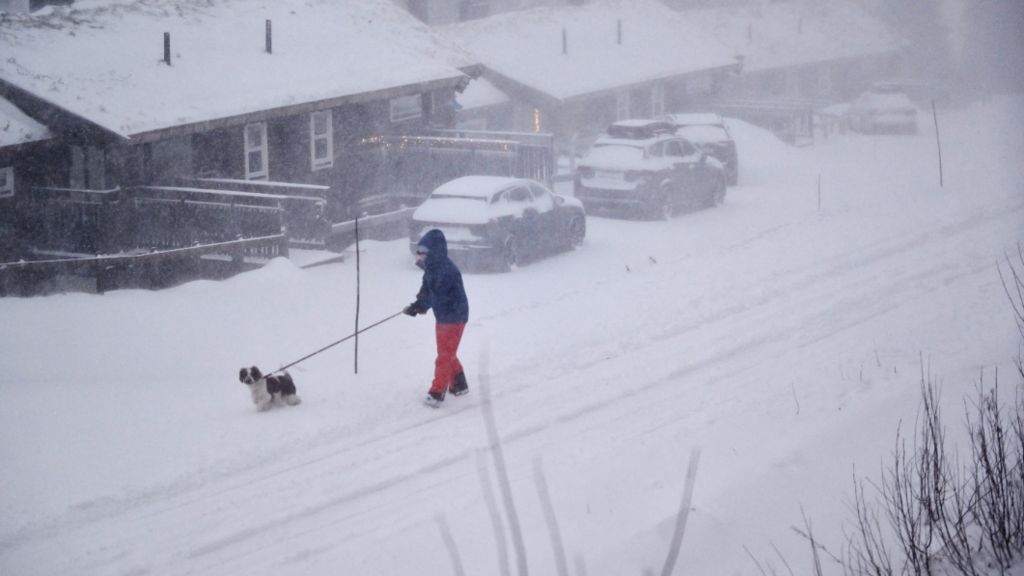
    A severe winter storm, identified as Johannes in Sweden and Norway and Hannes in Finland, has tragically resulted in a third fatality, compounding a trail of destruction across the Nordic region. The powerful weather system has inflicted significant casualties, widespread power outages, and severe disruptions to transportation networks.

    The human toll escalated as Swedish authorities confirmed the death of a man in his 60s. The victim succumbed to injuries after being struck by a falling tree while working in a forest near Hofors, located in east-central Sweden. This incident follows two previous storm-related fatalities: one individual at the Kungsberget ski resort and a utility employee from the regional company Hemab, who died while performing restoration duties.

    Infrastructure and essential services have been critically impaired. Combined figures from the affected nations reveal that over 130,000 households were plunged into darkness. Sweden reported more than 40,000 homes without electricity, while in Norway’s Nordland and Inland regions, approximately 32,000 customers lost power. Finland faced the most extensive outage, with public broadcaster Yle noting that more than 60,000 homes were impacted before the storm subsided on Sunday.

    The storm’s ferocious winds precipitated dramatic travel chaos. A significant incident occurred at Kittilä Airport in northern Finland, where powerful gusts forced a Swiss International Air Lines jet, carrying 150 passengers, and a smaller aircraft off the runway and into snowbanks shortly after landing. While no injuries were reported from the aviation mishap, the event led to a full ground stop at the airport. Across the region, numerous flights, ferry crossings, and rail services were preemptively canceled. Road and rail travel faced ongoing disruptions due to hazardous conditions and debris.

    Emergency services have been stretched to their limits. Norwegian broadcaster NRK highlighted the intense response in Nordland county, where local fire departments addressed over 200 weather-related calls. The Swedish Meteorological and Hydrological Institute (SMHI) had issued advanced alerts for strong winds encompassing much of northern Sweden as Storm Johannes made landfall, underscoring the predicted severity of the event.

  • Protesting students in Serbia urge support for early election they hope will oust Vucic

    Protesting students in Serbia urge support for early election they hope will oust Vucic

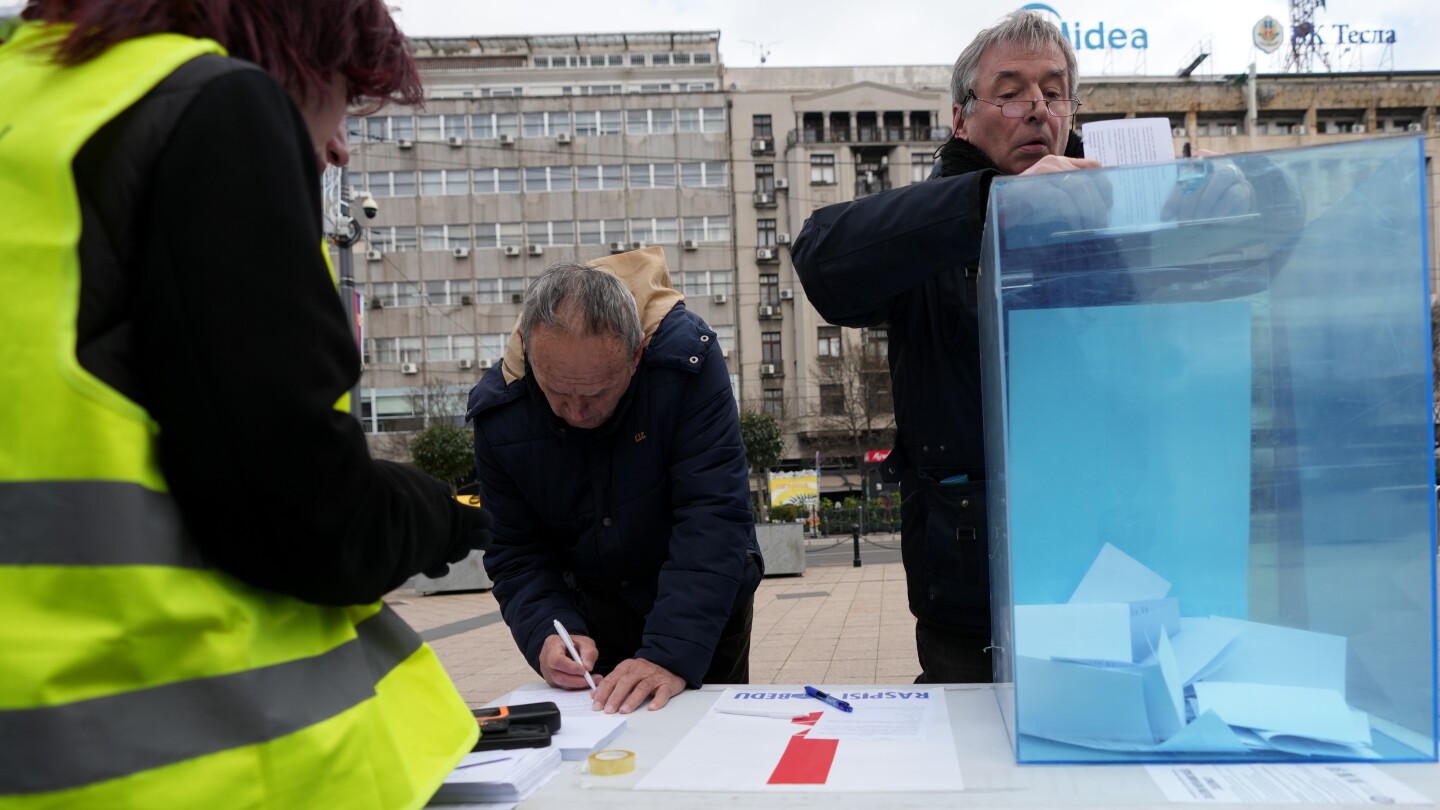
    BELGRADE, Serbia — In a bold demonstration of political dissent, Serbian university students orchestrated a nationwide signature-gathering initiative on Sunday, demanding early parliamentary elections to challenge President Aleksandar Vucic’s administration. Defying frigid temperatures, protesters established approximately 500 collection points across cities, towns, and villages throughout the Balkan nation.

    This mobilization represents the latest escalation in a sustained youth-led movement that has emerged as the most significant challenge to Vucic’s populist regime during his 13-year tenure. The protest movement initially gained momentum following the November 2024 train station catastrophe in Novi Sad, where 16 lives were lost due to a concrete canopy collapse. The tragedy has been widely attributed to systemic corruption and blatant disregard for construction safety protocols during station renovations, with no officials yet held accountable.

    While the signature drive does not constitute a formal petition, organizers describe it as both a barometer of public support and a mechanism to intensify pressure on the government. Igor Dojnov, a student coordinator at a Belgrade collection point, emphasized the campaign’s purpose: “We have stands that serve to connect with the citizens.”

    The political landscape has already shown signs of strain under protest pressure, culminating in the resignation of Serbia’s populist prime minister in January. Vucic subsequently initiated a crackdown on demonstrators that drew international condemnation. Although street protests have diminished recently, underlying discontent remains pervasive among the populace.

    Belgrade resident Milca Cankovic Kadijevic expressed solidarity with the students, stating, “I support them because I have a desire to live decently — me, my children and my grandchildren.”

    Vucic has dismissed calls for immediate early voting, suggesting potential elections might occur next year rather than waiting until the scheduled 2027 parliamentary and presidential votes. The president has accused protesters of attempting to orchestrate a Western-backed “color revolution” — a term referencing early 21st-century mass movements that toppled governments in post-Soviet states and other regions.

    Despite his formal commitment to European Union integration, Vucic maintains strong ties with Russia and China while facing persistent allegations of eroding democratic institutions and tolerating corruption and organized crime networks.

  • Hounded by photographers for years, Bardot identified with the animals she later set out to save

    Hounded by photographers for years, Bardot identified with the animals she later set out to save

    Brigitte Bardot, the iconic French actress who revolutionized global perceptions of sexuality in cinema before becoming a controversial animal rights advocate, has passed away at 91. Her remarkable transformation from international sex symbol to militant activist represents one of Hollywood’s most dramatic career evolutions.

    Bardot’s ascent to stardom began at just 22 when her breakthrough performance in the 1956 film ‘And God Created Woman’ catapulted her to international fame. Directed by her first husband Roger Vadim, the film showcased her provocative blend of childlike innocence and raw sexuality that would define her early career. Her tousled blonde hair, hourglass figure, and signature pout became synonymous with French cinema’s breaking of bourgeois conventions.

    Yet behind the glamour, Bardot developed profound antipathy toward the paparazzi culture that surrounded her celebrity. She described the constant flashbulb exposure as resembling ‘high-powered rifle bullets’ that ‘killed something inside me.’ This intense media scrutiny, including photographers invading her home weeks before childbirth, contributed to her eventual retirement from acting at 39.

    Her second act as an animal rights activist proved equally sensational. Bardot established a foundation devoted exclusively to preventing animal cruelty, selling personal memorabilia to fund her advocacy. She traveled to the Arctic to protest seal hunting, condemned laboratory animal testing, and campaigned against traditional sporting events involving animals. Her activism earned France’s Legion of Honor in 1985 but later courted controversy as her rhetoric grew increasingly extreme.

    Bardot faced multiple convictions for inciting racial hatred, particularly regarding her criticisms of Muslim slaughter rituals and immigration policies. Her association with far-right politics through her fourth husband Bernard d’Ormale further complicated her public legacy. Despite these controversies, she remained unapologetically outspoken, even criticizing the #MeToo movement in later interviews.

    The actress once reflected that she identified with hunted animals, drawing parallels between their suffering and her own experiences with relentless media pursuit. ‘I can understand hunted animals because of the way I was treated,’ she noted, adding ‘What happened to me was inhuman.’ Her journey from cinematic icon to controversial activist remains a testament to the complex relationship between celebrity, personal transformation, and public perception.