标签: Asia

亚洲

  • China sees marked rise in 5-year survival rate for pediatric, adolescent cancers

    China sees marked rise in 5-year survival rate for pediatric, adolescent cancers

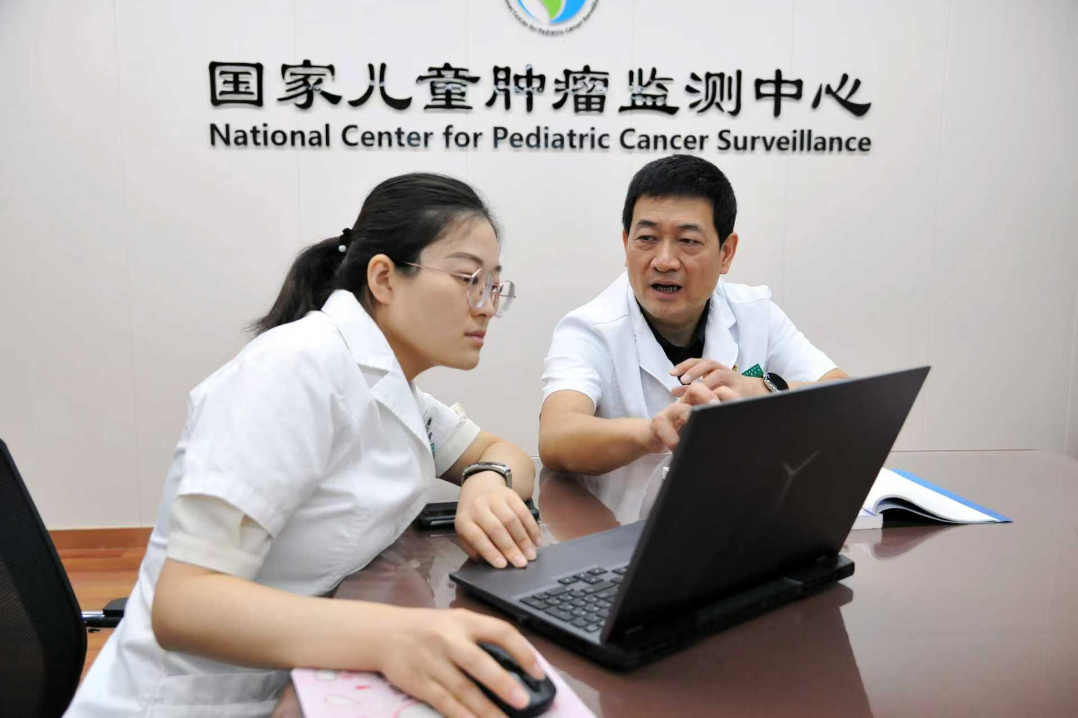
    China has achieved a remarkable breakthrough in pediatric oncology care, with the nation’s five-year survival rate for childhood and adolescent cancers reaching 77.2% according to groundbreaking research published in The Lancet. The comprehensive study conducted by the National Center for Pediatric Cancer Surveillance (NCPCS) reveals unprecedented progress in China’s healthcare capabilities, with certain cancer types now demonstrating world-class treatment outcomes.

    The extensive research, analyzing 95,189 cases diagnosed between 2018-2020, shows distinct variations across age groups and cancer types. Children under 14 years achieved a 77.8% survival rate, while adolescents aged 15-19 recorded 75.3%. Female patients showed marginally better outcomes than males across the study cohort.

    Retinoblastoma emerged as the most successfully treated cancer with a 91.2% survival rate, contrasting with malignant bone tumors which presented the greatest challenge at 60.4%. Most significantly, China exceeded all expectations for the six high-priority cancers identified by the WHO’s Global Initiative for Childhood Cancer, achieving survival rates above 80% across all categories—far surpassing the WHO’s 60% target. The exceptional 93.8% survival rate for certain prioritized cancers demonstrates China’s capacity to match treatment outcomes of high-income nations.

    Professor Ni Xin, director of NCPCS and president of Beijing Children’s Hospital, attributed this dramatic improvement to systemic healthcare reforms. “Compared with estimates from a decade ago, the five-year survival rate for cancer patients aged 0-19 in China has improved markedly,” Ni stated. “Particularly for common childhood cancers such as leukemia and lymphoma, progress has been significant. The survival rates for neuroblastoma, retinoblastoma, and Hodgkin lymphoma are now close to the levels seen in high-income countries.”

    The transformation stems from China’s strategic investments in healthcare infrastructure, including enhanced inter-provincial medical billing systems, specialized policies for major disease treatment, standardized treatment protocols, and the development of a multi-center collaborative network encompassing 1,760 medical institutions across all 31 provincial-level regions.

    This landmark study addresses a critical knowledge gap in China’s healthcare landscape, providing the first comprehensive nationwide data on pediatric cancer survival rates since the establishment of NCPCS in 2019. The findings not only demonstrate measurable progress in cancer care but also establish a new benchmark for ongoing monitoring and improvement of childhood cancer treatment outcomes in China.


  • First-time homebuyers in UAE: Navigate the buying process

    First-time homebuyers in UAE: Navigate the buying process

    The United Arab Emirates’ real estate sector is witnessing a significant transformation as homeownership becomes an increasingly attainable objective for residents. This shift is propelled by evolving long-term visa policies, robust salary growth, and a more accommodating mortgage environment tailored for newcomers to the property market. Despite rising interest, numerous prospective buyers seek a clear, structured understanding of the purchasing journey. Contrary to common perceptions, acquiring property in the UAE is a well-defined process, empowering informed financial decision-making for those aiming to transition from renting, establish permanent roots, or diversify investment portfolios.

    A successful purchase begins with a thorough eligibility assessment. Financial institutions evaluate applicants based on minimum salary thresholds (typically Dh10,000–15,000), employment classification, credit history, existing debt obligations, and nationality—which influences loan-to-value (LTV) ratios. Expatriates often qualify for up to 80% LTV, while Emirati nationals may access 85–90% financing. Consulting a mortgage advisor early can streamline this preliminary phase.

    Understanding genuine affordability, distinct from property prices, is crucial. Banks employ a Debt Burden Ratio (DBR), capping total monthly debt repayments at 50% of income. Prospective buyers must evaluate maximum loan amounts, installment schedules (extending to 25 years), and the implications of fixed versus variable interest rates, including potential early settlement fees and recurring service charges.

    Financial planning must also incorporate all ancillary costs. In Dubai, these encompass a 4% DLD transfer fee, administrative charges of Dh4,000, trustee fees (Dh2,000–4,000), mortgage registration (0.25% of loan value), bank processing fees (up to 1%), and valuation costs (Dh2,500–3,500). Off-plan purchases involve additional Oqood registration fees and developer-specific payment plans.

    Securing a pre-approval serves as a powerful strategic tool, validating borrowing capacity for 60–90 days and enhancing negotiation leverage with sellers and brokers. With financing parameters established, buyers can then identify suitable properties—balancing factors like readiness (ready versus off-plan), community amenities, proximity to essential services, infrastructure developments, rental yields, and long-term capital appreciation potential.

    The final transaction phase involves executing a Memorandum of Understanding, depositing 10% payment, completing property valuation, obtaining the final mortgage offer, clearing any seller liabilities, and formalizing the transfer at the trustee office with payment of due fees. Post-acquisition, prudent long-term ownership entails budgeting for maintenance, understanding service charge schedules, securing adequate insurance, and monitoring mortgage rates for future refinancing opportunities.

  • UAE: Pooran, Waseem put MI Emirates in playoffs after 8-wicket win over Gulf Giants

    UAE: Pooran, Waseem put MI Emirates in playoffs after 8-wicket win over Gulf Giants

    MI Emirates secured their place in the playoffs with a commanding performance against Gulf Giants at Abu Dhabi’s Zayed Cricket Stadium on Tuesday. The team recorded their fourth consecutive victory in spectacular fashion, chasing down a target of 142 with 21 balls to spare.

    The match began dramatically with MI Emirates struggling at 2/2 within the first two overs after Mark Adair and Azmatullah Omarzai dismissed Jonny Bairstow and Tom Banton respectively. However, what followed was a breathtaking display of controlled aggression as Nicholas Pooran and Muhammad Waseem constructed an unbroken partnership of 140 runs from just 89 deliveries.

    Waseem anchored the innings with a composed 59 not out from 42 balls, featuring three boundaries and three sixes. Meanwhile, Pooran delivered a explosive performance, hammering 69 runs from 49 balls with six massive sixes and three fours. The turning point came after the strategic timeout at 58/2 in 10 overs, after which the duo unleashed an aggressive assault, scoring 84 runs in the subsequent 6.3 overs.

    Earlier in the evening, MI Emirates’ bowling unit had set the stage for victory. Fazalhaq Farooqi led the attack with impressive figures of 2/17, while Romario Shepherd claimed two crucial wickets. The Giants struggled throughout their innings, managing only 141/6 despite Moeen Ali’s fighting 51 from 48 balls. Kyle Mayers provided late momentum with an unbeaten 28 from 18 deliveries, but the total proved insufficient against MI Emirates’ formidable batting lineup.

    The victory was characterized by exceptional game management, with Pooran and Waseem strategically navigating the early bowling threat before accelerating at the perfect moment. Their partnership demonstrated both technical proficiency and explosive power, leaving the Giants’ bowlers with no answers.

    Post-match, Player of the Match Muhammad Waseem revealed their strategy: “We focused on surviving the initial challenging overs and building a foundation. Once we settled, we capitalized on loose deliveries and executed our natural game plan perfectly.”

    Gulf Giants captain James Vince acknowledged his team’s shortcomings: “We continue to struggle with setting competitive totals. Early wickets disrupted our momentum, and despite finishing stronger than recent matches, the damage was already done.”

  • ‘Homecoming Across the Seas’: A song bridging homeland and the world

    ‘Homecoming Across the Seas’: A song bridging homeland and the world

    A groundbreaking musical composition titled “Homecoming Across the Seas” is creating cultural waves this Spring Festival season, serving as an artistic bridge between Chinese traditions and global audiences. The innovative piece seamlessly blends Eastern cultural symbols with Western landmarks, creating a harmonious dialogue between civilizations through the universal language of music.

    Crafted through the collaborative efforts of lyricists Huang Yichuan and Xie Hua, with musical composition by Fan Xin and Huang Yichuan, the song features performances by an international ensemble including members of the “Belt and Road” Band. The artistic collective represents diverse cultural backgrounds, featuring talents such as Zhang Zhongxu, Huang Siyu, Nepal’s Nishad Kumar Pokharel, Algeria’s Majd Bentalha, Yemen’s Salma Saybari, and Liberia’s David Yekeh.

    The composition masterfully incorporates traditional Chinese imagery including red lanterns, the Yangtze River, and blue-and-white porcelain, while simultaneously referencing global landmarks like the Eiffel Tower and London Eye. These elements are not merely symbolic decorations but represent genuine cultural exchange and mutual understanding. The song demonstrates how Tai Chi movements can harmonize with coffee aromas, and how lion dances can animate classical European architecture.

    Particularly poignant is the chorus line: “The blood of the Yellow River pulses through the veins of the four seas, the Great Wall embraces the Earth in its day-and-night watch,” which extends familial connections into shared human experiences. The modern rap segments creatively converge traditional Chinese New Year customs with contemporary global scenes. A deeply moving French phrase, “Maman, je suis de retour” (Mother, I have returned), resonates powerfully with overseas Chinese communities, touching the emotional core of diaspora experiences.

    Beyond depicting festive reunion scenes, “Homecoming Across the Seas” embodies China’s growing cultural confidence and openness to global exchange. The composition demonstrates how the Spring Festival has evolved from a traditional Chinese celebration into a universal emotional language that transcends geographical boundaries. The work stands as both a warm cultural encounter and a collective love letter to the spring season, celebrating shared humanity through artistic expression.

  • UAE: 16-year-old follows in father’s footsteps, completes 600km camel trek

    UAE: 16-year-old follows in father’s footsteps, completes 600km camel trek

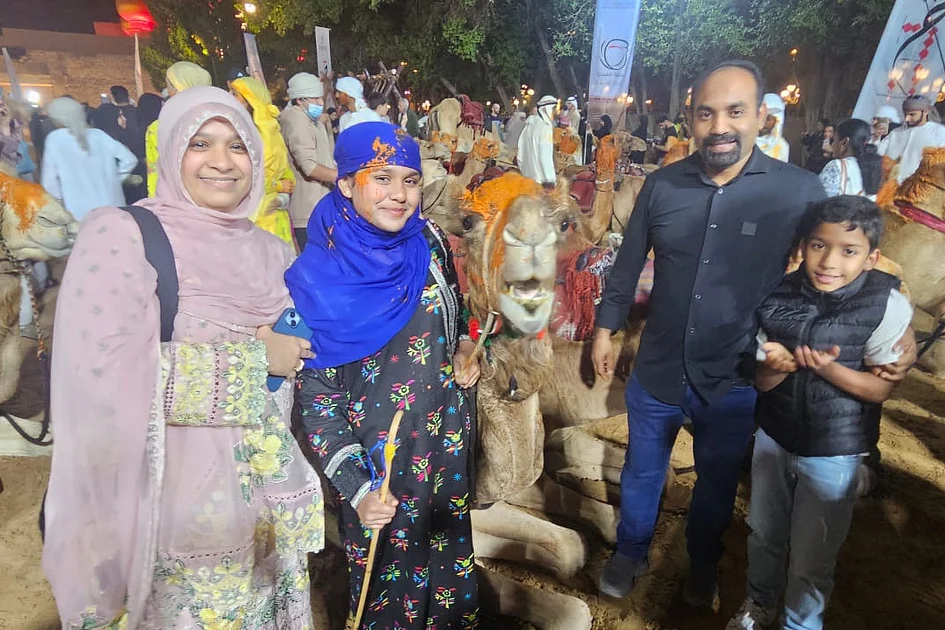
    In an extraordinary display of determination and familial legacy, 16-year-old Sarah Shajahan has successfully completed a grueling 600-kilometer camel trek across the United Arab Emirates desert, retracing the footsteps of her father’s journey from nearly a decade earlier. The adolescent adventurer transformed childhood bedtime stories into tangible reality during this winter’s demanding expedition.

    Sarah emerged as one of the youngest participants in this year’s camel caravan, joining dozens of seasoned trekkers navigating extensive desert routes. While some competitors undertook the full 1,000-kilometer challenge, Sarah conquered a significant 600-kilometer segment, enduring extended riding periods, frigid nighttime temperatures, and unpredictable harsh weather conditions.

    “This ambition grew organically from hearing my father’s experiences,” Sarah revealed. “Reaching participation age, I felt compelled to undertake this personal challenge.”

    Her father, Shajahan, who completed the same trek nine years prior, emphasized that Sarah’s motivation emerged independently. “There was no parental pressure whatsoever. She developed this inspiration naturally through exposure to my expedition photographs and regular riding excursions where I always included my children,” he noted, particularly praising her fearlessness around the majestic animals.

    Sarah’s journey to the desert began with formal applications and rigorous selection processes earlier this year. Training commenced in May, with September trials determining her qualification on the second attempt. During the actual trek, she bonded with a camel named Ataraiya, having trained with the animal four times during the week preceding the expedition.

    Despite meteorological challenges including unexpected sandstorms and rainfall that drenched equipment and disrupted sleep, Sarah maintained remarkable composure. “The experience proved less daunting than anticipated, largely due to my camel’s cooperative temperament,” she observed.

    Beyond physical achievement, her father contextualized the trek as profound life education. “This transcends mere hobbyism. It represents immersion in traditional desert living, connection with animals, and experiential understanding of ancestral travel methods,” he explained. “Participants engage with multinational companions and local Emiratis, experiencing ancient lifestyles that often evolve into spiritual journeys.”

    While Shajahan views his own prior completion as personal accomplishment, he perceives his daughter’s achievement differently: “For me, it represented closure. For Sarah, this signifies merely the commencement of her journey.”

    Notably, the teenager returned to normalcy without seeking social media validation, surprising her father given contemporary youth trends. The experience has ignited new aspirations, with Sarah expressing interest in future camel racing competitions. Nine years after witnessing her father’s return from the desert, the now-accomplished trekker has created her own legacy of quiet confidence and cultural connection.

  • Ramadan 2026 in UAE: Muslims prepare for holy month as Rajab begins

    Ramadan 2026 in UAE: Muslims prepare for holy month as Rajab begins

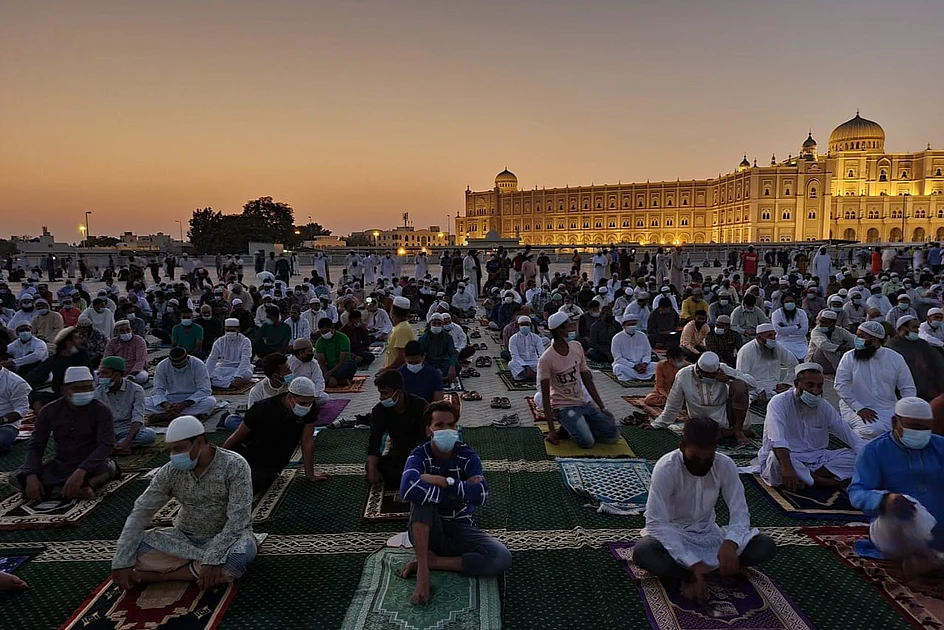
    As the sacred month of Rajab dawns across the United Arab Emirates, Muslim communities worldwide are initiating spiritual preparations for the approaching Ramadan season. Sheikh Nasser Al Hammadi of Sharjah Islamic Affairs delivered crucial guidance during a live Instagram lecture on Tuesday, emphasizing the significance of this preparatory period within the Islamic calendar.

    Sheikh Al Hammadi clarified that Rajab constitutes one of the four venerated months (Al-Ashhur Al-Hurum) in the Hijri calendar, alongside Dhul Qa’dah, Dhul Hijjah, and Muharram. These months hold distinctive spiritual status where righteous deeds yield amplified rewards and transgressions carry heightened consequences. The scholar described Rajab as an agricultural metaphor: “It resembles a farmer who commences by planting seeds, subsequently irrigating them, then nurturing the crop until harvest time” – representing spiritual groundwork for Sha’ban and ultimately Ramadan.

    Regarding worship practices, Sheikh Al Hammadi underscored that no exclusive rituals are designated for Rajab. Instead, Muslims should intensify general acts of devotion throughout the month while maintaining annual consistency. He referenced prophetic traditions indicating that even Muhammad (PBUH) never completed a full month of fasting outside Ramadan, and that Caliph Umar ibn Al-Khattab (RA) discouraged complete Rajab fasting to prevent resemblance to Ramadan.

    The Islamic authority issued specific cautions against introducing non-authenticated practices, particularly warning against innovations like Salat Al-Raghaib or specialized Umrah rituals exclusively for Rajab. He emphasized that worship foundations must derive exclusively from established Quranic principles and Sunnah teachings: “Muslims should not engage in any act of worship, add to it, or single it out, except based on what has been established in Islamic law.” This guidance aims to preserve religious authenticity while enabling meaningful spiritual preparation during Islam’s sacred months.

  • Xinjiang to introduce football classes across all schools

    Xinjiang to introduce football classes across all schools

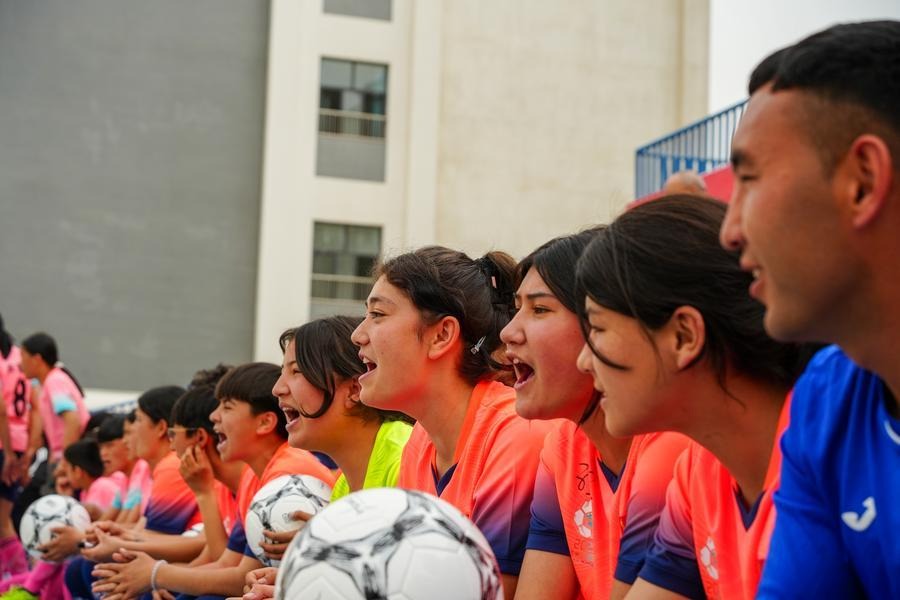
    Northwest China’s Xinjiang Uygur Autonomous Region has unveiled an ambitious educational initiative to integrate football into physical education curricula across all academic institutions. The comprehensive policy framework, developed through interdepartmental collaboration, aims to cultivate athletic talent while promoting sports participation among students.

    The strategic implementation plan establishes football-focused schools that will dedicate no less than one-third of physical education hours to football instruction and training. This institutional approach forms part of a broader vision to construct an integrated talent development pipeline connecting vocational schools, universities, football academies, and professional clubs.

    Xinjiang’s rich football heritage provides fertile ground for this expansion. With 4,595 football fields recorded by 2024, the region boasts one of China’s highest per capita rates of football infrastructure. The existing network of campus leagues will continue operations alongside newly expanded weekend competitions designed to increase regular student participation.

    Addressing historical challenges in coaching capacity, the initiative includes measures to enhance training protocols, improve recruitment strategies, and elevate compensation packages for football instructors. Educational institutions will expand specialized programs while actively recruiting retired professional players to bolster teaching ranks.

    The region has emerged as a significant talent source for Chinese football, producing national team players including striker Behram Abduweili and defender Umidjan Yusup. This new systematic approach to youth football development promises to strengthen both regional sports culture and China’s national football pipeline.

  • Fujian town produces over 1 billion slippers annually

    Fujian town produces over 1 billion slippers annually

    The modest town of Neikeng in Jinjiang, Fujian Province, has emerged as an unlikely global footwear powerhouse, manufacturing an astonishing 1 billion pairs of slippers annually. This remarkable output means approximately one in every eight people worldwide could be wearing slippers originating from this Chinese manufacturing hub.

    The town’s extraordinary journey began over four decades ago during China’s reform and opening-up period, starting from humble family-operated workshops. Through strategic development and industrial consolidation, Neikeng has transformed into a world-class manufacturing cluster with a fully integrated ecosystem encompassing research and development, production, supply chain management, and international trade operations.

    Today, Neikeng’s industrial landscape comprises more than 620 specialized slipper manufacturers, including 81 large-scale enterprises and 28 companies each generating annual revenues exceeding 100 million yuan ($14.2 million). The combined annual output value of the town’s slipper industry chain has surpassed 3 billion yuan, demonstrating significant economic impact and industrial concentration.

    Local authorities have actively promoted digital transformation within the traditional industry, facilitating e-commerce platform integration to expand market reach. This strategic approach has enabled Neikeng’s manufacturers to maintain competitive advantage while adapting to evolving global market demands and consumer preferences.

    The town’s success story exemplifies China’s manufacturing capabilities in transforming traditional industries through technological innovation, cluster development, and market-oriented reforms, positioning itself as a critical node in global footwear supply chains.

  • Thousands of wild white swans arrive in Shanxi for wintering

    Thousands of wild white swans arrive in Shanxi for wintering

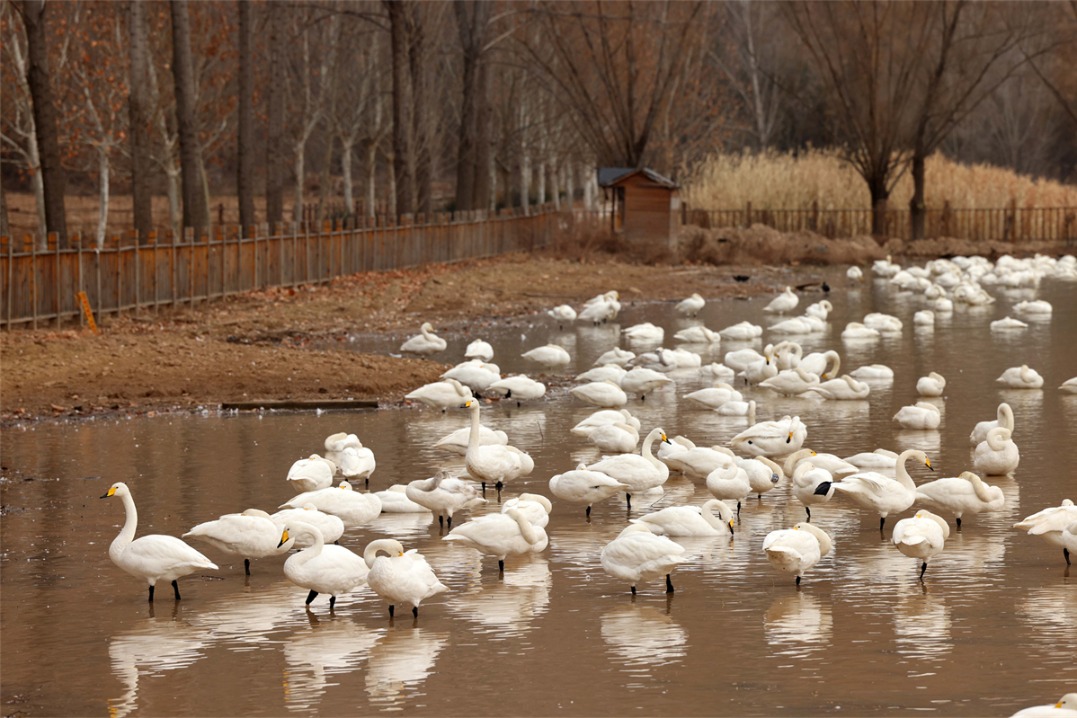
    The Yellow River wetlands in Pinglu county, Shanxi province, have transformed into a seasonal haven for an extraordinary natural spectacle as thousands of wild white swans complete their annual migration from Siberia. This massive avian gathering, occurring amidst dropping temperatures, marks one of China’s most significant wintering phenomena for these majestic birds.

    Strategically positioned at the provincial border between Shanxi and Henan, the Pinglu wetland ecosystem offers ideal winter conditions with its temperate microclimate and abundant nutritional resources. The area’s unique geographical attributes have established it as a crucial habitat for migratory swans seeking refuge from harsh northern winters.

    Local conservation authorities have implemented comprehensive measures to ensure the swans’ welfare during their extended stay. According to Wang Chao, a representative from the Pinglu County Forestry Bureau, the migration pattern typically begins in mid-to-late October, with populations remaining until March of the following year. “We’ve established substantial food reserves including Chinese cabbage and corn supplements,” Wang explained. “Additionally, we maintain continuous patrol operations with staff conducting 24-hour monitoring to protect these vulnerable migrants.”

    The swan population reaching approximately 10,000 annually reflects successful ecological preservation efforts in the region. Conservation initiatives have progressively enhanced the wetland environment, creating sustainable conditions that support this remarkable yearly migration. The growing numbers demonstrate how targeted environmental protection policies can positively impact wildlife preservation, offering a promising model for ecological balance between human activity and natural habitats.

  • Year-ender: China’s scientific achievements in 2025

    Year-ender: China’s scientific achievements in 2025

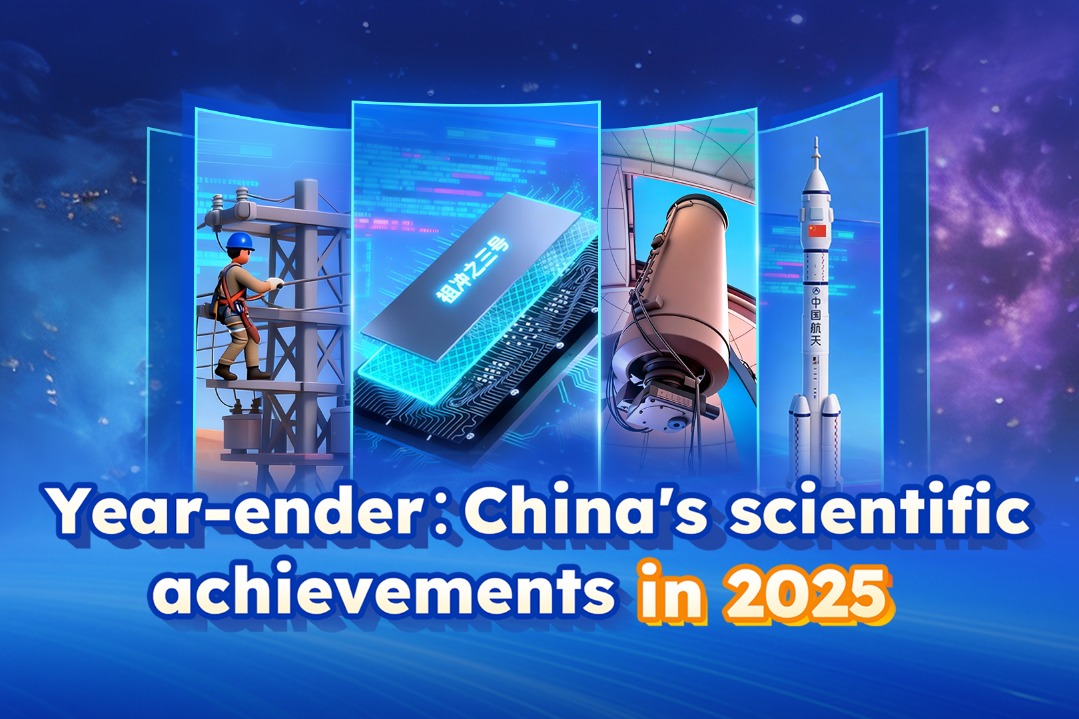
    China’s scientific landscape witnessed transformative breakthroughs throughout 2025, positioning the nation at the forefront of global technological advancement. The year’s achievements spanned multiple disciplines, demonstrating remarkable progress in both theoretical research and practical applications.

    In quantum technology, Chinese researchers achieved unprecedented computing stability, pushing the boundaries of qubit coherence and error correction. These developments have significant implications for cryptography, drug discovery, and complex system modeling. Parallel to these advances, China’s nuclear fusion program reached critical milestones, with experimental reactors sustaining plasma confinement for record durations, edging closer to viable commercial energy production.

    Space exploration efforts accelerated with multiple successful missions, including lunar sample-return operations and the deployment of next-generation orbital telescopes. The deep-sea exploration program simultaneously made groundbreaking discoveries, with manned submersibles documenting previously unknown marine ecosystems and geological formations at extreme depths.

    Interdisciplinary collaboration emerged as a defining characteristic of China’s 2025 scientific approach, with research institutions establishing unprecedented data-sharing protocols and international partnerships. The integration of artificial intelligence across research domains accelerated discovery timelines, particularly in materials science and biomedical engineering.

    These accomplishments reflect China’s strategic investment in research infrastructure and talent development, with particular emphasis on fostering young innovators and establishing world-class research facilities. The systematic approach to scientific advancement has created synergistic effects across industries, from renewable energy to telecommunications.