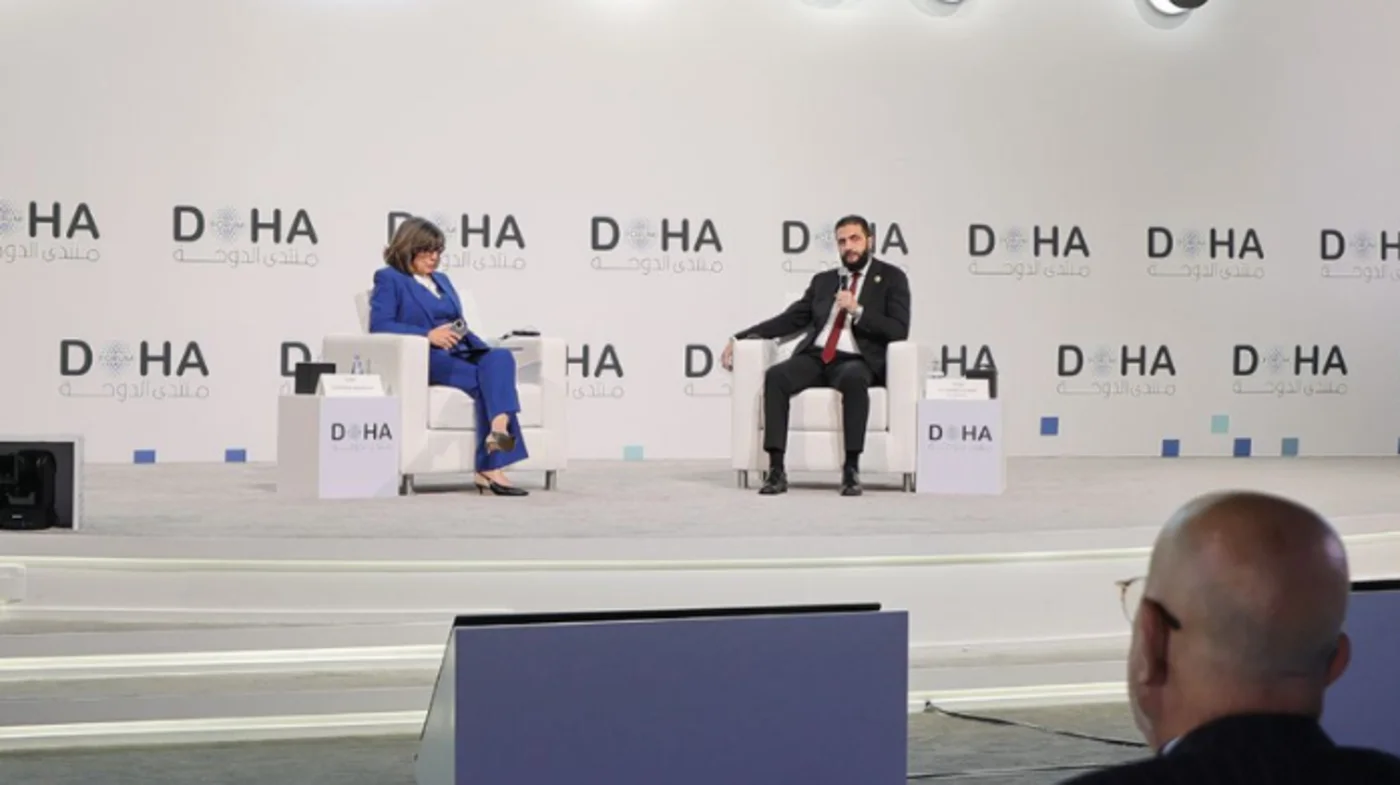
In a forceful address at the Doha Forum on Saturday, Syrian President Ahmed al-Sharaa launched a sharp critique against Israel, accusing the nation of deliberately exporting regional crises to obscure international focus on its military operations in Gaza. Speaking with CNN’s Christiane Amanpour, Sharaa characterized Israel as a state “in a fight against ghosts,” exploiting the October 7 attacks to justify an aggressive posture across the Middle East.
The Syrian leader detailed a stark contrast between his administration’s outreach and Israel’s response. Since assuming power in Damascus following the fall of the Assad dynasty in December 2024, Sharaa claimed to have sent positive messages advocating for regional peace and disavowing conflict exportation. However, he asserted that Israel reciprocated with “extreme violence,” citing over 1,000 airstrikes and 400 ground incursions into Syrian territory.
Sharaa reiterated calls for Israel to withdraw from territories seized during the recent conflict, including the strategic UN buffer zone on Mount Hermon. He confirmed that negotiations are currently underway with the United States to facilitate this withdrawal, while simultaneously expressing support for the foundational 1974 disengagement agreement. The president warned that tampering with this agreement or establishing alternative security arrangements like demilitarized zones could lead to dangerous instability, questioning who would protect such zones without Syrian forces.
Addressing Syria’s internal challenges, Sharaa acknowledged the deep sectarian divisions inherited from the Assad regime but emphasized his administration’s commitment to reconciliation and institutional rebuilding. He highlighted economic recovery as crucial for stability, specifically noting efforts to persuade Washington to lift Caesar Act sanctions originally imposed against the previous government. Despite ongoing difficulties, Sharaa portrayed Syria as on a “positive path toward stability and economic growth,” with governance based on competence rather than sectarian quotas.
The geopolitical context of these remarks was underscored by recent comments from U.S. President Donald Trump, who issued a veiled warning to Israel against interfering with Syria’s “evolution” following a deadly raid. Trump emphasized the importance of maintaining “strong and true dialogue” between the nations to support Syria’s transition to prosperity.