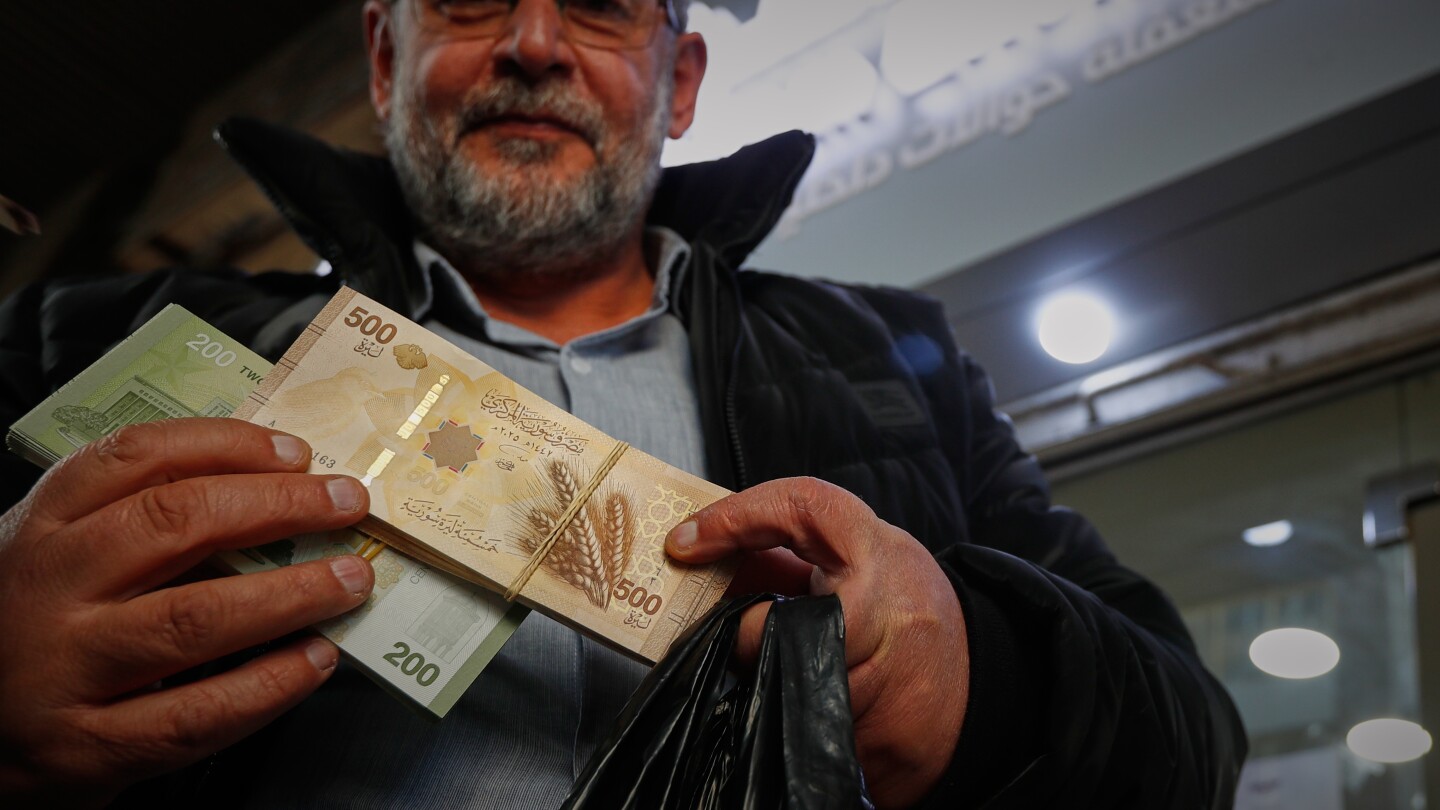
DAMASCUS, Syria — Syrian authorities initiated a comprehensive currency overhaul on Saturday, marking a pivotal step in the nation’s economic recovery strategy following the collapse of the Assad regime. The monetary reform involves the introduction of new banknotes while systematically withdrawing existing currency from circulation.
President Ahmad al-Sharaa’s administration issued an official decree earlier this week outlining the structured transition process. The central bank will oversee the gradual phase-out of old Syrian pounds through designated exchange centers according to a predetermined timetable.
Central Bank Governor Mokhles Nazer announced via social media platform X that the currency exchange operation commenced Saturday morning after months of meticulous preparation. The presidential decree, published by the state-run SANA news agency, specifies that the redenomination removes two zeros from nominal values, effectively making every 100 old Syrian pounds equivalent to one new pound.
This monetary restructuring significantly alters currency denominations. The previous highest-value note of 5,000 Syrian pounds has been replaced by a new 500-pound bill, representing a substantial reduction in numerical value while maintaining equivalent purchasing power.
Market observations revealed the U.S. dollar trading at approximately 11,800 old pounds in Damascus exchange shops on Saturday. Many of the outgoing banknotes feature images of former leader Bashar Assad and his father Hafez Assad, whose 54-year family rule ended when insurgent groups entered Damascus in December 2024.
The currency overhaul represents the latest effort by Syria’s new leadership to address an economy devastated by prolonged conflict and international sanctions. The economic deterioration is starkly illustrated by the currency’s collapse: at the conflict’s inception in March 2011, the U.S. dollar traded at just 47 Syrian pounds.
Recent months have seen significant diplomatic developments, with the United States and European Union removing most sanctions previously imposed during Assad’s administration, potentially facilitating economic recovery efforts.