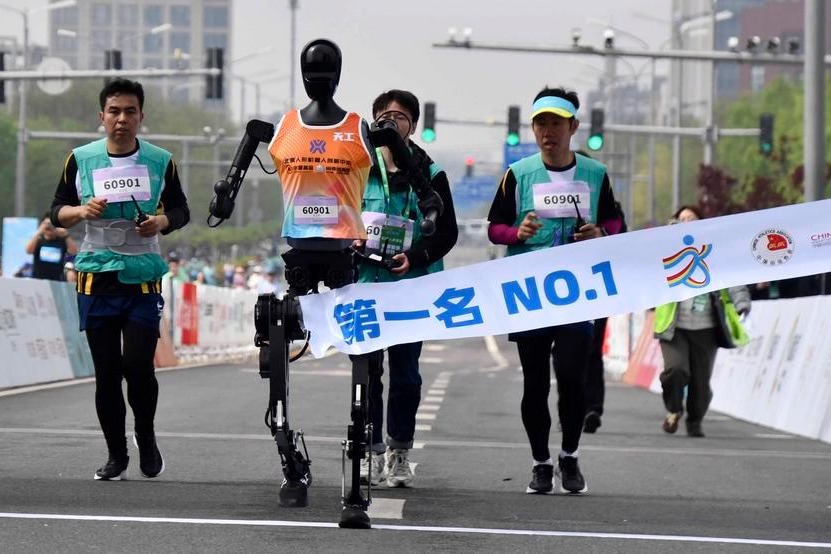
Beijing officials have announced significantly enhanced competition regulations for the second edition of the world’s pioneering humanoid robot half-marathon, scheduled for April 19, 2026. The event will return to the Beijing Economic-Technological Development Area (Beijing E-Town), where the inaugural race captivated a global audience of approximately 128 million viewers in April 2025.
The revised framework introduces stringent penalties designed to minimize human intervention during the competition. Teams will face substantial consequences for on-track battery replacements or robot substitutions, effectively forcing developers to prioritize endurance, reliability, and complete operational autonomy. This strategic shift aims to transform the event from a demonstration into a genuine testing ground for robotic capabilities under real-world conditions.
Liang Liang, Deputy Director of Beijing E-Town’s administrative committee, emphasized that ‘autonomy is no longer optional—it is the core goal of the competition.’ The organizers expect participants to demonstrate significantly longer battery life and substantially reduced reliance on human operators compared to the first edition, where several robots required assistance to complete the course.
The race will feature humanoid robots running alongside human athletes along a route beginning in a commercial district and concluding at Nanhaizi Park. Beyond the main event, Beijing E-Town will host two training camps in January and February 2026 to prepare teams for the heightened challenges.
Jiang Hongchao, Deputy Director of the Beijing Municipal Bureau of Economy and Information Technology, highlighted that humanoid robotics has emerged as one of Beijing’s fastest-growing technology sectors. The city continues to leverage real-world scenarios like the marathon to drive technological breakthroughs and industrial advancement.
Industry participants recognize the event’s growing significance. Cheng Hao, Founder and CEO of Booster Robotics—whose robots have excelled in international competitions—noted that public demonstrations are accelerating progress across the humanoid robotics industry, pushing developers toward more ambitious technological boundaries.