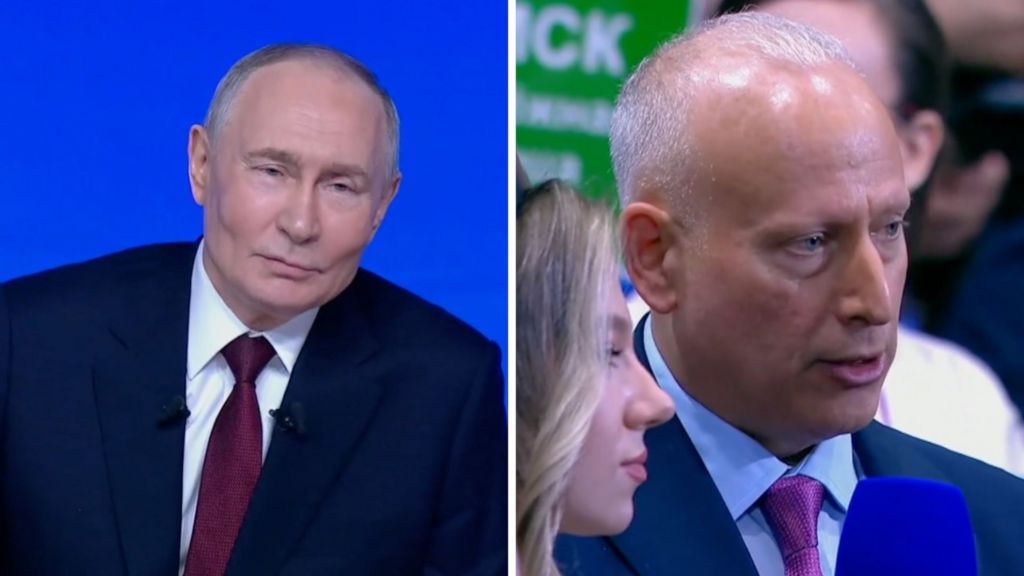
In a remarkable televised exchange during his annual press conference, Russian President Vladimir Putin engaged in a pointed dialogue with BBC correspondent Steve Rosenberg, delivering sharp criticisms of Western nations while extending a conditional offer to cease hostilities in Ukraine.
The confrontation began when Rosenberg challenged Putin about Russia’s future trajectory, questioning whether the current climate of repression—characterized by internet outages, persecution of dissidents under foreign agent laws, and military operations—would persist. While Rosenberg spoke, Putin was observed taking notes, preparing his response.
Putin vigorously defended Russia’s controversial foreign agent legislation, asserting that Western nations—particularly the United States with its 1930s-era Foreign Agents Registration Act—pioneered such measures. ‘We didn’t invent it,’ Putin stated. ‘These laws, including the US one, are much tougher.’ This comparison overlooks the draconian nature of Russia’s implementation, which effectively excludes designated individuals from public life, imposes severe financial restrictions, and can lead to criminal prosecution after a single administrative violation.
The conversation took an unexpected turn when moderators abruptly redirected discussion to the BBC’s legal challenges, including a multi-billion dollar lawsuit referenced by former US President Donald Trump. Putin aligned himself with Trump’s position, creating a rare moment of Kremlin-White House agreement regarding the British broadcaster.
Returning to Rosenberg’s initial question, Putin articulated his core grievance: years of Western deception regarding NATO expansion. ‘There won’t be new special military operations if you treat us with respect and respect our interests,’ Putin declared, adding that Western leaders ‘cheated us with NATO’s eastward expansion.’
The Russian leader expressed particular outrage over allegations that Moscow plans to attack Europe, dismissing them as ‘rubbish.’ Yet European leaders remain skeptical, citing Russia’s pattern of denial before the Ukraine invasion and recent violations of European airspace through fighter jets, drones, cyber-attacks, and sabotage.
In a significant closing statement, Putin extended an olive branch: ‘We’re ready to cease hostilities immediately provided that Russia’s medium- and long-term security is ensured.’ However, this offer remains contingent on Moscow’s maximalist security demands regarding Ukraine, which European leaders have consistently rejected.