A devastating season of climate-fueled wildfires is unfolding across Western Europe, bringing a mixed wave of cautious relief and fresh anxiety this week as evacuees in Spain begin returning to their homes while France braces for a new dangerous heatwave that threatens to reignite raging blazes.
Over the past seven days, neighboring Spain and France have faced some of the most destructive forest fire events in modern history. Vast swathes of woodland and populated areas have been reduced to ash, forcing more than 30,000 people to flee their properties to escape the advancing flames.
On Wednesday, Spanish authorities lifted all remaining evacuation orders for Avila province, marking a full step toward recovery one day after lifting similar orders for multiple districts in the Madrid surrounding region. For some returning residents, the moment was a quiet celebration: 70-something Maria Jesus Perez Blanca, one of a dozen residents who gathered at local cafes in the Madrid-western town of Aldea del Fresno on Wednesday morning, called the return home a joyous occasion, saying she had been counting down the minutes to enjoy her morning coffee and breakfast in her own space.
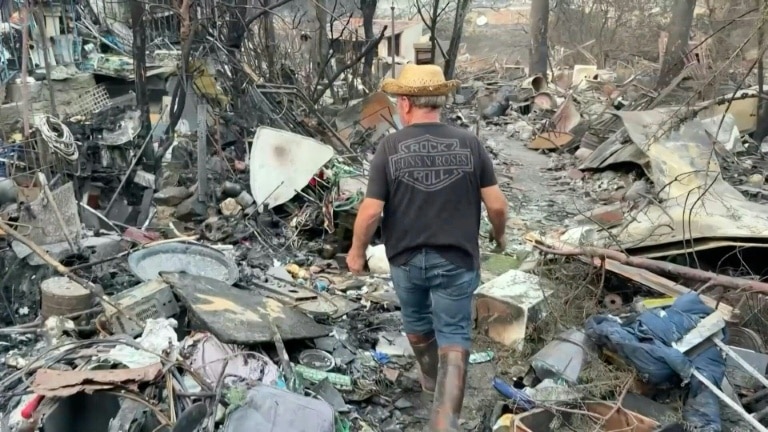
But just 12 kilometers away, in Pelayos de la Presa, the story was one of total loss. David Rodriguez was bulldozing the blackened, collapsed remains of the family home his father built four decades ago, which had been completely consumed by the fire. “It’s a disaster. Just look at it,” he told reporters. “All my memories, everything I worked for and owned was here. Everything is gone.”
Spanish officials credited cooler, wetter overnight conditions with allowing fire crews to fully stabilize the wildfire perimeter across most affected areas. Prime Minister Pedro Sanchez noted that the coming 24 hours would be “decisive” in the effort to fully extinguish all remaining hotspots and flare-ups.
Across the border in France’s Gironde region, the massive wildfire burning west of Bordeaux—one of the country’s most famous winemaking hubs—has also been held in check after a second consecutive calm night, bringing tentative optimism to emergency teams. Still, that optimism is tempered by the impending arrival of the country’s fourth major heatwave of an already record-hot summer, which is forecast to send temperatures soaring and worsen fire conditions.
Already, crews supported by volunteer civilians and water-bombing aircraft have been working around the clock to contain a new outbreak near the coastal resort town of Lanton, west of Bordeaux. For 67-year-old volunteer Jean-Claude Bonnet, the scale of destruction is unlike anything he has witnessed in his lifetime. “The worst part is seeing the animals that have been burnt to death by the side of the road,” he said.
The volatile conditions have already forced crews to repeatedly re-attack contained areas: shortly after water-bombing planes departed the Lanton fire line, a gust of superheated wind carried stinging hot ash off burning pine trees, whipping the flames back to life and forcing emergency teams to resume their containment work.
Forecasts predict temperatures will reach 41°C across parts of Gironde and the southern Landes region, and fire officials warn that strengthening winds could stir dormant embers and trigger new large-scale flare-ups of the main Bordeaux-area blaze. Even with these risks, authorities announced that 57,000 residents evacuated from three towns near Bordeaux would be allowed to return to their homes starting this week, five days after they were forced to leave.
Regional fire services report they are nearing completion of a 127-kilometer firebreak to contain the Gironde blaze, a massive effort that has been supported by a surge of civilian volunteer support across the region. Firefighting Captain Wilfried Schneider highlighted the wave of public solidarity that has emerged amid the crisis, saying: “We’re seeing this outpouring of solidarity — you can see it at the water points, you can see it at our command posts, where we have more to eat and drink than we could possibly need.”
This wildfire crisis is not limited to Spain and France: it is part of a continent-wide disaster driven by human-caused climate change, scientists confirm. A string of record-breaking heatwaves combined with a widespread, severe drought across Europe have turned normally green vegetation into dry tinder, after unusually wet spring weather that created extra vegetation growth that is now fully parched.
Data from the European Forest Fire Information System shows that Spain has already seen 207,000 hectares of land burn between January and July 2023—one of the largest five-month totals recorded in the country’s modern history. For France, the toll is even more unprecedented: roughly 92,000 hectares have burned over the same period, the largest total recorded in 20 years of official record-keeping.
While Western Europe is currently the epicenter of the crisis, the European Union warned this week that fire-friendly conditions are expected to spread toward Central Europe over the coming days. Emergency crews are already battling new blazes across southern Europe: a large fire is active on the Greek island of Paros, and three firefighters have already died battling blazes in Crete and near the Peloponnese port of Gytheio. In southern Turkey, wildfires near popular tourist beach destinations have forced hundreds of people to evacuate, with hundreds of firefighters working to contain the spread.