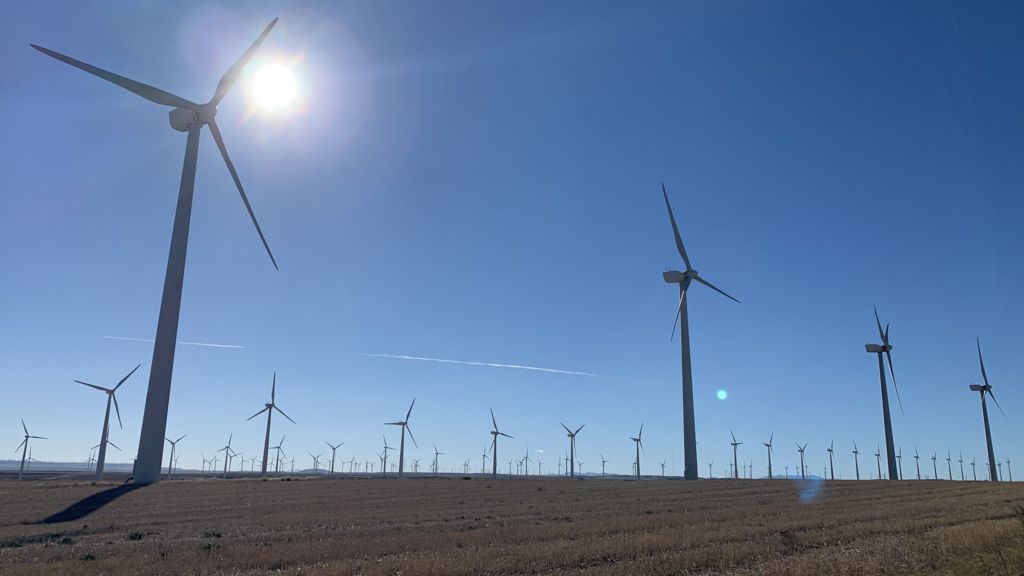
In the windswept plains of Aragón, northeastern Spain, the sleepy town of Figueruelas has emerged as an emblematic symbol of the nation’s ambitious renewable energy transition. Towering wind turbines cast their shadows over the landscape, representing Spain’s remarkable achievement: over 57% of electricity now generated from wind and solar sources, nearly doubling the 2017 figure of just one-third.
The region’s renewable abundance has attracted massive international investment, most notably a joint €4 billion venture between Chinese battery giant CATL and Dutch automaker Stellantis to construct a major electric vehicle battery manufacturing facility. Chinese Ambassador Yao Jing characterized this project as “one of the biggest Chinese investments Europe has ever seen.”
Figueruelas Mayor Luis Bertol Moreno explains the strategic logic: “We’re in Aragón, where there’s wind all year round, there are lots of hours of sunshine, and we are surrounded by wind turbines and solar panels. Those energy sources will be crucial in generating electricity for the new factory.”
However, Spain’s renewable energy model faces intense scrutiny following a significant blackout on April 28th that left millions without power across Spain and Portugal for several hours. The incident ignited fierce political debate, with conservative opposition leader Alberto Núñez Feijóo accusing the government of “fanaticism” in pursuing its green agenda and suggesting over-reliance on renewables might have caused the outage.
National grid operator Red Eléctrica vehemently denies this connection. Concha Sánchez, head of operations, stated: “We have operated the system with higher renewable rates previously with no effect on the security of the system. Definitely it’s not a question of the rate of renewables at that moment.” She attributed the blackout to a combination of factors, including anomalous voltage oscillations from an “unknown event” in the system moments before the collapse.
The incident has intensified discussion about Spain’s planned nuclear plant closures between 2027 and 2035, which would make the country an outlier in Europe where nuclear energy is experiencing a renaissance. Ignacio Araluce, president of industry association Foro Nuclear, argues that “It’s prudent to have a mix of renewables and nuclear energy” to ensure stability when weather conditions don’t favor solar or wind generation.
Spain’s political landscape adds further uncertainty to its energy future. The Socialist-led coalition, which championed the aggressive renewable transition, has seen its parliamentary majority collapse amid corruption scandals, raising possibility of snap elections. Polls suggest a right-wing government would likely place less emphasis on renewables and advocate returning to more traditional energy sources.
Despite these challenges, Spain continues its green transition with a target of 81% renewable electricity by 2030. For communities like Figueruelas, this means not just clean energy but economic revitalization—the town of 1,000 expects an influx of 2,000 Chinese workers for the battery factory construction and up to 35,000 indirect jobs once operational.
As local resident Manuel Martín observes: “These kinds of investments revitalize the area, they revitalize the construction sector, hostelry. And the energy is free—it just depends on the sun and the wind.”