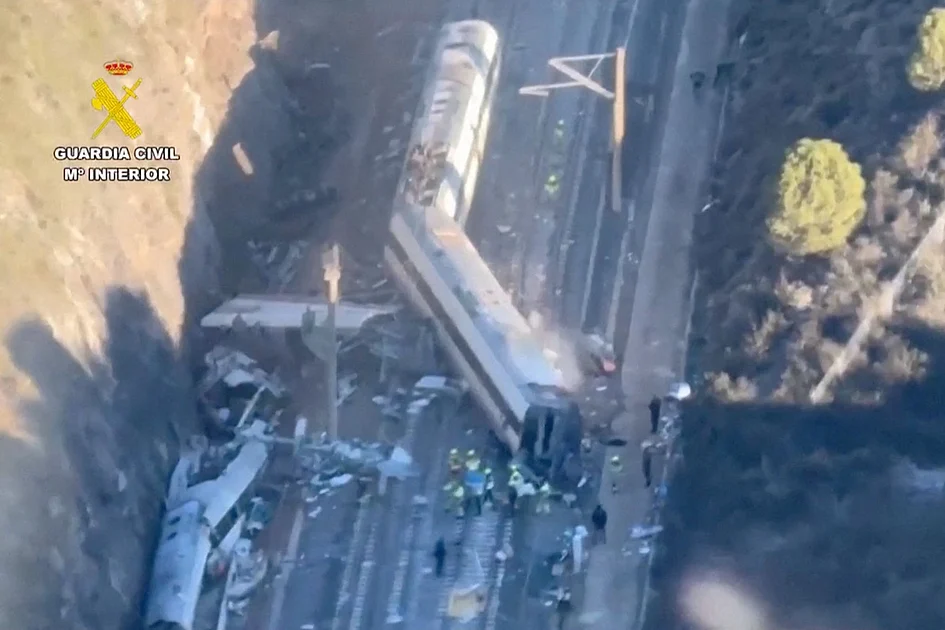
Spain has initiated three days of national mourning following the country’s most devastating rail disaster in over a decade. The catastrophic collision between two high-speed trains near Adamuz in southern Andalusia has resulted in 40 confirmed fatalities, with the death toll potentially rising as rescue operations continue.
The tragedy occurred Sunday evening when an Iryo-operated train traveling from Malaga to Madrid inexplicably derailed and crossed onto adjacent tracks, colliding with an oncoming Renfe service headed to Huelva. The impact caused both trains to derail in a devastating chain of events that rescue officials describe as one of the most complex emergency responses in recent Spanish history.
Prime Minister Pedro Sanchez, who visited the crash site Monday, characterized the event as “a day of sorrow for all of Spain” while promising absolute transparency in the investigation. Emergency crews utilizing heavy machinery worked through the night to lift severely damaged carriages and access trapped victims.
Current figures indicate over 120 injured persons, with 41 remaining hospitalized in Córdoba medical facilities. Distressed relatives have turned to social media platforms to locate missing passengers, sharing photographs and personal details in desperate attempts to find loved ones.
Investigative authorities have described the accident as “extremely strange” given several mitigating factors. Unlike the 2013 Santiago de Compostela disaster that claimed 80 lives, this derailment occurred on a straight section of recently renovated track with both trains operating within legal speed limits. The involved Iryo locomotive was manufactured in 2022 and underwent inspection just three days prior to the accident.
Transport Minister Óscar Puente confirmed that human error and excessive speed have been largely ruled out as causative factors. Renfe President Álvaro Fernández Heredia suggested the investigation should focus on either Iryo’s rolling stock or infrastructure anomalies, noting both trains were traveling approximately 200 km/h—well below the 250 km/h limit for that section.
Survivor accounts depict scenes of horror and chaos. Passenger Lucas Meriako described the impact as “a very strong hit from behind” that created the sensation “the whole train was about to collapse,” with numerous injuries resulting from shattered glass throughout the carriages.
The tragedy has mobilized international response, with condolences offered by Pope Leo XIV and French President Emmanuel Macron. Local residents of Adamuz immediately organized relief efforts, delivering water, blankets, and essential supplies to emergency crews working at the disaster site.
Spain maintains Europe’s most extensive high-speed rail network, with over 3,000 kilometers of dedicated tracks connecting major urban centers. This incident represents the most significant safety challenge to the system’s otherwise exemplary safety record, prompting nationwide scrutiny of rail infrastructure and operational protocols.