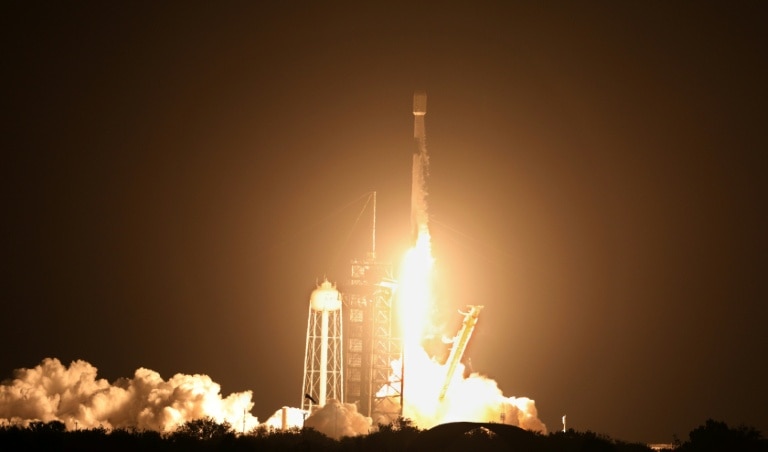
An unplanned collision between the discarded upper stage of a SpaceX Falcon 9 rocket and the lunar surface is set to take place this week, an event that carries no risk to life or infrastructure on Earth but promises to deliver valuable new insights for lunar research. The 4,000-kilogram booster section, left adrift in space after launching a mission carrying two lunar landers in January 2022, is on track to strike the Moon’s northern hemisphere near the iconic Einstein Crater at roughly 06:35 GMT on Wednesday, hurtling toward the surface at 8,690 kilometers per hour. Once impact occurs, researchers expect a bright, sunlit plume of dust, rubble and ejecta to burst outward from the crash site — a phenomenon that both professional scientists and amateur astronomers around the world are being encouraged to observe and document. Benjamin Fernando, a researcher at Los Alamos National Laboratory in New Mexico and lead author of a recent pre-print paper analyzing the upcoming impact, notes that the brightness of the ejecta plume remains unpredictable, which makes this unplanned event all the more valuable for the research community. “It might be possible for folks with a telescope to observe the plume of ejecta created by the impact,” Fernando told Agence France-Presse. “It is unclear how bright it will be, which is one of the reasons why we are looking to study this event.” The crash will leave a new, permanent crater on the lunar surface, and NASA has confirmed it will track the rocket body through its final approach for training purposes, then study the impact site after the collision to advance scientific understanding of lunar dynamics. In an official statement, NASA spokesperson Jimi Russell emphasized, “There is no danger to Earth.” SpaceX’s director of NASA Science and Dragon Programs, Julianna Scheiman, explained at a Monday press briefing that standard protocol is followed for all high-energy deep space missions to dispose of second stages in compliance with global space regulations. “We did that,” Scheiman said, confirming that the planned disposal maneuver was executed correctly. However, “what has happened is essentially a mixture of solar activity and gravity forces have put it on a path towards the Moon.” Like many researchers and space enthusiasts, Scheiman added that she is eager to see observations of the rare event. The research team behind the pre-print paper notes that the unplanned impact offers a rare chance to test core systems for future lunar exploration. The event will help scientists refine their methods for locating impact craters on the lunar surface, which will support upcoming planned lunar seismic experiments. It also offers an unmatched opportunity to study how dust and ejecta behave during high-velocity impact events on the Moon, and to improve assessments of the hazard artificial space debris poses to future lunar infrastructure. With NASA targeting the late 2020s to establish a long-term sustained human presence on the Moon through its Artemis program, understanding the distribution and behavior of artificial debris in lunar orbit has become a critical priority for space agencies worldwide. While the Moon is constantly impacted by natural space debris such as meteoroids, collisions with large artificial objects are far less common. The last major intentional artificial impacts were carried out by NASA decades ago during the Apollo program, when the space agency deliberately crashed mission stages into the Moon to collect seismic data from the Apollo seismometers left on the surface. Unlike those planned tests, this unplanned event gives the modern research community a chance to study an impact with current observational technology, filling gaps in knowledge that will support the next generation of lunar exploration.