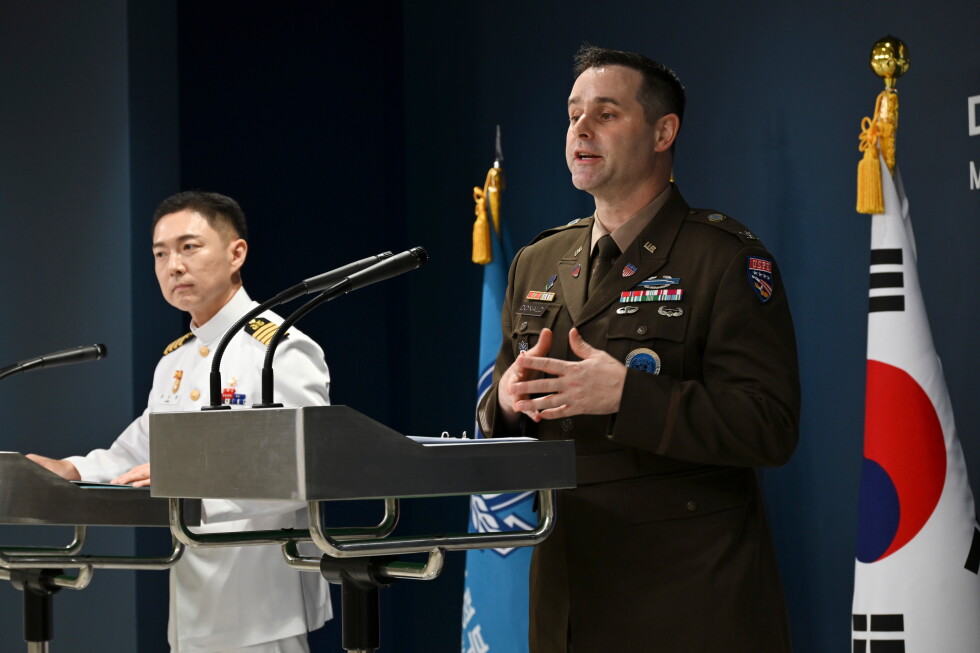
Tensions on the Korean Peninsula have risen again after North Korea resumed banned ballistic missile testing earlier this month, prompting the United States and South Korea to confirm they will move forward with their annual joint military exercise, Ulchi Freedom Shield, starting next Monday.
The 11-day drills will maintain a similar scope to previous iterations, with roughly 18,000 South Korean service members set to participate, according to South Korean military spokesperson Jang Do-young. Officials from both allies frame the exercise as a defensive measure designed to sharpen coordinated response capabilities against growing threats from Pyongyang.
In a joint press briefing Monday, U.S. military spokesperson Ryan Donald explained that this year’s training has been updated to integrate real-world threat insights pulled from recent global conflicts, most notably the war in Ukraine. Donald highlighted that North Korea, officially the Democratic People’s Republic of Korea (DPRK), has deployed troops to support Russia’s military campaign in Ukraine, allowing DPRK forces to gain frontline combat experience that they have brought back to their home country.
“That changes the DPRK capability and our training accounts for that threat,” Donald told reporters. He added that the exercise will focus on combined, joint, all-domain operations to further solidify the bilateral alliance’s combat readiness and collective defense capabilities. The drills will include a mix of live-fire drills, virtual simulation, constructive training scenarios and field-based operational exercises, making it one of the two major annual joint military exercises held by the U.S. and South Korea, alongside a separate springtime training series.
The announcement comes just four days after South Korea, the U.S. and Japan detected North Korea’s first short-range ballistic missile launch since late June. The missile landed in waters off North Korea’s east coast, drawing immediate condemnation from Seoul, Tokyo and Washington, as the test violates multiple long-standing United Nations Security Council resolutions that ban all North Korean ballistic missile activities. The U.S. Pacific Command reaffirmed its unwavering commitment to defending the U.S. homeland and its regional allies following the launch.
Pyongyang had not issued an immediate public response to the scheduled drills as of Monday. In the past, North Korea has consistently characterized large-scale U.S.-South Korean joint exercises as preparation for an invasion of the DPRK, and has responded to previous drills with aggressive rhetoric and a series of provocative weapons tests. U.S. and South Korean officials have repeatedly stressed that their joint military activities are strictly defensive in nature.
Since the collapse of high-stakes denuclearization diplomacy between North Korean leader Kim Jong Un and former U.S. President Donald Trump in 2019, Pyongyang has accelerated efforts to expand its nuclear and missile arsenals. Many regional security experts believe Kim is pursuing a larger, more advanced weapons stockpile to strengthen his negotiating position and secure greater concessions from Washington in any future diplomatic talks.
North Korea’s deployment of troops and supply of ammunition to Russia for the war in Ukraine has sparked widespread concern among Western and regional powers. Analysts warn that Russia could reciprocate North Korea’s support by sharing sensitive military technologies that would significantly advance Pyongyang’s nuclear and ballistic missile programs. Beyond potential technology transfers, experts also note that North Korea’s troop deployment has already given the country’s military invaluable direct battlefield experience that can be used to refine its own tactical and strategic capabilities.