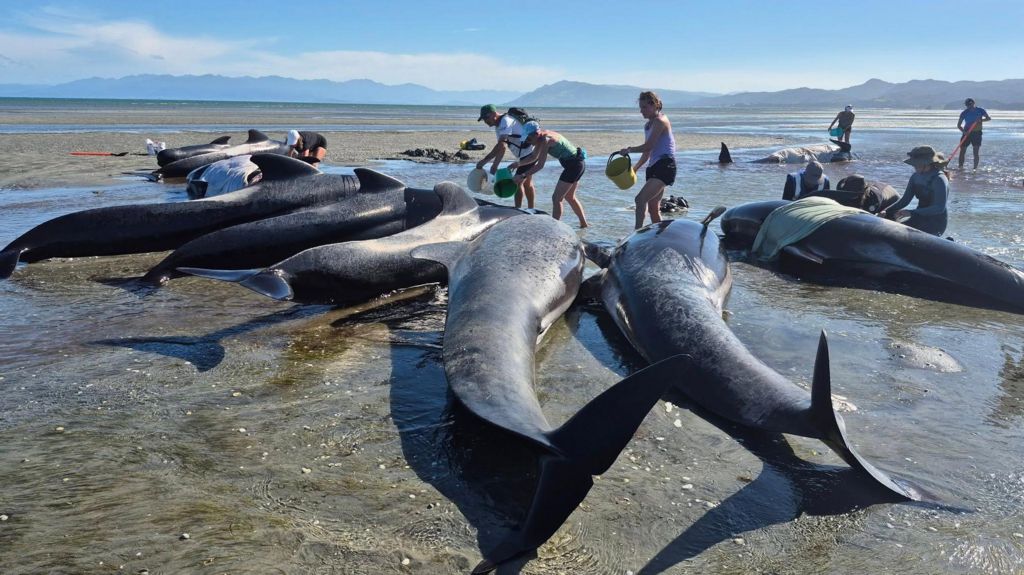
A critical rescue operation is underway on New Zealand’s remote Farewell Spit following a mass whale stranding that has left six pilot whales dead and 15 others fighting for survival. The dramatic event began Thursday when approximately 55 marine mammals washed ashore on the South Island’s northernmost coastline.
While most of the initially stranded whales managed to return to sea during high tide, a group of 15 individuals became restranded along a kilometer-long stretch of beach. Conservation organization Project Jonah has mobilized teams of volunteers who are working against the clock to keep the surviving whales hydrated and cool through constant water application.
Louisa Hawkes of Project Jonah emphasized the urgency of the situation: ‘When the tide comes in, we’re going to have to move really quickly to bring these whales together, then move them out to deeper waters.’ The rescue strategy focuses on leveraging pilot whales’ highly social nature by forming them into a tight-knit group to encourage collective swimming back to safety.
New Zealand’s Department of Conservation has deployed additional resources including rangers, marine vessels, and drone technology to monitor the area for further strandings. Farewell Spit is notoriously known as a natural ‘whale trap’ due to its gently sloping tidal flats and rapidly receding waters that frequently disorient marine mammals following their migratory routes.
This location has witnessed numerous mass strandings throughout history, most notably in February 2017 when over 400 pilot whales beached themselves in what became New Zealand’s largest recorded stranding event in a century. The current operation represents another chapter in the ongoing challenge of marine mammal conservation in this geographically vulnerable region.