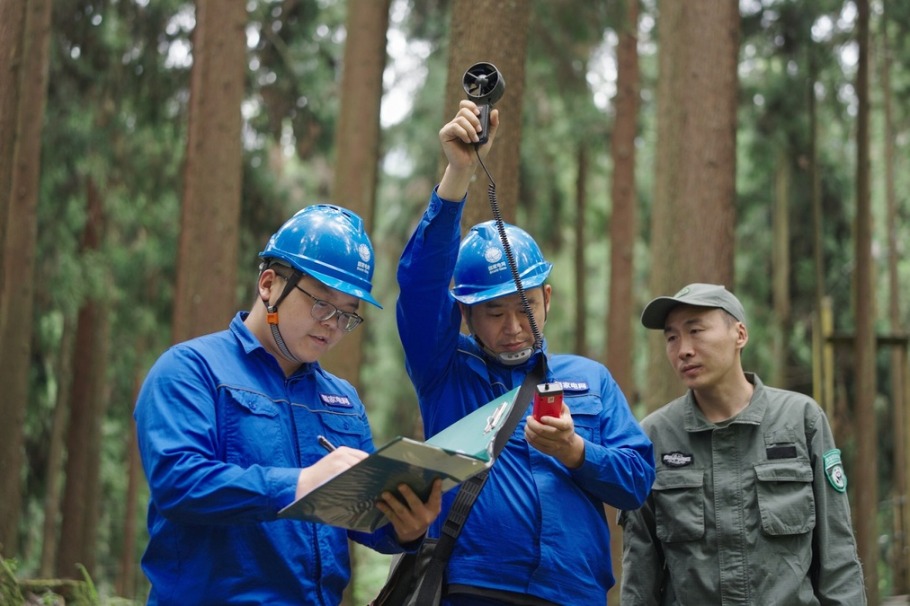
Nestled within the bounds of China’s Giant Panda National Park, the Ya’an region of Sichuan province has emerged as a global stronghold for wild giant pandas, and a groundbreaking infrastructure upgrade is now safeguarding both the endangered animals and their critical habitat. Local power sector officials announced this Wednesday that years of targeted, environmentally conscious modifications to power transmission networks have eliminated once-common threats including wildlife electrocution, habitat fragmentation, and vegetation-triggered wildfires in key panda habitats.
As one of China’s five pioneering national parks, Giant Panda National Park spans vast swathes of southwestern China, with the Ya’an section covering 5,936 square kilometers — 27 percent of the protected area’s total size. This region is uniquely important to giant panda conservation: it is home to 340 wild giant pandas, boasting the highest population density of the vulnerable species anywhere on the planet. For decades, aging overhead power lines posed hidden risks to both wildlife and the ecosystem: uninsulated lines could electrocute wandering animals, while encroaching bamboo and tree growth near lines raised persistent wildfire risks that threatened both panda habitats and local communities.
To address these hazards, the Ya’an branch of State Grid Sichuan Electric Power Co has led a systematic retrofitting project focused on balancing human energy needs with wildlife protection. To date, the utility has completed upgrades on three separate 10-kilovolt power lines stretching a combined total of nearly 2.8 kilometers across core protected zones within the park. Beyond adding protective insulation to eliminate electrocution risks, the project has also integrated cutting-edge intelligent monitoring infrastructure along all upgraded routes. These connected systems allow grid workers to track potential hazards in real time, from vegetation overgrowth to equipment faults, ensuring consistent, reliable power access for local residents and economic development while minimizing human disturbance to the fragile panda ecosystem. Since the completion of the first phase of upgrades, no safety or environmental incidents linked to the power infrastructure have been recorded, marking a major success for coexistence between energy infrastructure and biodiversity conservation.