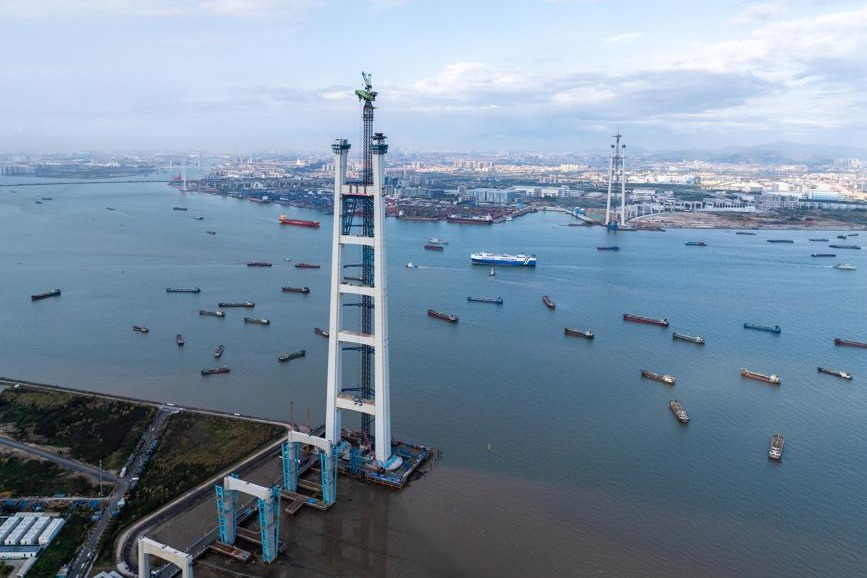
China’s ambitious Shiziyang Bridge project has reached a critical construction milestone with the completion of its twin 342-meter main towers, marking significant advancement in the infrastructure development of the Guangdong-Hong Kong-Macao Greater Bay Area. This engineering marvel forms the centerpiece of the 35-kilometer Shiziyang Link, strategically connecting Guangzhou’s Nansha district with Dongguan’s Shatian and Humen townships across the Pearl River estuary.
The bridge represents a paradigm shift in suspension bridge technology, incorporating groundbreaking innovations that address complex challenges including dense waterways and limited cross-river passage resources. Its revolutionary design features a double-deck configuration accommodating 16 traffic lanes and a record-setting 2,180-meter main span that clears the river in a single leap.
Engineering breakthroughs extend to the tower construction, where developers implemented a novel steel plate-concrete composite structure that reduces wall thickness by 50% and decreases concrete usage by 43% compared to conventional designs. This innovation alone reduces carbon dioxide emissions by approximately 53,000 tons while significantly enhancing structural stability under the immense pressure of over 200,000 metric tons.
The project has pioneered large-scale application of C80 high-strength concrete, capable of withstanding 8,000 tons of pressure per square meter. Construction teams overcame substantial technical challenges, including managing hydration heat effects during massive pours exceeding 300 cubic meters. Through extensive research, engineers developed an advanced air-cooled aggregate system and intelligent pouring platform featuring automated temperature measurement, flow adjustment, and precision vibration positioning.
According to project officials, the Shiziyang Bridge is poised to establish five world records for double-deck suspension bridges upon completion, spanning main span length, lane capacity, tower height, anchor diameter, and main cable dimensions. The project has generated comprehensive technological standards for ultra-long-span suspension bridges, significantly advancing China’s capabilities in mega-infrastructure development.
With tower construction completed, the project now advances to the superstructure phase, with cable saddle installation and catwalk construction preparations underway. Project planners anticipate implementing the pilot cable crossing operation during the latter half of this year.