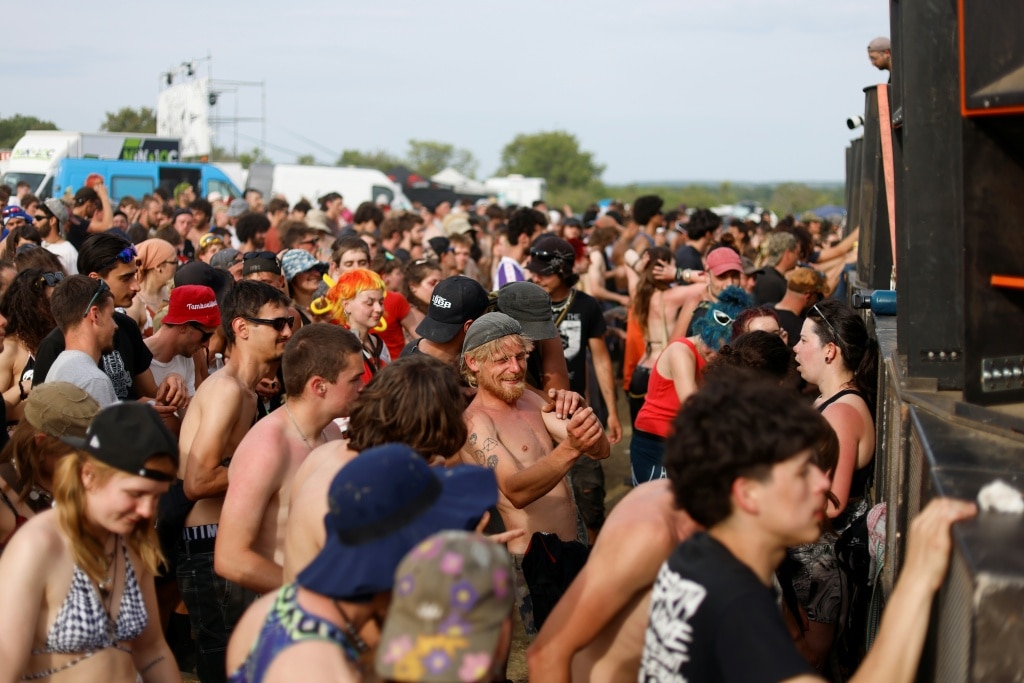
A massive unauthorized rave that drew tens of thousands of partygoers to a former French military firing range has sparked public safety outrage after officials confirmed a second unexploded World War II-era shell was discovered at the site, just one day after the first dangerous ordnance prompted an emergency bomb disposal response.
The unsanctioned gathering, commonly called a “free party” by organizers, launched Friday on the 10,000-hectare decommissioned firing range located near the central French town of Bourges, roughly 120 miles south of Paris. The rave was coordinated via encrypted messaging platforms, allowing crowds to converge quickly before authorities could block access, with conflicting estimates of attendance: organizers claim up to 40,000 people traveled to the site from France and nearby neighboring countries, while French Interior Minister Laurent Nunez pegs the total number at 17,000.
Local authorities had explicitly warned the crowd that holding a dance event on the former military site was an extreme safety risk, as the ground still holds unaccounted-for unexploded ordnance dating back to World War II. Despite repeated warnings, partygoers entered the site anyway. On Saturday evening, bomb disposal squads were called to the location after the first unexploded shell was unearthed near a main road cutting through the party grounds.
After conducting an aerial inspection of the site via helicopter Sunday, Nunez confirmed to reporters that a second unexploded shell had been located and that disposal experts were working to neutralize the new threat. “When the prefect warned that this was dangerous land, it was not a joke,” the minister emphasized.
In a surprising twist, organizers have openly acknowledged they deliberately selected this specific firing range—located in Nunez’s own hometown—to stage the protest against a pending national bill that would dramatically increase criminal penalties for people who organize and participate in unauthorized free parties.
Organizers have claimed the event has proceeded without major disruptions or safety incidents, but Nunez refuted this account. He told reporters that 12 attendees have already been transported to local hospitals, multiple for drug-related complications, and five participants have been taken into police custody. Authorities have so far issued more than 600 fines for trespassing on military land and participating in an illegal gathering.
Once a little-known underground tradition, illegal raves have become a growing issue for French law enforcement. Nunez reported that officials recorded 337 unauthorized music events across the country in 2025. Most of these gatherings draw around 300 attendees, but roughly four percent attract crowds of more than 1,000, creating major public safety and logistics challenges for local communities.
The gathering has already hardened the government’s commitment to passing stricter penalties for illegal rave organizers and participants. Back in April, France’s lower parliamentary house approved a draft bill that would impose up to six months of prison time for anyone directly or indirectly involved in organizing or facilitating unauthorised raves. The legislation’s broad definition of organizing extends even to sharing logistical information about planned events online. Nunez argued that current penalties are far too lenient, classifying violations as minor offenses that do little to deter organizers.
By early Sunday afternoon, an AFP journalist on the ground observed that many performance stages had been cleared out and a large portion of attendees had begun departing the site. The incident has reignited national debate over balancing personal recreation freedoms with public safety, and is expected to speed up passage of the stricter rave regulation legislation.