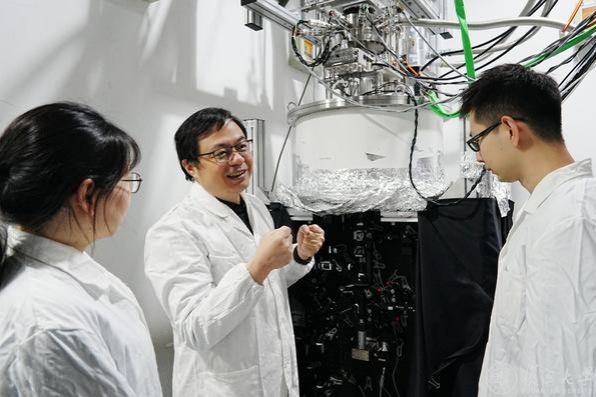
Researchers at Shanghai’s Fudan University have achieved a transformative breakthrough in semiconductor technology that could revolutionize computing performance and energy efficiency. The pioneering study, conducted by the State Key Laboratory of Surface Physics and published in the prestigious journal Nature, successfully bridges the critical gap between theoretical potential and practical application of antiferromagnetic materials—a challenge that has perplexed scientists for decades.
Traditional computing devices predominantly utilize ferromagnetic materials for data storage, encoding information through magnetization directions that represent binary data. However, these conventional materials face significant limitations including vulnerability to magnetic interference, restricted data density capacity, slower operational speeds, and higher power consumption—constraints that have become increasingly problematic as the semiconductor industry pursues more compact and efficient devices.
Antiferromagnetic materials present a revolutionary alternative with their unique atomic structure where adjacent magnetic moments oppose each other, effectively neutralizing stray magnetic fields. This intrinsic property enables superior stability, enhanced data packing density, and dramatically faster switching capabilities compared to conventional ferromagnetic materials.
The research team’s groundbreaking discovery identified that specific low-dimensional, layered antiferromagnets—particularly chromium thiophosphate (CrPS4)—can be reliably controlled using external magnetic fields. This manipulation allows predictable switching between two stable magnetic states, mirroring the functionality of current ferromagnetic materials while overcoming their limitations.
Professor Wu Shiwei, co-corresponding author of the study, explained: ‘We have developed both the methodology to precisely control these magnetic states and the specialized magneto-optical microscopy technology to directly observe them. This dual capability fulfills the fundamental requirements for practical data reading and writing applications.’
The research establishes clear criteria for identifying optimal antiferromagnetic materials, providing engineers and scientists with a practical framework for developing next-generation semiconductor devices. Industry analysts note this advancement could significantly influence global semiconductor competition, potentially accelerating China’s progress in advanced chip technologies amid ongoing international efforts to enhance computing capabilities while reducing energy consumption.