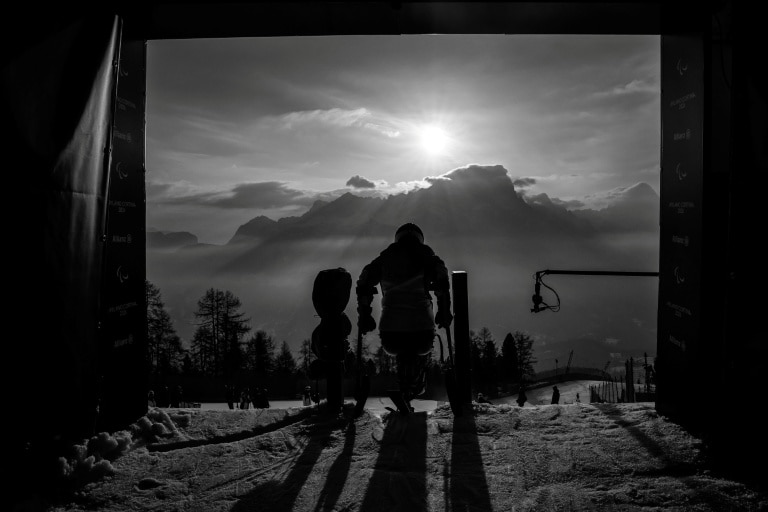
MILAN-CORTINA – Athletes competing in the Paralympic alpine skiing events are demonstrating extraordinary courage as they navigate treacherous slopes at speeds exceeding 100 kilometers per hour, despite physical impairments including limb differences and visual disabilities. The competition, divided into three classifications—visually impaired, standing, and sitting—showcases remarkable athleticism and mental fortitude.
Visually impaired skiers rely on guides and radio communication to navigate the course, with some wearing blacked-out goggles to ensure fair competition. Meanwhile, many competitors in standing and sitting categories ski with one or more limbs absent. The downhill event, renowned for its extreme velocity, presents a unique set of psychological and physical challenges.
American skier Meg Gustafson, 16, who is classified as AS4 due to her limited vision, described the sensation of racing as akin to ‘flying.’ Before each run, she admits, ‘I say a little prayer and then I send it.’ Her teammate, Allie Johnson, 31, acknowledged the fear involved, stating, ‘Being scared and doing things scared—that’s what it is to me.’
Even seasoned athletes are not immune to mishaps. American sitting skier Anna Soens experienced a crash during her Paralympic debut, later quipping that the lesson was to ‘land straighter.’ Swedish gold medalist Ebba Aarsjoe emphasized the razor-thin margin for error, noting that imprecise technique can lead to disastrous outcomes.
The risks are substantial—high-speed accidents can result in severe injuries, as evidenced by Olympic skier Lindsey Vonn’s recent near-amputation on the same course. Yet, for athletes like Australia’s Michael Milton, 52, who returned from retirement, the adrenaline and emotional intensity are irresistible. ‘It’s the feeling of standing at the start… and then overcoming that fear,’ he explained.
For Slovakia’s Alexandra Rexova, a double bronze medalist, skiing has been transformative. ‘It opened new doors for me,’ the 20-year-old said. ‘I’m glad I can race here… and survive.’