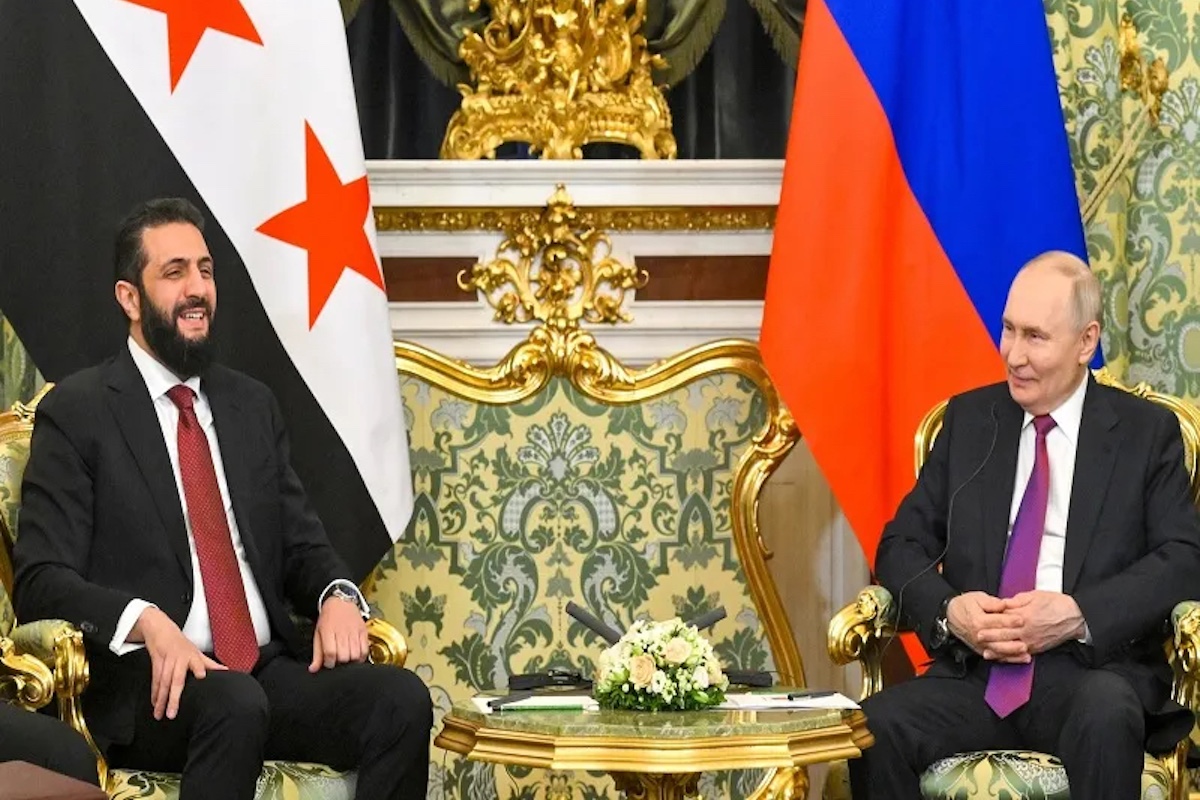
Syrian President Ahmed al-Sharaa’s recent diplomatic engagement in Moscow signifies a substantial evolution in Russian-Syrian relations that transcends mere military logistics. While the preservation of Russia’s air and naval installations in Syria remains strategically vital—particularly for supporting its Africa Corps operations—the bilateral partnership now encompasses far more ambitious nation-building objectives.
During high-level discussions with President Vladimir Putin, al-Sharaa articulated a comprehensive vision for Russian collaboration in constructing what he termed the ‘New Syria.’ This initiative mirrors the Soviet Union’s historical nation-building endeavors across the Global South during the Cold War era, representing a postmodern approach to international development and influence projection.
The Russian strategy advances multiple interconnected interests: preserving and expanding commercial activities amid Western sanctions, demonstrating reconstruction capabilities in conflict-affected regions, and strengthening geopolitical partnerships. This model has already shown promising applications in the Central African Republic and the Alliance of Sahelian States, with potential expansion to the Democratic Republic of the Congo and Sudan.
Contrary to expectations that Russian influence would diminish following the Assad administration, the strengthened Moscow-Damascus alliance now serves as a strategic blueprint for other nations facing similar geopolitical challenges. This includes post-Maduro Venezuela and potentially Iran, where Russia aims to maintain influence despite Western pressure.
The Syrian paradigm demonstrates that pragmatic partnerships with Russia can provide nations with increased political flexibility while avoiding excessive dependence on Western patrons. This approach has significant appeal for newly US-aligned states, conflict-affected regions, and geopolitically neutral Global South countries seeking balanced international relationships.
Additionally, Russia’s constructive role in Muslim-majority Syria enhances its soft power within the international ummah (Muslim community), potentially facilitating broader diplomatic engagement across the Islamic world. While military bases remain operationally important, Russia’s comprehensive strategy ultimately seeks to establish itself as a reliable partner for economic development and post-conflict reconstruction.