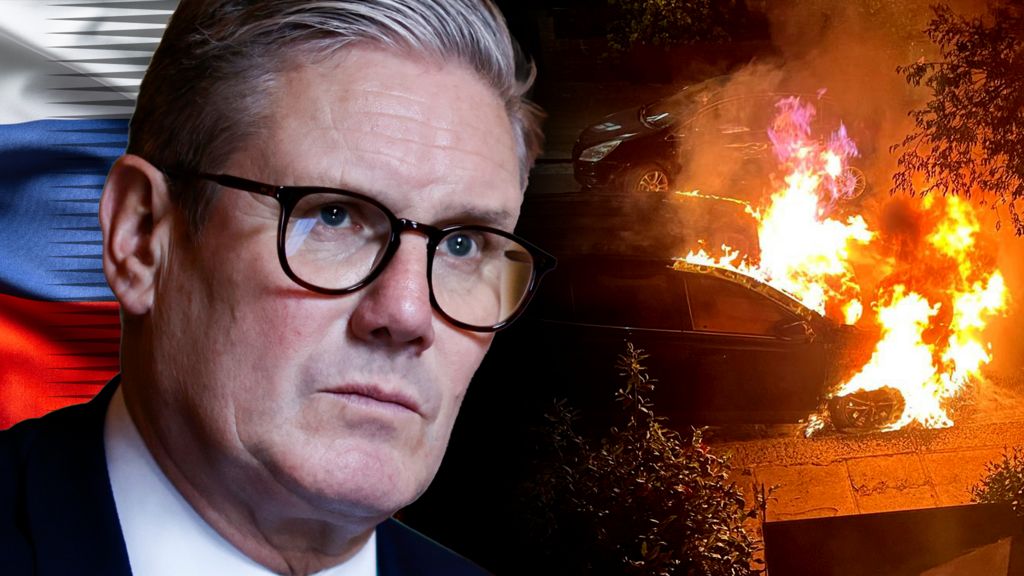
A months-long open-source investigation by the BBC has uncovered damning new evidence linking a series of arson attacks targeting properties connected to UK Prime Minister Sir Keir Starmer to an extensive, state-aligned Russian campaign of sabotage, division and provocation on British soil.
The plot unraveled hours after 22-year-old Ukrainian builder Roman Lavrynovych set fire to the entrance of Starmer’s former home – a property rented to the prime minister’s sister-in-law after his move to Downing Street. Lavrynovych, who was recruited remotely via the messaging app Telegram by an anonymous handler going by the initials EL, was arrested within hours of the attack. In pre-arrest messages, EL, who had already promised Lavrynovych thousands of dollars in payment and Russian citizenship for carrying out attacks, urged him to flee the city immediately after the arson.
The BBC’s investigation has traced EL’s identity to 23-year-old Evgeny Lyukshin, a young Russian diplomat-in-training and the son of a senior Russian foreign ministry official. Multiple lines of open-source evidence tie Lyukshin directly to the campaign: his initials match the handler’s alias, he appears in official Russian foreign ministry photos alongside top diplomatic leadership, he studied information warfare at a Kremlin-run training program taught by veteran Russian spies, and he was a core administrator for multiple Russian-backed fake extremist channels operating in the UK. When contacted by the BBC with the full body of evidence linking him to the plot, Lyukshin did not respond. Within hours, multiple channels linked to Lyukshin – including a disinformation outlet tied to the sanctioned Russian media network Rybar – disappeared from Telegram, and an official photo of Lyukshin with Russia’s deputy foreign minister was removed from a Russian state media website.
The arson attacks on Starmer’s properties are just one small piece of a far larger campaign, the investigation found. Russian operatives led by Lyukshin built a network of completely fake extremist groups online, designed to stoke intercommunal division and fear among British communities. The first of these, the bogus Takbir Foundation, posed as an extremist Islamic organization that paid non-Muslim artists to spray Islamic graffiti on public British buildings – a deliberate ploy to inflame far-right anger. The second, Direct Action UK, was framed as a homegrown British far-right group that paid vulnerable job seekers to carry out Islamophobic vandalism against mosques and Islamic schools across London. Between autumn 2024, when the group launched after the Southport riots, and the arson attacks on Starmer’s properties, at least six London mosques and one Islamic school were vandalized under Direct Action’s direction, with the group sharing clips of the attacks online to amplify fear.
Crucially, neither group had any genuine grassroots support in the UK. Both were entirely constructed by Russian operatives working remotely from Moscow. Metadata from posts in the Direct Action UK Telegram channel carried Moscow timestamps, used Cyrillic typography conventions, and placed currency symbols at the end of numerical values – a formatting quirk unique to Russian language use. Extremist content from the group was amplified by far-right British figures like Tommy Robinson, who was knowingly or unknowingly used to spread Russian-aligned disinformation. Even the false narrative that the Starmer arson suspects were sex workers tied to a personal scandal for the prime minister was spread by Robinson, before being reposted by a senior Putin administration envoy.
Two leading UK anti-hate organizations – Hope Not Hate and Tell Mama – warned counter-terrorism police about the Russian links to Direct Action UK months before the arson attacks on Starmer’s properties, but neither received any meaningful follow-up. Nick Lowles, CEO of Hope Not Hate, told the BBC his organization received no response at all after submitting a full report. Tell Mama CEO Iman Atta added that Muslim communities had been left vulnerable by authorities’ failure to act on the warnings, noting that what began as online disinformation quickly escalated to on-the-ground criminal violence.
A recent trial at the Old Bailey resulted in convictions for Lavrynovych and 27-year-old Stanislav Carpiuc, a Ukrainian-born Romanian national, on charges of conspiracy to commit arson. A third defendant, 35-year-old Petro Pochynok, was acquitted. The trial deliberately avoided any mention of the handler’s ties to Russia, focusing solely on the alleged financial motive for the attacks. The Metropolitan Police, which is currently investigating seven anti-Muslim hate crime incidents linked to Direct Action UK, has said it has no conclusive evidence of state backing for the plot, but multiple senior UK and Ukrainian sources have confirmed to the BBC that authorities have privately concluded the Russian state is behind the campaign.
This operation fits a long-established pattern of Russian hybrid warfare across Europe and North America, where Russian operatives recruit vulnerable young people – often displaced Ukrainians – as proxy actors to carry out low-level criminal attacks. Senior Ukrainian investigator Vitaliy Sova told the BBC that a recent joint EU-Ukraine operation uncovered a Russian sabotage network operating in 11 countries including the UK, with roughly a third of recruited proxies being Ukrainian nationals. The tactic allows Russia to discredit Ukraine in the eyes of Western allies while maintaining plausible deniability for its own actions.
Lyukshin’s training places him directly at the heart of the Kremlin’s modern information warfare apparatus. He is a graduate of a two-year-old information warfare program created on the direct orders of the Kremlin, jointly run by Putin’s presidential administration and sanctioned Putin ally Andrey Sushentsov. The program’s teaching staff includes veteran Russian spies: Andrey Bezrukov, a deep-cover spy who operated in the US for decades under a stolen Canadian identity before being uncovered in 2010, and Sergey Nalobin, a former Russian embassy London official widely accused of espionage activity.
Former UK Conservative Defence Secretary Ben Wallace, who oversaw the British government’s response to the 2018 Salisbury nerve agent attack, said the targeting of the UK prime minister’s property marks a deliberate escalation of Russian aggression against Britain. “This would not have just come from a low-level individual, it would have come from the very top,” Wallace told the BBC.
The Russian embassy has denied all allegations of involvement, saying in a statement that Russia “poses no threat to the United Kingdom or its people and harbours no aggressive intentions towards Britain.”
Anyone with additional information on the campaign can contact the BBC Investigations team via email or anonymous secure whistleblowing tool SecureDrop.