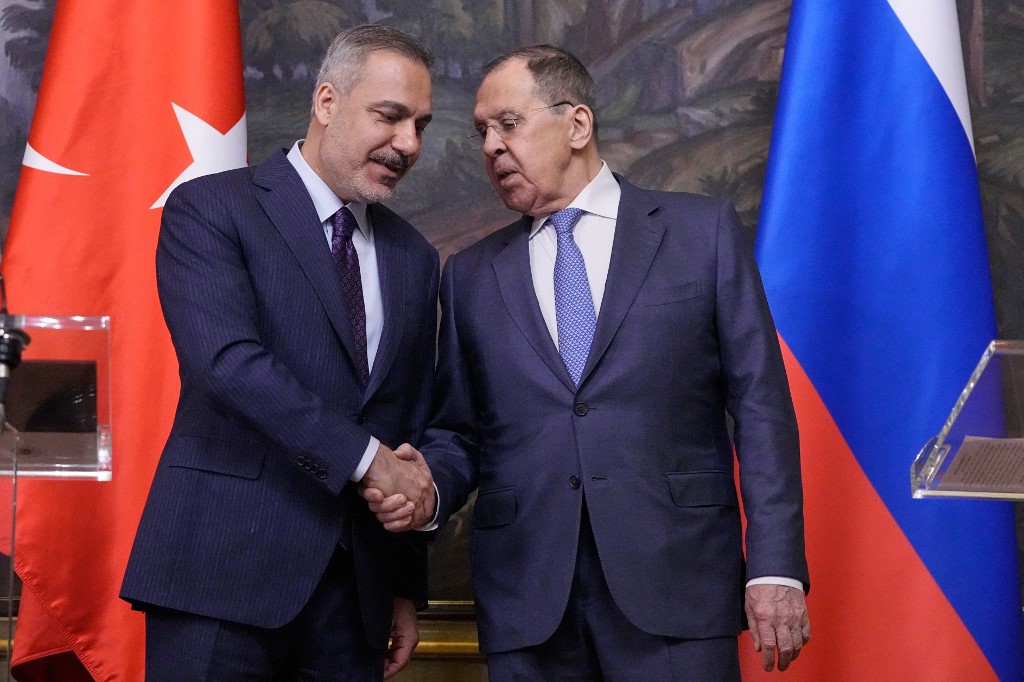
In mid-June, during a high-profile diplomatic visit to Moscow, Turkish Foreign Minister Hakan Fidan tabled a new peace initiative aimed at halting active hostilities between Russia and Ukraine and reopening bilateral negotiations, multiple anonymous sources with direct knowledge of the talks confirmed to Middle East Eye. But the proposal, which called for establishing a tentative ceasefire window and aligning on a foundational framework to resume dialogue, was firmly turned away by Russian officials, who declined to open discussions on the terms.
Fidan held meetings with Russia’s top leadership during his trip, including Foreign Minister Sergey Lavrov and President Vladimir Putin. Had the Turkish initiative gained traction, the plan would have brought Russian and Ukrainian negotiating teams to Turkey for formal talks coinciding with the upcoming NATO summit scheduled to be held in the country in July. For now, that diplomatic path appears all but closed, according to sources familiar with Ankara’s strategic planning.
Russia’s non-negotiable precondition for any lasting agreement with Kyiv remains unchanged: Ukraine must formally recognize Russia’s 2014 and 2022 annexations of the Donbas region’s provincial borders, a demand Kyiv has repeatedly rejected outright. While Ukrainian officials have pushed back against claims of expanding Russian control along the Donbas frontline, recent on-the-ground reporting from *The New York Times* confirms Russian forces have advanced into the outskirts of Kostyantynivka, one of the last remaining major Ukrainian-held urban centers in the region.
Russia currently holds more than 80 percent of Donetsk Oblast, the economic heart of Donbas, and is continuing offensive operations to encircle both Kostyantynivka and Lyman. The neighboring city of Druzhkivka has been reduced to a largely uninhabitable wasteland by months of heavy fighting, leaving Sloviansk and Kramatorsk as Kyiv’s last significant fortified strongholds in the oblast. Despite Kyiv’s unwavering public commitment to retaking all of Donbas, military analysts warn that many of the region’s key population centers may be left unrecognizable by the time frontline fighting stabilizes, leaving little infrastructure or civilian presence to defend.
Parallel to Russia’s incremental territorial gains in eastern Ukraine, which come even as Ukraine expands its long-range strike capacity to hit Russian energy infrastructure deep inside Russian territory including within Moscow, multiple independent economic analyses paint an increasingly grim picture of strain on Russia’s domestic economy. The Russian government has already imposed intermittent full shutdowns of mobile internet access in parts of the country to curb unrest, and after more than two years of full-scale invasion and sweeping Western sanctions, deep structural fissures have begun to emerge in the country’s financial sector.
A confidential European economic analysis reviewed by MEE reveals that Russian regulators and top government officials are deeply alarmed by growing systemic risk in the domestic banking industry, which faces overlapping threats that could trigger a widespread sectoral crisis. The report notes that Russian banks’ balance sheets have been artificially inflated by aggressive risk-taking designed to attract new investment, leaving institutions heavily exposed to widespread loan defaults from borrowers who overstate their income and creditworthiness.
Multiple factors have amplified this risk. Widespread government subsidies for low-interest mortgages have driven a rapid surge in residential property prices, creating the conditions for a potentially destabilizing property bubble that could pop once demand cools, triggering mass defaults on home loans. Additionally, public-private partnership schemes used to fund regional development projects have shifted billions in regional debt onto the balance sheets of private and state-owned Russian banks, forcing financial institutions to absorb losses from unprofitable infrastructure projects as regional governments struggle to repay their obligations. As of 2024, Russia hosts roughly 3,500 active public-private partnership projects with a combined total valuation of nearly €50 billion, all of which place additional pressure on the banking sector.
Industry projections indicate that more than a dozen Russian banks will be forced to cease operations by the end of 2025 amid mounting insolvency risk. Personal financial distress is also spreading rapidly across the country: more than 500,000 Russian individuals filed for personal bankruptcy in 2025, marking a 31.5 percent jump from the total number of filings recorded in 2024.