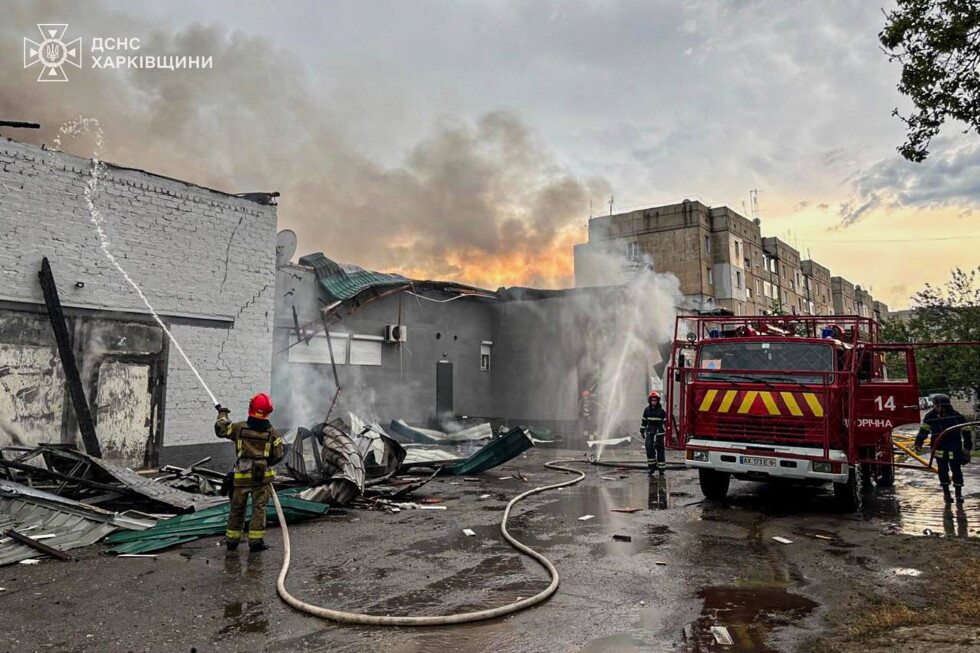
Overnight Sunday, the Ukrainian capital Kyiv came under a sustained, large-scale Russian attack combining cruise missiles and attack drones, triggering widespread panic and damaging multiple civilian and state sites across the city center, local Ukrainian officials confirmed on the record. Based on preliminary casualty counts released by municipal authorities, at least 10 people were wounded in the strikes, which sent plumes of smoke rising over multiple districts and kept the entire city on high alert through the pre-dawn hours.
Reporters with the Associated Press, who were on the ground in Kyiv, documented multiple powerful detonations concentrated near central Kyiv, in close proximity to key government administrative buildings. As of sunrise on Sunday, the assault was still ongoing, with Ukrainian air defense officials warning that additional incoming projectiles were expected to reach the capital imminently.
Tymur Tkachenko, head of Kyiv’s military administration, announced via a Telegram public post that visible damage to infrastructure had been confirmed across at least nine of the capital’s districts, with multiple residential apartment buildings among the impacted sites. Kyiv Mayor Vitalii Klitschko added that a school building in the city’s central Shevchenko district suffered structural damage during the attack, at a time when local civilians were sheltering inside the facility to avoid incoming strikes. Beyond public and residential sites, local officials also confirmed that multiple supermarkets and logistics warehouses scattered across Kyiv suffered damage from shrapnel, blast waves, and direct hits.
Mykola Kalashnyk, governor of Kyiv Oblast, added that residential and civilian communities across the wider regional area outside the capital city limits also recorded damage from the overnight assault.
The attack comes just after Ukrainian leadership issued explicit warnings about a potential new Russian strike using the advanced hypersonic Oreshnik ballistic missile. Ukrainian President Volodymyr Zelenskyy noted that he based the warning on intelligence shared by the United States and other Western allied partners, and Ukraine’s Air Force followed the president’s statement with an official advisory of a possible Oreshnik launch. As of Sunday morning, it remains unconfirmed whether the Oreshnik system was actually deployed in the overnight attack on Kyiv.
Russia first deployed the multiple-warhead Oreshnik missile against Ukrainian infrastructure in the city of Dnipro in November 2024, with a second strike using the weapon carried out in Ukraine’s western Lviv region this past January. Russian President Vladimir Putin has publicly emphasized the capabilities of the new system, whose name translates to “hazelnut tree” in Russian. He claims the missile travels at Mach 10—10 times the speed of sound— and can penetrate reinforced underground bunkers three, four, or more levels below the surface. Putin has described the weapon as moving like a meteorite, noting that it is impervious to all existing Western and Ukrainian missile defense systems. He added that even a small number of Oreshnik missiles armed with conventional warheads can generate destructive power on par with a nuclear strike, according to his public comments on the weapons system.