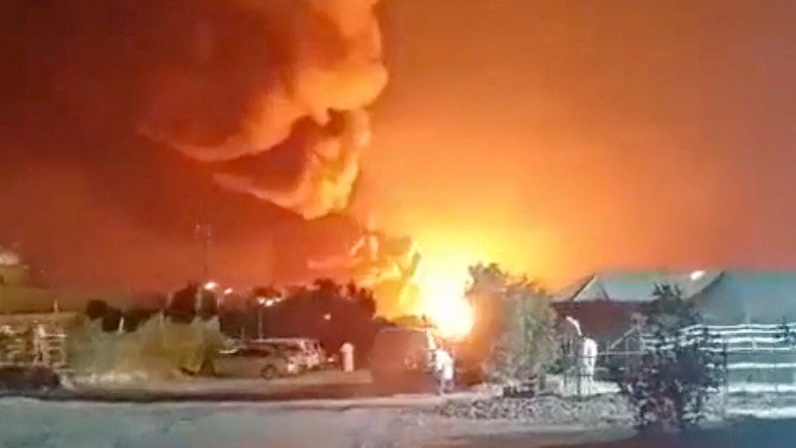
Emerging evidence suggests Russia is providing critical intelligence support to Iran, significantly enhancing Tehran’s capability to target American military assets across the Middle East. According to unnamed U.S. officials cited by The Washington Post, Moscow’s assistance has substantially improved Iran’s ability to track and strike U.S. warships and aircraft throughout the region.
The cooperation follows the comprehensive 20-year strategic agreement signed last year between Iranian President Masoud Pezeshkian and Russian President Vladimir Putin, which included provisions for strengthened military ties amid increasing international isolation and U.S. sanctions.
Recent satellite imagery indicates Iran has likely successfully destroyed Terminal High Altitude Area Defense (THAAD) radar systems in three regional countries—a significant strategic setback for the United States and its allies Saudi Arabia, the UAE, and Jordan, all of which depend exclusively on Washington for defense protection. The THAAD system, manufactured by U.S. weapons giant Lockheed Martin, is designed to detect and intercept short, medium, and long-range ballistic missiles.
Nicole Grajewski, author of ‘Russia and Iran: Partners in Defiance from Syria to Ukraine,’ told Middle East Eye that the intelligence cooperation represents a substantial enhancement of Iran’s targeting capabilities without direct Russian involvement in the conflict. ‘Not only is there an improvement of Iran’s targeting and what they’re targeting,’ Grajewski noted, ‘but there’s existing cooperation between Iran and Russia in the intelligence domain.’
The improved targeting capabilities have yielded devastating results. CNN reports outline extensive destruction of U.S. facilities as Iran continues its retaliation in what observers describe as an ‘existential’ fight for Tehran. In the first 48 hours of conflict, at least nine U.S. bases were struck by Iranian missiles and drones with no signs of escalation slowing.
A previously undisclosed CIA station in Riyadh was hit by an Iranian drone on Monday, demonstrating sophisticated strike capabilities even amid disrupted command and control systems. ‘Some of the targets that they’ve hit—that’s impressive to an extent,’ Grajewski commented, noting the advanced nature of these strike packages.
The human cost continues to mount with six U.S. military personnel officially confirmed killed in Kuwait, where U.S. operations have sustained the most damage. Both former President Trump and Chairman of the Joint Chiefs of Staff Dan Cain have warned the public to expect additional casualties. ‘Sadly, there will likely be more before it ends,’ Trump stated this week.
Andrew Leber, assistant professor at Tulane University, suggests the U.S. maintains ‘complete informational control’ over events at its Gulf bases, indicating potential unreported losses. This possibility is underscored by a since-deleted LinkedIn job posting from government contractor Joint Technology Solution Inc. seeking part-time ‘Personal Effects Specialists’ to process belongings of U.S. personnel killed overseas.
U.S. Central Command’s last update on March 2 confirmed 18 Americans seriously wounded, while denying Iran’s claim of 100 U.S. troops killed. The accuracy of casualty reporting remains unclear, particularly following a Washington Post revelation that two U.S. personnel were present in a Manama hotel struck by Iranian forces on March 1.
Iranian Foreign Minister Abbas Araghchi accused Americans of evacuating bases for hotels, thereby ‘turning civilians into human shields’—a claim vehemently denied by Bahrain and Gulf partners. Leber explained the dispersal policy: ‘They try to spread US personnel out as much as possible to basically every hotel in Bahrain.’
The precision of hotel attacks suggests human intelligence networks complement satellite surveillance. ‘Iran does have a pretty large network of intelligence assets in the Gulf,’ Grajewski confirmed, indicating sophisticated intelligence gathering beyond technological means.