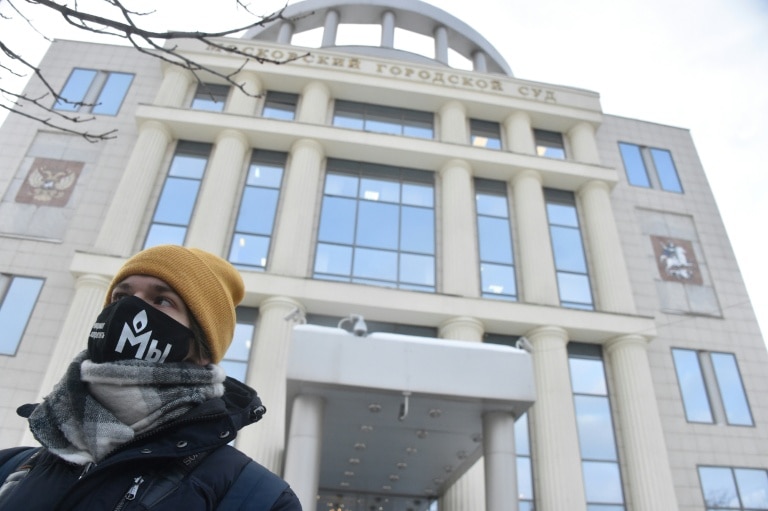
In a move that escalates the Russian government’s crackdown on independent civil society, the country’s Supreme Court formally designated Nobel Peace Prize-winning human rights organization Memorial as an extremist group on Thursday. This latest designation lowers the legal bar for authorities to prosecute anyone connected to the organization, deepening a years-long campaign to erase one of Russia’s most prominent voices for human rights.
Memorial traces its origins to the late 1980s, founded in the final years of the Soviet Union with a core mission of documenting the millions of lives lost to political repression in the Soviet Gulag penal system. Its founding chairman was Andrei Sakharov, a legendary Soviet dissident and Nobel Peace Prize laureate, and the organization built the world’s largest public database of Gulag victims. Emerging as a beacon of hope during Russia’s turbulent transition to democracy in the 1990s, Memorial expanded its mandate in subsequent decades to track growing authoritarian trends under President Vladimir Putin.
Over the past 15 years, the organization has documented a sharp surge in political detentions across Russia. As of 2026, the group counts more than 1,000 political prisoners held in the country – a massive jump from just 46 recorded in 2015, spurred by a widespread crackdown on dissent following the 2022 full-scale invasion of Ukraine. Memorial’s rolls of political prisoners include prominent Kremlin critics, opponents of the Ukraine war, and religious minorities. It has also documented human rights abuses linked to Russia’s military campaigns in Chechnya and Syria, investigated the mistreatment of Ukrainian prisoners of war, and tracks persecution of religious groups including more than 200 jailed Jehovah’s Witnesses.
The latest designation is not the first time Memorial has faced harsh repression from the Russian state. In 2015, the organization was added to the government’s controversial “foreign agent” registry, a label widely seen as branding groups as enemies of the state that forces mandatory public funding disclosures and prominent disclaimer labels on all published content. In 2021, the Supreme Court ordered Memorial to liquidate all its operations within Russia, forcing the bulk of its leadership and staff to relocate to exile, where the group maintains its work through satellite offices across Europe and beyond. The Russian government further restricted Memorial’s activity earlier this year, when it designated the organization’s international arm as an “undesirable organization”, a status that already banned Russians from collaborating with or donating to the group.
Thursday’s extremist designation adds much harsher legal penalties for any association with Memorial, even for actions connected to the group’s exiled network. Memorial officials have denounced the ruling as unlawfully overbroad: the designation formally targets a non-existent entity called the “Memorial international public movement”, a vague legal wording that gives Russian authorities wide latitude to target any group or individual linked to Memorial’s legacy. All logos associated with any Memorial affiliate are now classified as extremist symbolism, meaning even public display can open people to prosecution.
Natalia Sekretaryeva, head of Memorial’s legal department, told Agence France-Presse that the ruling was “absurd” but widely expected. She noted that even Russians who participated in the organization’s long-standing annual *Returning of the Names* ceremony – a quiet, public event to honor victims of Soviet political repression – now face the risk of being charged as accomplices to extremism. In an official statement, Memorial called the ruling unlawful, framing it as “a new stage of political pressure on Russian civil society”. International human rights groups have swiftly condemned the move: Amnesty International described the extremist designation as “deplorable” and called on Russian authorities to immediately reverse the ruling.
In 2022, just months after Russia launched its full-scale invasion of Ukraine, Memorial was awarded the Nobel Peace Prize alongside imprisoned Belarusian activist Ales Bialiatski and Ukraine’s Center for Civil Liberties. The Norwegian Nobel Committee recognized the three groups for “an outstanding effort to document war crimes, human right abuses and the abuse of power”. Within hours of the prize announcement, a Moscow court ordered the seizure of Memorial’s former headquarters, transferring the property to state ownership.
Work with Memorial has long carried severe personal risks for activists on the ground in Russia. In 2009, Natalya Estemirova, the organization’s lead researcher in Chechnya, was abducted outside her home and found dead hours later from multiple gunshot wounds. In 2020, Yury Dmitriev, a 70-year-old historian who spent decades locating unmarked mass graves of Gulag victims in Russia’s Karelia region, was jailed on widely contested child sex charges that supporters frame as retaliation for his work. Most recently, Memorial co-chair Oleg Orlov was jailed in 2024 for protesting the Ukraine war, and was only released months later during a high-profile prisoner exchange between Russia and the United States.
Since the 2021 liquidation of Memorial’s Russian operations, all the group’s financial assets in the country have remained frozen, and its core activities have been shifted to exiled satellite offices across Europe and other regions. The latest extremist designation closes off any remaining space for even informal association with the group inside Russia, cementing its complete erasure from the country’s public sphere.