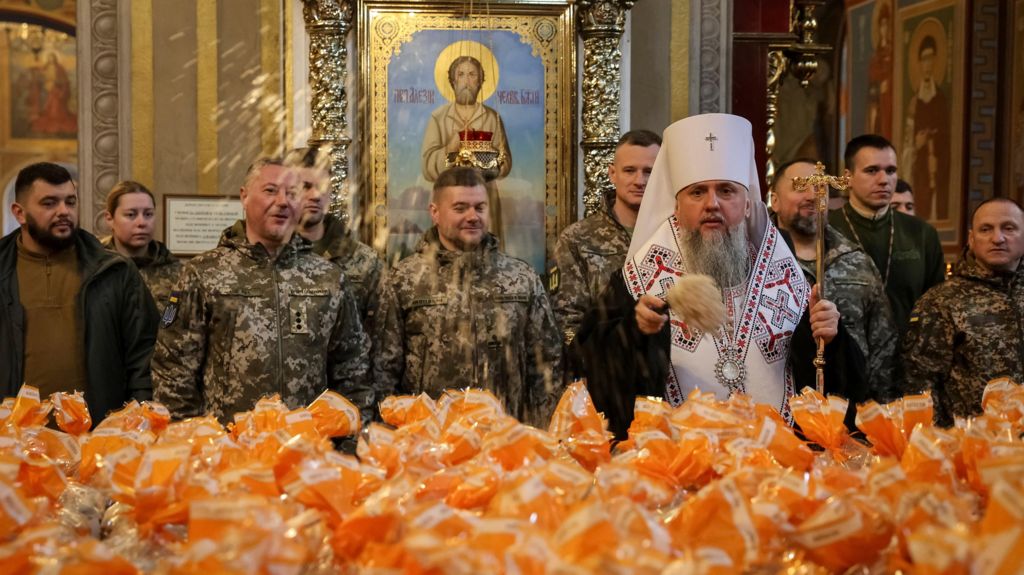
In the heart of Kyiv’s St. Michael’s Cathedral on April 9, 2026, a solemn yet hopeful ceremony unfolded days before Orthodox Easter. Metropolitan Epiphanius I, the primate of the Orthodox Church of Ukraine, performed a blessing by sprinkling holy water over stacks of Easter cakes, all bound for Ukrainian troops holding defensive positions along the country’s frontlines. This quiet act of spiritual support comes as both Moscow and Kyiv have formally announced a temporary ceasefire set to coincide with the religious holiday, a rare break in a conflict that has stretched on for years.
The path to this truce began with repeated ceasefire appeals from Ukrainian President Volodymyr Zelensky, all of which were previously rejected by the Kremlin. In an unexpected shift, Russian President Vladimir Putin announced that he had ordered all Russian military forces to hold their fire across the entire frontline from 16:00 local time (14:00 BST) on April 11 through Easter Sunday. Putin added that he expected Ukraine to mirror Russia’s gesture, while also ordering his troops to remain on high alert to respond to any perceived Ukrainian provocations or aggressive actions.
This framing of the truce, which positions Russia as the initiator to seize diplomatic initiative, has historically created friction with Ukrainian officials, but Kyiv moved quickly to confirm its willingness to match the pause. Shortly after Putin’s announcement, Zelensky published a post on X confirming Ukraine would take reciprocal steps. “People need an Easter free from threats and real movement toward peace,” he wrote, adding that Russia had an opportunity to extend the pause beyond the holiday weekend rather than resuming offensive strikes.
Days earlier, Zelensky revealed he had asked the United States to relay his proposal for a holiday truce to Moscow, framing the temporary pause as a small but critical first confidence-building step toward broader peace talks. For frontline soldiers who face constant harassment from Russian attack drones along the hundreds of kilometers of eastern front, any halt to active fighting would bring much-needed relief. The truce would also grant a rare reprieve to civilians across Ukraine, where daily air raid sirens, regular Russian missile and drone strikes have become a normalized part of life, with civilian casualties reported just days before the truce announcement.
Just last week, multiple civilians were killed when a drone struck a passenger bus in Nikopol, a southeastern Ukrainian city near the frontline. In Zhytomyr, a city west of Kyiv, a woman died when a Russian missile landed adjacent to her home in the middle of a weekday morning. Even moments after the truce was publicly announced, air raid sirens blared again across Kyiv, a stark reminder that the conflict remains active. In recent weeks, Ukraine has also ramped up its own cross-border drone campaign against Russia, with strikes focusing heavily on Russian energy export infrastructure, though Moscow claims residential areas have also been hit in the attacks.
Despite the announcement of a temporary pause, many Ukrainians remain deeply skeptical that this truce will hold beyond the holiday weekend. Past Russian-declared ceasefires have been short-lived and marred by violations, reinforcing Kyiv’s distrust of Moscow’s intentions. Earlier this year, Putin announced a so-called “energy truce” that paused Russian strikes on Ukraine’s critical power infrastructure during the coldest months of winter. That pause only lasted long enough for Russia to reposition and rearm for a new wave of large-scale missile attacks. In May 2025, Russia declared a unilateral ceasefire to mark the 80th anniversary of the Soviet Union’s victory over Nazi Germany; Ukrainian officials recorded hundreds of Russian ceasefire violations during that planned pause.
For Ukraine, the end goal remains unchanged: Kyiv has repeatedly pushed for a full, permanent ceasefire as the first step toward formal negotiations to end Russia’s full-scale invasion. Moscow, by contrast, has insisted that a final peace agreement be reached before any lasting ceasefire can take effect, a position that has led Kyiv to accuse the Kremlin of acting in bad faith and lacking genuine commitment to ending the war. Multiple rounds of peace talks mediated by the United States have taken place over the course of the conflict, but negotiations have been stalled since the Trump administration redirected its diplomatic focus to the ongoing crisis in the Middle East.