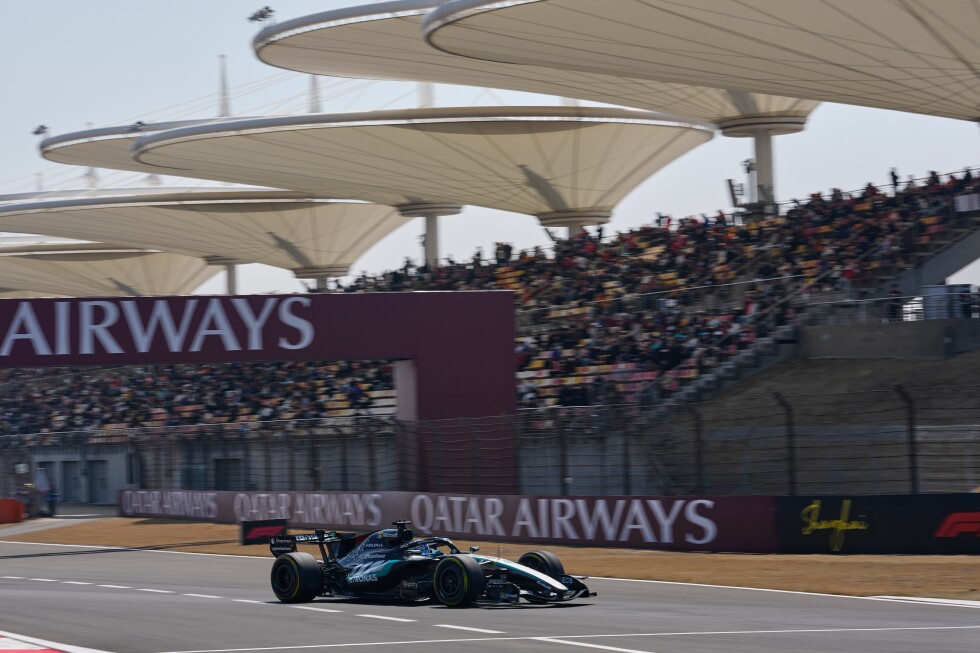
Mercedes driver George Russell secured a commanding pole position for Saturday’s sprint race at the Chinese Grand Prix, declaring his car “a joy to drive” as the team continued its dominant form in Formula 1’s new regulatory era. Russell’s performance in Shanghai builds upon his decisive victory in Australia last week, with teammate Kimi Antonelli qualifying second to position Mercedes for another potential 1-2 finish.
The qualifying gap demonstrated Mercedes’ overwhelming advantage, with McLaren’s Lando Norris trailing by 0.621 seconds in third position—a substantial margin in F1 terms. Only Lewis Hamilton (Ferrari) and Oscar Piastri (McLaren) managed to come within one second of Russell’s benchmark time.
While Max Verstappen, the most vocal critic of the new regulations, endured another difficult qualifying session in eighth, Hamilton emerged as the most likely challenger to Mercedes’ dominance given Ferrari’s demonstrated straight-line speed advantage.
Technical innovation took center stage as Ferrari debuted its unique rotating rear wing—dubbed the “Macarena” or “flip-flop” wing—which invertes aerodynamically to maximize straight-line speed. Though briefly tested previously and omitted in Australia, the innovative design could potentially help Ferrari compete with Mercedes, though concerns remain about its disruptive effect on airflow for trailing cars.
Meanwhile, the FIA faces mounting pressure to address technical issues with the new power unit regulations. Drivers have expressed frustration with limited control over electrical power deployment, which Verstappen described as “not a lot of fun and also quite dangerous” after incidents in Australia where cars completed formation laps with depleted batteries.
The session also featured a notable moment for Chinese motorsport as Zhou Guanyu, though now a reserve driver for Cadillac after leaving Sauber, remained a prominent figure in his home country, potentially boosting the new team’s recognition in this crucial market.