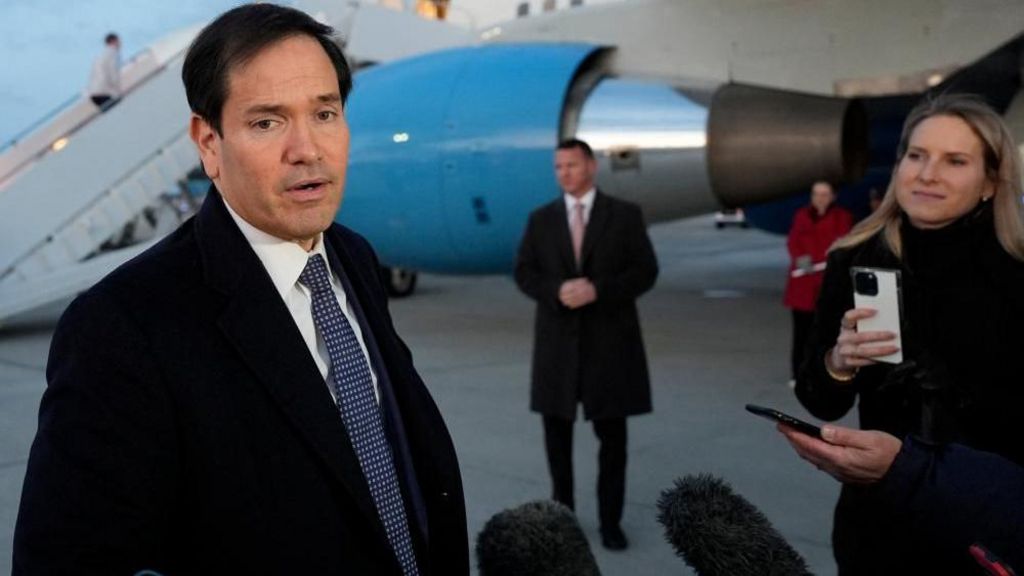
U.S. Secretary of State Marco Rubio has characterized the current geopolitical climate as a “defining moment” and a “new era” as he leads the American delegation to the prestigious Munich Security Conference. This gathering of global leaders occurs amidst unprecedented strain in transatlantic relations, fueled by recent remarks from President Donald Trump questioning U.S. commitments to NATO and controversially asserting claims over Denmark’s semi-autonomous territory of Greenland.
The conference agenda is densely packed with critical issues, including the ongoing war in Ukraine, escalating tensions with China, and the potential for a renewed nuclear agreement with Iran. Rubio’s address is highly anticipated, following last year’s contentious speech by then-Vice President JD Vance, which critics say triggered a year of diplomatic friction. Secretary Rubio indicated a potential shift in tone, telling reporters that the rapidly changing world requires all nations to “re-examine what that looks like and what our role is going to be.”
The Greenland controversy has emerged as a central point of tension. Danish Prime Minister Mette Frederiksen confirmed plans to meet with Secretary Rubio to discuss what European leaders view as a watershed moment that has significantly eroded trust. President Trump’s unsubstantiated claims that Greenland is “covered with Russian and Chinese ships” and vital to U.S. national security have alarmed allies.
Ahead of the conference, a significant coalition of eight former U.S. ambassadors to NATO and eight former American supreme commanders in Europe issued a powerful open letter defending the alliance. They argued that NATO serves as a crucial “force-multiplier” for American power, enabling influence “in ways that would be impossible – or prohibitively expensive – to achieve on its own.”
This gathering highlights divergent views on the future of Western alliances. French President Emmanuel Macron, who will also address the conference, has consistently advocated for European strategic independence from the United States. Conversely, NATO Secretary General Mark Rutte has emphasized the enduring importance of transatlantic bonds. German Foreign Minister Johann Wadephul stated the conference aim was to jointly redefine what holds NATO together and demonstrate to the U.S. that it equally needs European partnership.
With approximately 50 world leaders in attendance, including British opposition leader Sir Keir Starmer, the conference will grapple with fundamental questions about European defense and international cooperation in an increasingly uncertain geopolitical landscape. Conference chairman Wolfgang Ischinger noted that the White House’s evolving foreign policy “is already changing the world, and it has triggered dynamics whose full consequences are only beginning to emerge.”