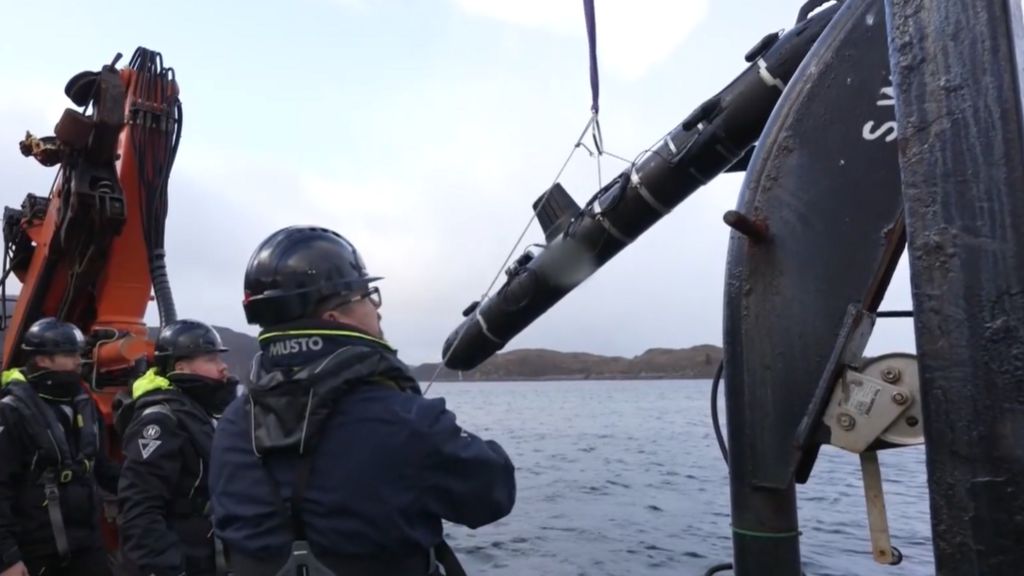
Beneath the murky waters off Scotland’s western coast, a revolutionary autonomous defense system is being deployed to safeguard national security. The SG-1 Fathom, a torpedo-shaped glider with wing-like appendages, operates silently as it patrols the depths, its advanced sensors constantly gathering intelligence on potential underwater adversaries.
Developed by German defense contractor Helsing and currently undergoing trials with the Royal Navy, this cutting-edge technology represents a significant advancement in maritime surveillance. The Fathom glider is engineered for extended autonomous operations, capable of patrolling for months without human intervention while working in coordination with dozens of similar units.
Programme Manager Katie Raine explains the system’s capabilities: ‘The glider processes and identifies threats more quickly than we’ve been able to do previously, using software trained on decades of acoustic data.’ This enhanced detection capability is specifically designed to counter Russian submarines suspected of covertly mapping the UK’s critical undersea infrastructure, including communication cables and energy pipelines.
The Fathom system forms a crucial component of Atlantic Bastion—a comprehensive defense network incorporating drones, warships, and surveillance aircraft. The Ministry of Defence unveiled elements of this program Monday, stating it directly addresses ‘the resurgence in Russian submarine and underwater activity.’ Official reports indicate a 30% increase in Russian vessels threatening UK waters over the past two years.
Defence Secretary John Healey emphasized the urgency of the situation during a recent Portsmouth visit, stating, ‘This is about keeping us ahead of the Russians.’ He highlighted government investments in new technologies, including remote-controlled speedboats, unmanned helicopters, and the 12-meter Excalibur unmanned submarine.
The UK has strengthened its response through the Lunna House Agreement, a defense pact with Norway enabling joint operations against Russian submarine activities. First Sea Lord Gen Sir Gwyn Jenkins acknowledged the challenge: ‘We’re still ahead in the Atlantic, but not by as much of an advantage as I would like. We’re being pressed, and we’re definitely in the competition to stay ahead.’
However, some experts express skepticism about the strategy. Prof Peter Roberts of RUSI argues that the Royal Navy ‘does not have the ships to do this job coherently or credibly’ and is relying on drones as cheaper alternatives to proper naval assets. He suggests Russia has operated largely unchallenged in UK waters for years, with current measures representing belated attempts to address long-ignored threats.
Russia has dismissed UK concerns as provocative and hysterical, with Foreign Ministry spokesperson Maria Zakharova warning that increased monitoring of Russian naval activity risks ‘provoking unnecessary conflicts’ in international waters. Despite diplomatic tensions, military officials maintain they are proceeding with clear-eyed determination to protect critical undersea infrastructure from potential disruption.