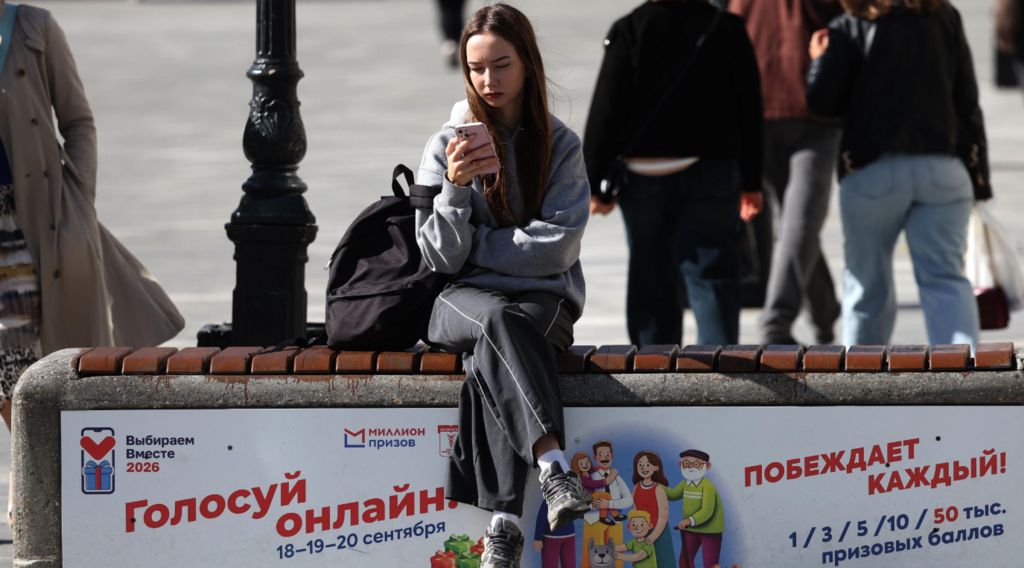
Four and a half years into Russia’s full-scale invasion of Ukraine, the country is holding its first national parliamentary election since the conflict began – a vote that analysts and ordinary Russians alike broadly expect will do nothing to move the needle toward peace. Long labeled a system of “managed democracy” under Kremlin control, Russia’s political process is structured to deliver predictable, preordained outcomes: concentrated authority in the presidency, minimal room for unexpected shifts, and a loyal legislative body fully aligned with President Vladimir Putin’s agenda. This weekend’s vote for the 450-seat State Duma, Russia’s lower house of parliament, is already projected to maintain the ruling United Russia party’s overwhelming majority and lock in a new cohort of MPs uniformly loyal to Putin.
Critics across Russia and the international community have uniformly dismissed the vote as neither free nor fair, but the Kremlin has pushed back against external and domestic criticism, rejecting outside standards for its political process. “We have our own political system, our own political process,” Kremlin spokesperson Dmitry Peskov recently stated, making clear that the leadership has no intention of adjusting the process to satisfy critics. For the Kremlin, however, this election carries far more significance than a routine rubber-stamping of power: it is framed as a public mandate to validate both Putin’s leadership and the ongoing invasion of Ukraine, with close to 200 military veterans who have returned from the war fielded as candidates to advance their political careers and embed pro-war sentiment deeper into the country’s governing structure.
The election campaign has offered an unvarnished window into the state of Russian society mid-war, and while few unexpected outcomes are expected, the campaign trail has thrown up some unusual moments that underscore the apathy and uniformity of the current political landscape. During one televised campaign event for a Moscow constituency, a presenter opened the broadcast to reveal six empty lecterns – all the registered candidates had failed to show up, forcing the program to end immediately after it began. In another televised debate that did feature candidates, a Communist Party hopeful chose to sing his campaign pitch to the crowd: “The Communist Party, onwards we go! We’re with the people, don’t you know?” – a moment that felt more like a reality TV talent show than a serious political contest.
That whimsical, performative tone turned out to be oddly fitting for a political system where all officially permitted parties are aligned on the core issue of the war. In the outgoing Duma, that unanimity was on full display at the body’s final session in July, when the entire chamber stood and applauded as the speaker chanted the rallying cry “Russia, Putin, Victory!” over and over. In an interview on the campaign trail at a baked goods factory outside Moscow, Communist Party leader Gennady Zyuganov openly boasted of the full pro-war unity across Russia’s official political factions, noting that every single party in the previous Duma voted to pass 170 pieces of legislation supporting the so-called “special military operation” in Ukraine. “In that sense there is 100% agreement in the Duma,” Zyuganov said. While official “systemic” parties vary on minor social and economic issues – ranging from nationalist factions to left-wing groups like Zyuganov’s Communist Party – all uniformly back the Kremlin’s legislative agenda and the war effort, acting as integrated cogs in a political machine built to center the Kremlin’s authority.
For any faction that deviates from that pro-war consensus, the response has been swift and punitive. Yabloko, the only remaining registered anti-war party that publicly calls for an immediate ceasefire in Ukraine, was initially approved for the ballot in July, only to be removed from the national party list by the Russian Supreme Court just 12 days later. The move was widely interpreted as a clear sign the Kremlin fears that anti-war messaging could resonate with large swathes of the Russian public. Though a small number of Yabloko candidates remain in the race running as independents in individual constituencies, a growing wave of crackdowns has targeted these remaining hopefuls: dozens have been detained by police, charged with vague criminal offenses, and barred from running.
Yabloko candidate Grigory Grishin, who is still in the race despite ongoing pressure, says the crackdown is a transparent political order aimed at silencing calls for peace. “The authorities are setting the boundaries within which they believe the elections should take place,” he explained. “It is well known that the demand for an end to the bloodshed in this conflict with Ukraine is very popular. In my opinion, most people in Russia now want peace and Yabloko helped people express this. That’s why it’s been excluded from the party lists, and why individual candidates are being barred.” Grishin has faced direct retaliation himself: plainclothes police recently brought him in for questioning over a post on his Telegram channel, which authorities claimed included the “extremist symbol” of the name Alexei Navalny – Russia’s late, most prominent opposition leader, who died in a Russian penal colony in 2024 after years of imprisonment on disputed extremism charges.
Russian authorities maintain that the Duma election is conducted transparently and fairly, but critics point to a years-long crackdown that has eliminated independent opposition voices: most leading opposition politicians are either imprisoned or forced into exile, and the country’s most prominent independent election monitoring group, Golos, has been shut down after its co-leader Grigory Melkonyants was jailed for five years in 2025 on charges of collaborating with an “undesirable organization.”
On the ground in towns across Russia, the election has barely registered as a priority for most residents, who are far more consumed by the human and economic costs of the ongoing war. Fifty miles outside Moscow in the town of Dmitrov, the central public space features a memorial to local residents killed while fighting in Ukraine, a constant reminder of the conflict that dominates daily life. Olga, a local woman whose son-in-law is currently serving as a soldier in the invasion, says the vote cannot change the trajectory of the war. “We feel it every day, because of the people who’ve gone to fight and the families left behind,” she said. “But these elections can’t influence what will happen.” Polina, another local resident, shared a simple hope: “I’d like us to live in a peaceful country, with no war, so that you don’t have to worry that a drone will fall down in front of you.”
Beyond the war, Russians are also grappling with growing economic strain: repeated Ukrainian drone attacks on Russian oil refineries have triggered widespread fuel shortages across the country, and inflation has outpaced wage growth for most workers. “What worries me is that no matter how much you earn it’s not enough,” said Ivan, a barber in Dmitrov. “Prices are rising faster than wages. I speak to lots of people in my job. I know how hard-up they are.”
Across the political spectrum, from anti-war candidates to ordinary voters, expectations that this election will deliver any meaningful change – particularly toward ending the war – are almost nonexistent. Grishin, the anti-war Yabloko candidate, summed up the common view of Russia’s managed electoral system: “Western elections and elections in Russia are completely different things. Elections in the West are a way of forming a government, which is replaced later if voters aren’t satisfied. Elections in Russia never bring a change in government. At best, they’re a way of influencing it, of sending a signal. But power in Russia never changed because of an election. That’s how Russia is.”