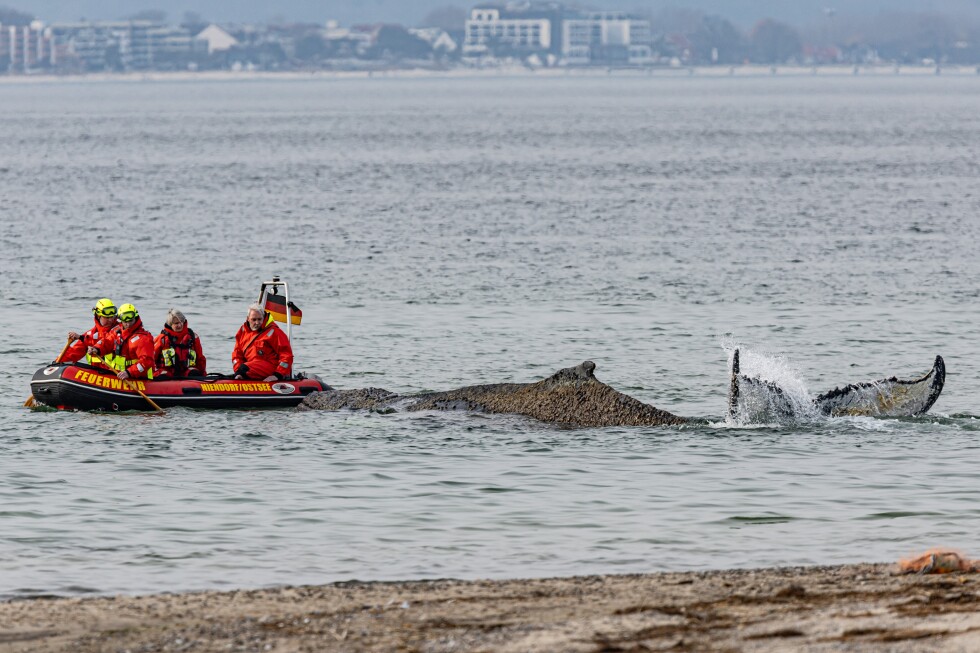
BERLIN — A critical rescue operation is underway along Germany’s northern coastline as marine experts battle against time to save a humpback whale stranded in the shallow waters of the Baltic Sea. The 10-meter (30-foot) juvenile male whale remains trapped near Timmendorfer Strand beach despite multiple intensive rescue attempts.
Marine conservation specialists from Sea Shepherd confirmed the whale remains alive but shows deteriorating vital signs. “The animal continues breathing, produces audible vocalizations, and periodically raises its head,” reported Carsten Mannheimer, a representative from the organization. However, Sven Biertümpfel of the same group delivered a grave assessment: “Without successful refloating, this situation becomes a death sentence for the mammal, with its condition worsening hourly.”
Rescue teams executed a coordinated strategy involving police vessels, inflatable boats, and drone-assisted monitoring during Monday’s operations. Crews strategically repositioned the whale toward deeper waters and generated artificial waves using coast guard and fire department boats to facilitate movement. Despite these efforts, the whale persistently returned to its stranded position.
Complicating rescue efforts, the whale’s enormous mass—estimated at several tons—makes direct physical intervention potentially lethal. Rescuers discovered and removed sections of fishing net entangled around its body, though the primary cause of stranding remains undetermined.
Authorities have established perimeter fencing to minimize human disturbance. “Preventing additional stress to the animal is paramount,” emphasized police spokesperson Ulli Fritz Gerlach, as crowds of spectators gathered along the beach.
Marine biologists identify this specimen as likely being the same young male humpback previously sighted in Wismar harbor in recent weeks, noting that male whales typically undertake migratory journeys unlike their female counterparts. The ongoing operation continues to evolve as rescuers explore alternative methodologies during tidal cycles.