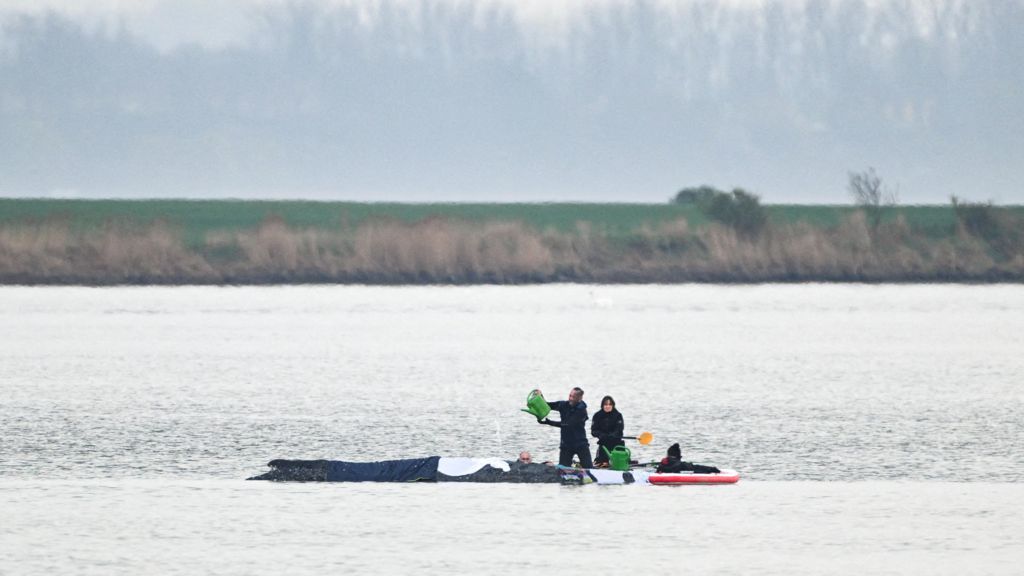
For weeks, a young humpback whale that wandered far from its natural ocean habitat has been stranded in the shallow coastal waters off Germany’s Baltic Sea coast, capturing global public attention and sparking a tense debate over wildlife rescue ethics. Now, state authorities have given the green light to a new, low-impact operation to free the animal, nicknamed Timmy by local media, even as many leading wildlife experts warn the mission carries severe risks and stands little chance of success.
Timmy was first spotted in the low-salinity waters of the Baltic Sea at the start of March, hundreds of kilometers away from the humpback’s native range in the North Atlantic Ocean. After the whale became stuck on a sandbank off the coast of Poel Island in the state of Mecklenburg-Western Pomerania, rescuers launched an earlier intervention: they dug a channel with heavy excavators to help the animal swim free, but the plan fell apart when the disoriented whale turned back into shallow water instead of following the plotted route toward the North Sea.
Wildlife biologists who have examined the animal say Timmy has sustained extensive life-threatening injuries. Visible damage includes large patches of detached skin, caused in part by the Baltic’s much lower salt concentration that triggered a debilitating skin condition. Experts also assume significant internal organ damage, brought on by weeks of the whale’s own body weight pressing down on its frame in shallow waters. Trauma consistent with contact with a ship propeller and entanglement in commercial fishing netting has also been documented, confirming the animal has been struggling with multiple harm for an extended period. After the first rescue attempt failed, many specialists concluded the whale’s chance of long-term survival was extremely low, and authorities initially agreed that the kindest option would be to let the animal pass peacefully.
But a recent reassessment of possible intervention methods has led state environment minister Till Backhaus to reverse that decision, approving a new plan led by a private rescue initiative. The operation relies on a simple, minimally invasive tool: large air cushions, similar in concept to inflatable arm bands, that will be positioned around the whale’s flippers to gently lift it off the seabed and onto a reinforced tarp connected to a tugboat. Once the whale is secured, the tug will transport it around Denmark’s Jutland peninsula into the North Sea, with the potential to release it further into the Atlantic Ocean, where humpback whales normally live.
Mecklenburg-Western Pomerania officials confirmed as of this week that the injured whale is still showing clear signs of life, though it remains severely weakened. “The prognosis remains critical. But a chance of survival cannot be completely ruled out,” Backhaus said in a statement announcing the new attempt. “Against this background, it is justifiable to allow this attempt, and I thank the initiative for it.”
Not all groups involved in earlier rescue work back the new operation, however. Greenpeace Germany, which assisted in the first attempt to free Timmy, has publicly announced it will not participate in or support the latest effort, citing the whale’s critical condition and the high risk of increasing its suffering. Independent experts from the German Oceanographic Museum and the Institute for Terrestrial and Aquatic Wildlife Research have echoed that concern, stressing that any transportation or physical manipulation of the already severely weakened animal carries substantial risk of exacerbating its injuries and hastening its death.
Timmy’s prolonged struggle has drawn international media coverage, but it has also created problems for authorities managing the site. The state government has issued formal warnings about rampant misinformation and unfounded conspiracy theories spreading across social media about the whale’s condition and the rescue process, and a 500-meter exclusion zone has been established around the stranded animal to protect both the whale and rescue teams. Even with that restriction in place, a 67-year-old woman made headlines over the weekend when she jumped off a private boat in an attempt to swim closer to Timmy, before being stopped by on-site enforcement officers.
Backhaus acknowledged the deep public empathy that has driven the global interest in Timmy’s fate. “The outpouring of sympathy shows how deeply the animal’s fate moves people,” he said. “At the same time, I ask that you respect the work of the emergency services and adhere to the existing protective measures.”
To this day, researchers remain uncertain how the humpback whale ended up so far outside its normal range in the Baltic Sea. Experts say the unusual stranding highlights the growing risks large marine mammals face from human maritime activities, including shipping traffic and commercial fishing, even in well-monitored European coastal waters.