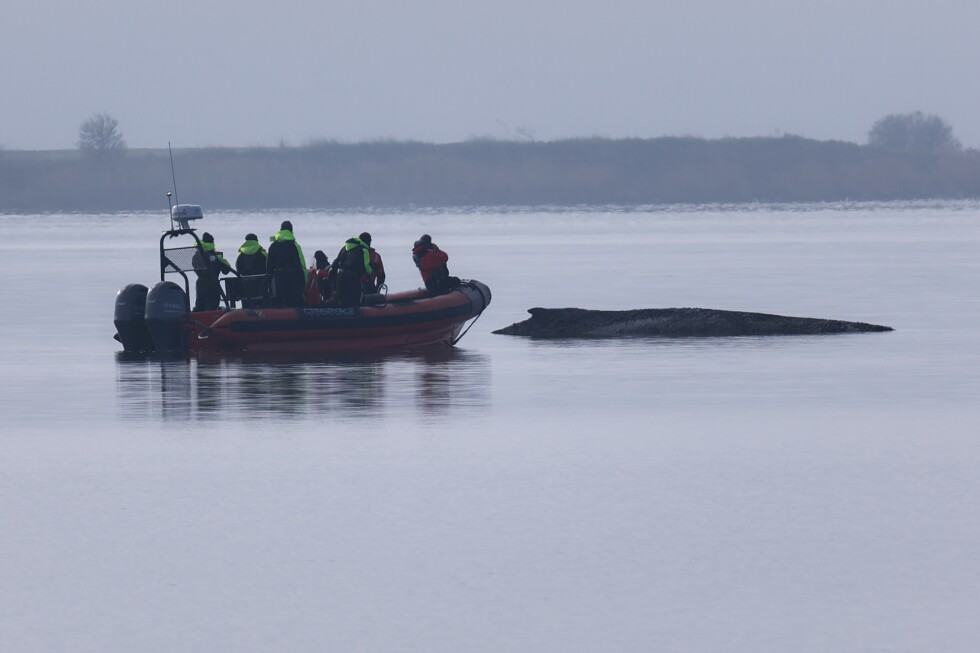
BERLIN — For nearly three weeks, a wayward humpback whale that wandered far from its natural Atlantic habitat into Germany’s Baltic Sea coast has captivated national attention, but rescue teams announced Wednesday they have ended all efforts to save the animal, concluding the exhausted mammal will not survive its current stranding.
Nicknamed ‘Timmy’ by the public and media following weeks of repeated strandings and close calls, the whale became trapped for the second time in as many days on Tuesday, when it swam into a shallow inlet off Germany’s small Baltic island of Poel. Poel sits just off the coast near the northern port of Wismar, roughly 30 miles northeast of Timmendorfer Strand, where rescuers pulled Timmy free from even shallower waters just one week earlier using a heavy excavator. That successful rescue proved temporary, however: within days, the lost whale once again found itself stuck in low, unnavigable waters.
In the days following the first successful rescue, authorities adopted a careful, low-intervention strategy aimed at letting the already exhausted animal rest and rebuild its strength. Teams occasionally used small boats to gently nudge the whale toward deeper open water, but prioritized minimizing stress to give Timmy the best chance to swim out to the North Sea and eventually back to the Atlantic on its own.
That strategy has now been abandoned, lead scientific coordinator Burkard Baschek told reporters at a televised press conference Wednesday. Baschek, who also serves as scientific director of the Ocean Museum Germany, said monitoring on Wednesday revealed deeply concerning signs: the whale was breathing at highly irregular intervals, drone footage showed almost no movement of sediment beneath its 12-15 meter body, and it barely responded when rescue teams approached.
Though Timmy showed a small uptick in activity after crews pulled back to give it space, Baschek noted that the change was not enough to signal any real chance of recovery. ‘It is not activity that gives us grounds for hope,’ he said. ‘We firmly believe that the animal will die there.’
Two prior times during the whale’s three-week odyssey along the Baltic coast, Timmy managed to gather enough strength to free himself from shallow waters. But repeated strandings have left the whale severely weakened, and falling seasonal tides have only worsened the dangerous conditions in the inlet. ‘The prospects that it will free itself are very small,’ Baschek added. ‘The approach of maximum rest and respect for nature demands at some point that we let it go.’
Timmy’s unplanned journey through the Baltic has been front-page news across Germany, with national media running constant updates on the whale’s status that turned the lost animal into a viral national sensation. The humpback was first spotted in the region on March 3, far outside its normal range: the Baltic Sea is not a natural habitat for the species, and its shallow, cooler waters do not support the large prey humpbacks rely on for long-term survival.
Experts still do not know exactly what led the whale so far off course. The most common theories suggest Timmy may have followed a large shoal of herring into the Baltic, or lost his bearings during his annual northward migration. Even under the best conditions, the journey back to open Atlantic waters would have been a monumental challenge: the trip from the inlet to the North Sea, and then out to the Atlantic, stretches hundreds of kilometers, a taxing swim for even a healthy humpback.