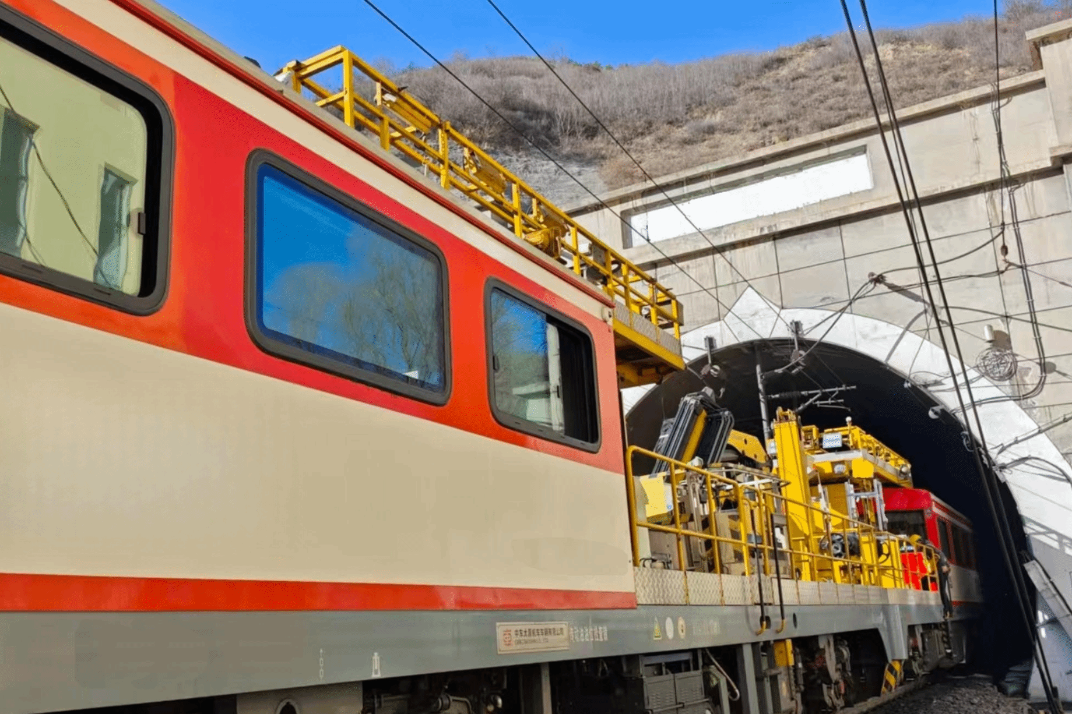
A groundbreaking radar technology developed by researchers at Xidian University is transforming railway tunnel safety inspections across China. The innovative system, mounted on moving trains, recently completed comprehensive scans of 77 railway tunnels in just eight hours—setting an unprecedented industry speed record.
Professor Su Tao’s team at the university’s Hangzhou Institute of Technology engineered the radar equipment to operate at speeds up to 160 kilometers per hour, representing a 30-fold increase in efficiency compared to conventional inspection methodologies. This technological leap addresses critical maintenance challenges within China’s rapidly expanding rail network, which encompasses 17,177 operational railway tunnels spanning 22,669 kilometers as of late 2023.
The radar system specifically targets hidden structural defects that develop over time, including internal voids, lining delamination, and water infiltration—flaws that traditionally required manual inspection during brief intervals between train operations. Project leader Xu Zhi emphasized the limitations of conventional approaches: “Traditional methods are slow, risky, and produce few traceable digital records. For a network measuring tens of thousands of kilometers, routine inspection becomes impractical.”
Through four years of on-site development in active tunnels, the research team overcame significant technical hurdles, including adapting radar signals for arched tunnel environments, developing pattern recognition algorithms for defect identification, and filtering noise generated by train vibrations. The system performs full cross-section scans from distances exceeding 4.5 meters, eliminating the need for physical contact with tunnel walls.
Validation procedures involving core sampling at radar-identified locations demonstrated remarkable accuracy, with physical evidence consistently confirming the radar’s diagnoses of thin lining and internal voids. The technology now progresses toward automated data processing and three-dimensional visual reconstruction capabilities.
“High precision rapid inspection is only the first step,” Xu noted. “We’re developing systems that will enable inspectors to view tunnel interiors on screens with defect locations, types, and scales clearly visible—essentially providing complete CT scans of tunnel infrastructure during normal train operations.”