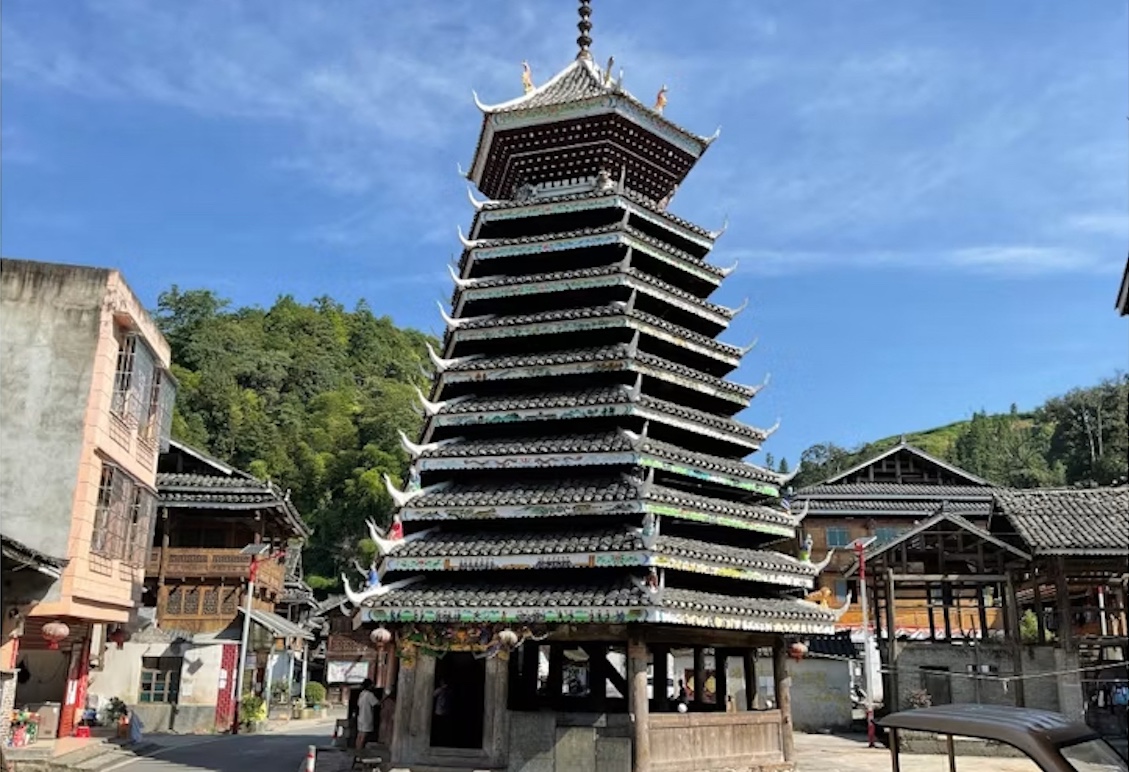
For nearly six centuries, the Indigenous Dong people of China have called the remote mountain ranges of southwestern China home. Without a formal written language, their centuries-old cultural knowledge has been passed down exclusively through oral tradition, leaving much of their unique way of life largely underexplored and unknown to broader global society. Now, an ambitious academic-led research initiative is pulling back the curtain on this little-understood marginalized community by systematically documenting their one-of-a-kind built environment, unlocking new insights into their social structure, spiritual beliefs and longstanding traditions.
Today, an estimated 3 million Dong people reside across the mountainous provinces of Guizhou, Hunan and Guangxi Zhuang Autonomous Region. The group is already recognized globally for its polyphonic choral singing, which was added to UNESCO’s Representative List of the Intangible Cultural Heritage of Humanity in 2009. While their unique approach to terraced agriculture, handcrafted architecture and harmonious integration of settlements with natural landscapes are equally distinctive, these cultural treasures have never been systematically digitally recorded, remaining largely invisible to outside researchers and conservationists.
Typically tucked away in dense fir forests, with direct access to waterways at valley bottoms or mid-hill slopes, Dong settlements follow a deliberate, community-focused layout. Most villages house between 200 and 500 households, with an average of four to five people per family. Every settlement is marked by a formal gatehouse that clearly defines its territorial boundaries relative to neighboring communities. Most are also home to a signature wind-and-rain bridge: a multi-purpose structure that blends the function of a village entrance and a covered bridge, serving as a gathering space for communal events and traditional blocking ceremonies. Scattered across the village landscape are hand-dug ponds, traditional wells, and raised granaries that support daily community life.
At the core of every Dong village, surrounded by two- to three-story wooden family homes, stand two central structures that anchor the community’s spiritual and social life: the iconic drum tower and the sacred Sa-Sui shrine. The drum tower embodies the Dong people’s deeply held spiritual connection between clan kinship and the fir trees that sustain their mountain homes, while the Sa-Sui shrine serves as the central site for worship of “Sa”, the grandmother deity central to Dong religious tradition. For security, social cohesion and spiritual identity, these two structures are the most significant buildings in any Dong village.
Despite their centuries of resilience, the Dong people’s unique built and cultural heritage now faces growing, existential threats from a combination of overlapping forces: accelerating climate change, unplanned modern development, expanding infrastructure, and the rapid growth of mass rural tourism. A warming global climate has increased the frequency of destructive wildfires and severe mountain flooding that ravage traditional wooden structures. As urban development encroaches on remote Dong territories, it brings improvements to quality of life but also introduces new fire risks via substandard electrical infrastructure retrofitted into historic wooden buildings.
In recent years, the expansion of transportation networks including roads, railways and new bridges, paired with unregulated tourism growth, has pushed many traditional villages toward becoming superficial decorative stage sets for visitors. While tourism generates new local income, it erodes the authentic relationship between Dong architecture, the surrounding landscape and the community’s traditional way of life. Making matters worse, the remote mountain location of most Dong villages has left local communities and regional authorities with extremely limited financial and institutional resources to address threats. Existing conservation policies and frameworks are underdeveloped, meaning repair, restoration and sustainable regeneration projects have lagged far behind the pace of destruction.
As China has undergone rapid urbanization over the past four decades, contemporary housing built with modern industrial materials and non-traditional designs has increasingly replaced historic wooden structures, irreversibly altering the visual identity and cultural meaning of traditional Dong settlements. The impact of poorly planned development can be seen at Ju Dong Village, where new infrastructure has permanently altered the historic setting surrounding the village’s ancient drum tower. Even purpose-built tourist attractions misrepresent Dong heritage: at Guizhou’s Danzhai Wanda Village, a new tourism development near Kaili, five newly constructed “iconic” drum towers are presented as standalone tourist monuments, stripped of their original contextual connection to surrounding homes, forests and community life that gives the structures their cultural meaning.
It is this urgent need to document and protect authentic Dong heritage that gave rise to the groundbreaking *Decoding Dong* project. Launched in 2023 and completed in 2025, the interdisciplinary initiative brought together experts from architecture, anthropology, heritage science, sociology and digital humanities to create the first systematic digital record of the Dong people’s physical and cultural heritage.
The project employed a suite of cutting-edge, complementary research methods, including 3D LiDAR scanning, aerial and terrestrial photogrammetry, 3D reality capture modeling, precise measured drawing, documentary filmmaking, and detailed geographic mapping. These technical tools were paired with oral history interviews collected directly from Dong community members, centering Indigenous knowledge in the documentation process. To date, the project has completed the first-of-its-kind digital archive of Dong architectural heritage, creating detailed digital and audio-visual records of approximately 100 historic buildings across a dozen remote Dong villages. Throughout the research process, the team prioritized consultation with key community stakeholders, including clan leaders, elderly villagers and regional cultural policymakers, to ensure the work aligned with community needs and priorities.
While Dong Indigenous heritage remains under significant threat, constrained by limited resources for local governments and communities, the *Decoding Dong* project marks a critical step forward for conservation efforts. By building a publicly accessible, community-centered archive of cultural information supported by modern digital technology, the project team aims to raise global awareness of the Dong people’s unique cultural legacy without compromising the traditions and identity that make the community distinct.