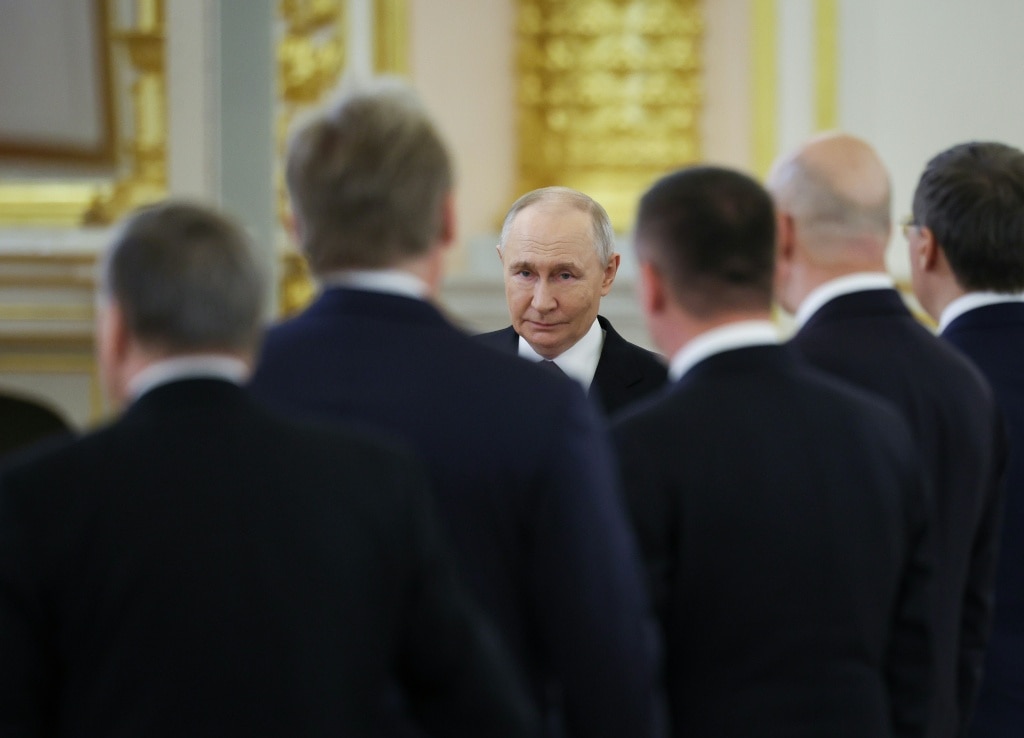
As Russia’s full-scale invasion of Ukraine enters its third year, Vladimir Putin is set to deliver a keynote address Friday at the Saint Petersburg International Economic Forum (SPIEF), the country’s premier annual investment gathering, long nicknamed “Russia’s Davos.” His appearance comes amid mounting economic headwinds and a fresh wave of brazen Ukrainian drone strikes that have underscored the Kremlin’s ongoing security vulnerabilities even on home soil.
The cumulative costs of the war have pushed Russia’s economy into its most challenging stretch since the 2022 invasion. Official data shows gross domestic product contracted by 0.2% in the first quarter of 2025, marking the first quarterly decline in three years. In the first four months of 2025, the federal government recorded an $80 billion budget deficit, equal to 2.5% of full-year GDP and already exceeding the deficit target set for the entire 12-month period.
Inflation has spiked across consumer goods, while the central bank has lifted borrowing costs to a two-decade high to cool price growth. Tax increases have squeezed households and businesses alike, widespread labor shortages have disrupted production lines across multiple sectors, and hundreds of businesses have been forced to cease operations. Compounding these pressures, intensifying Ukrainian strikes on key Russian energy infrastructure — including oil depots, refineries and export hubs — have put Moscow’s single largest source of state revenue at growing risk. In a strike loaded with symbolic significance, a Ukrainian drone hit an industrial facility in Saint Petersburg earlier this week as forum delegates began arriving, leaving a thick plume of black smoke visible to assembled dignitaries.
Alexander Kolyandr, a leading Russian economy expert based in London, told Agence France-Presse ahead of Putin’s address that the Russian economy has now entered a period of prolonged stagnation. “I don’t see the Russian economy collapsing into the chaos of the 1990s or anything similar — it’s just a slow degradation of everything,” he explained.
Once a magnet for Western investors eager to capitalize on Russia’s energy and natural resource wealth in the early years of Putin’s presidency, SPIEF has been fundamentally transformed by the war and Western sanctions. Where foreign business leaders once mixed with Russian political and business elites to strike multi-billion dollar deals, today the forum features public displays of military drones and machine guns, and top-tier attendees now come almost exclusively from neutral and allied nations such as China and Saudi Arabia. Attendees from the United States and Europe are extremely rare, with the small Western contingent led by high-profile pro-Putin figures: American right-wing commentator Candace Owens, former Hollywood actor and long-time Putin ally Steven Seagal, and members of parliament from Germany’s far-right Alternative for Germany party.
Putin has used past SPIEF addresses to push back against claims of economic collapse, argue that Western sanctions backfire by hurting European and North American economies more than Russia, and reassure the public that the state can afford the massive costs of its military operation while keeping domestic life stable. Speaking to reporters Thursday, he pushed back on narratives of imminent economic crisis, quoting Mark Twain’s famous quip: “Rumours of my death have been greatly exaggerated.”
But far from the forum’s keynote stage, small and medium-sized business owners across Russia report growing struggles that threaten their survival. Svetlana, a 40-year-old owner of a maternity and children’s apparel brand in the far eastern city of Khabarovsk, told AFP her business is on the brink of closure. “People are having fewer children, they’re tightening their belts, and our operating costs keep going up,” she explained. Government-mandated internet blackouts, implemented to disrupt Ukrainian drone strike coordination, have repeatedly knocked out her card payment terminals, leaving her unable to serve many customers. “We are going back to life 18 years ago, when there was no internet or social media,” she said. “I’m tired of worrying about fines under new laws and the endless stream of new requirements that keep popping up.”
Vera, a 42-year-old beauty salon owner in the Moscow region, said her supply costs have doubled so far this year. Having survived a near-collapse of her business in 2022, however, she remains optimistic she can weather the current challenges, calling ongoing difficulties “just unpleasantries.”
Expert Kolyandr warned that the current trajectory of slow economic degradation will become irreversible unless the Kremlin makes fundamental political changes, including ending the war in Ukraine and restructuring the country’s growth model. Since the invasion began, Russia has operated a two-tier economy, prioritizing resources for the state-dominated defense sector above all other civilian industries. While higher global oil prices driven by regional tensions following the Iran war have boosted energy revenues, Kolyandr noted the increase has not been large enough to close the country’s growing budget gap. Persistent labor shortages have also worsened, with an estimated 30,000 working-age men conscripted into the military each month to support the war effort.
“There is no good solution,” Kolyandr said. “They will continue to kick the can for as long as possible.”