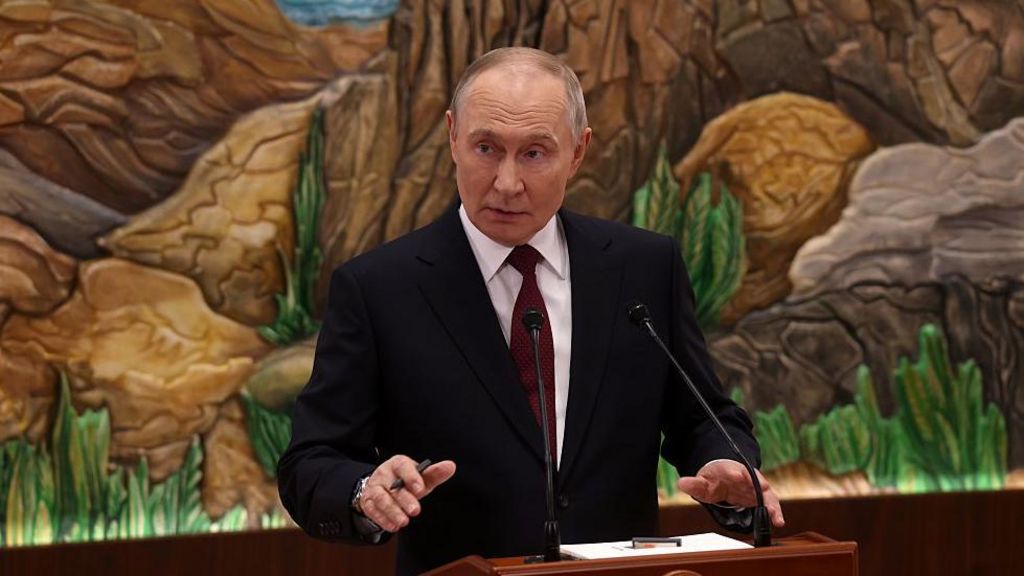
Russian President Vladimir Putin has reiterated his non-negotiable conditions for ending the Ukraine conflict, declaring that Moscow will only cease hostilities if Ukrainian forces completely withdraw from territories currently claimed by Russia. During his diplomatic visit to Kyrgyzstan, Putin emphasized Russia’s perceived battlefield advantage, stating that military force would ultimately achieve this objective if diplomatic efforts fail.
The contested regions include Crimea, illegally annexed in 2014, and the predominantly occupied Donbas territories comprising Luhansk and Donetsk. Putin’s statements come amid intensified diplomatic movements, including the anticipated arrival of U.S. special envoy Steve Witkoff in Moscow next week. President Donald Trump revealed that his son-in-law Jared Kushner might accompany the delegation, while U.S. Army Secretary Dan Driscoll is scheduled to visit Kyiv simultaneously.
Putin acknowledged reviewing a revised American-drafted peace proposal from October, which he suggested could serve as a foundational document for future agreements. However, he stressed the necessity of refining “certain specific points that require diplomatic formulation,” particularly regarding the status of occupied territories. When questioned about potential de facto versus legal recognition of Russian control over Crimea and Donbas, Putin identified this as the central focus of discussions with American counterparts.
The Russian leader reiterated his dismissal of Ukraine’s political legitimacy, claiming there was “no use” negotiating with what he considers an illegitimate government. This contradicts the Ukrainian parliament’s unanimous affirmation of President Zelensky’s legitimacy despite martial law preventing scheduled elections.
European leaders expressed skepticism toward Putin’s intentions, with European Commission President Ursula von der Leyen accusing Russia of maintaining a post-World War Two mentality regarding European spheres of influence. Putin dismissed warnings about potential Russian attacks on Europe as “laughable,” while the White House maintained optimism about recent diplomatic progress despite acknowledged remaining disagreements.