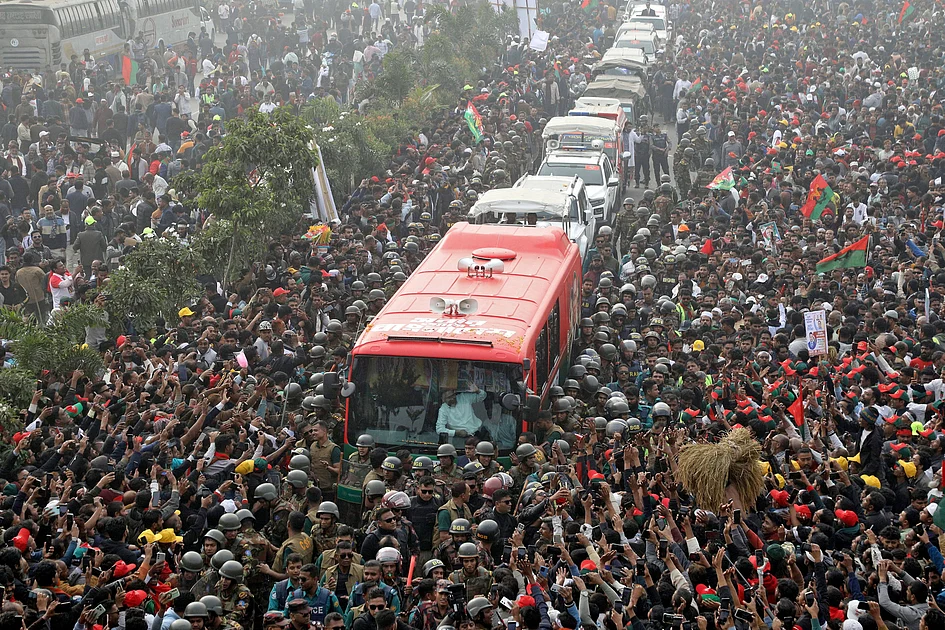
In a watershed moment for Bangladeshi politics, Tarique Rahman, the exiled opposition leader and heir apparent to the Bangladesh Nationalist Party (BNP), made a dramatic return to Dhaka on Thursday after 17 years of self-imposed exile. The politically charged homecoming attracted massive crowds of enthusiastic supporters who had been gathering since early morning, transforming the capital’s streets into a sea of banners and festoons bearing Rahman’s image.
The emotional significance of the occasion was palpable as Rahman, accompanied by his wife and daughter, performed a symbolic gesture upon arrival—removing his shoes to touch and collect soil from his homeland in a display of reverence. The BNP’s acting chairman, who had resided in London since 2008 citing political persecution, was greeted by senior party leaders at Hazrat Shahjalal International Airport before departing under tight security.
Rahman’s return occurs against a backdrop of profound political upheaval following the ouster of former Prime Minister Sheikh Hasina, whose 15-year autocratic rule ended with a student-led uprising last year. The upcoming February 12 general election represents the first electoral contest since Hasina’s departure, with Rahman positioned as the BNP’s prime ministerial candidate should the party secure a majority.
The political landscape has been further complicated by recent unrest triggered by the assassination of student leader Sharif Osman Hadi, a prominent critic of India, whose death sparked violent protests including attacks on media outlets perceived as pro-Indian and the Indian High Commission in Chattogram. These events have strained diplomatic relations with India, historically Bangladesh’s ally, which is currently considering extradition requests for the exiled Hasina, convicted in absentia for her administration’s crackdown on protesters.
Adding to the tensions, religious divisions surfaced recently when a Hindu garment worker was lynched by a mob over blasphemy allegations on December 18, reigniting anti-India sentiments in the predominantly Muslim nation.
Rahman’s legal standing has shifted significantly since Hasina’s fall from power, with courts acquitting him of the most serious charge—a life sentence connected to a 2004 grenade attack on a political rally, which he consistently denied. His return symbolizes hope for many supporters like former BNP lawmaker Jahan Panna, who described him as ‘the symbol of hope for this country’ capable of ending the current ‘cycle of anarchy.’
The BNP’s main rival, Hasina’s Awami League party, has been barred from contesting the upcoming elections, potentially clearing the path for a BNP victory. Meanwhile, Rahman’s ailing mother, former Prime Minister Khaleda Zia, remains hospitalized in Dhaka after being admitted to intensive care shortly after vowing to campaign in November.
During his exile, Rahman maintained political engagement through social media and significant meetings, including a June discussion in London with Nobel Peace Prize laureate Muhammad Yunus, who leads the interim government until the February elections.