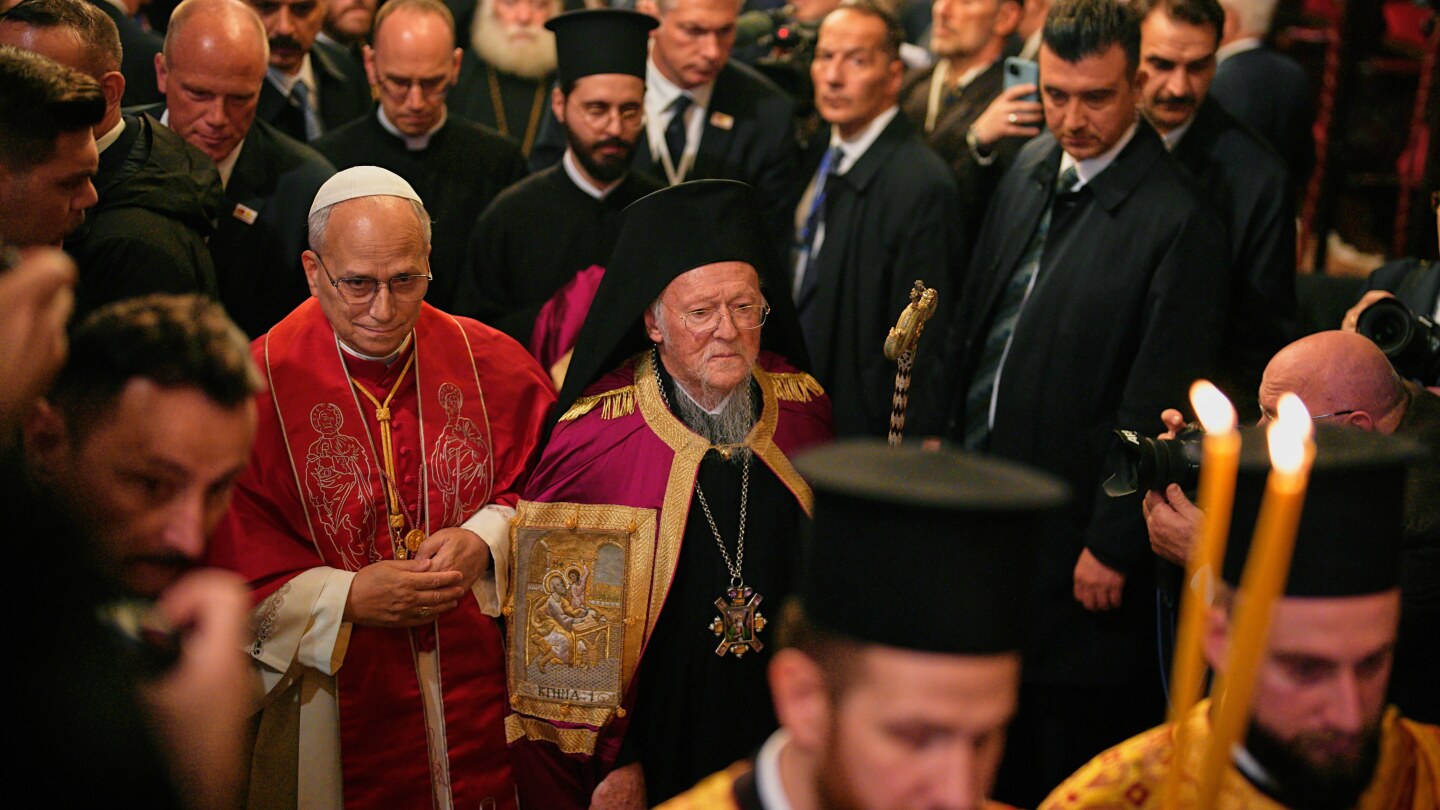
ISTANBUL — Pope Leo XIV departed Turkey on Sunday, concluding the initial phase of his inaugural foreign papal journey before proceeding to Lebanon. His visit aims to deliver a potent message of hope to the nation’s beleaguered citizens and reinforce the vital Christian presence within the Middle East.
The Pontiff’s schedule in Istanbul featured two significant ecumenical engagements: a solemn prayer service at the Armenian Apostolic Cathedral and participation in a divine liturgy alongside Ecumenical Patriarch Bartholomew, the spiritual head of global Orthodox Christianity. This invitation, extended to commemorate a major Christian anniversary, formed the foundational purpose for Leo’s regional tour.
Arriving in Lebanon during a period of profound instability, the Pope seeks to honor a commitment originally made by his predecessor, Francis, whose declining health prevented his own long-desired pilgrimage. Francis frequently echoed St. John Paul II’s 1989 declaration that Lebanon represents more than a nation—it is a symbolic ‘message’ of fraternity and coexistence. This ethos is institutionalized through a unique power-sharing governance structure, mandating a Maronite Christian president, a Sunni Muslim prime minister, and a Shiite parliament speaker.
As a Muslim-majority country with a substantial Christian minority constituting approximately one-third of its population, Lebanon has perpetually held strategic importance for the Vatican, serving as a critical stronghold for regional Christianity. However, decades of persistent conflict have precipitated a concerning diminishment of ancient Christian communities tracing their origins to the Apostolic era.
Local religious leaders, including Bishop George, Archbishop of the Melkite Greek Catholic Archeparchy of Beirut, emphasized the visit’s critical timing. ‘The Holy Father is coming at a very difficult moment for Lebanon and for our region,’ he stated, noting widespread public anxiety over the future and lingering fears of a resurgent full-scale war with Israel. ‘In this difficult moment, the pope’s visit is a sign of hope. It shows that Lebanon is not forgotten.’
The nation’s precarious state stems from a cascading series of catastrophes. A devastating economic collapse in 2019 obliterated the national currency and banking sector, erasing life savings and triggering critical shortages of electricity, fuel, and medicine. This was compounded in August 2020 by the cataclysmic Beirut port explosion, where improperly stored ammonium nitrate detonated, killing 218 individuals, injuring thousands, and inflicting billions in damages.
A central, highly symbolic moment of Pope Leo’s itinerary is scheduled for December 2nd: a period of silent prayer at the epicenter of the 2020 blast site, followed by a personal meeting with affected victims and their families. Public fury persists over the tragedy, widely attributed to governmental negligence, and is exacerbated by the repeated stalling of a formal investigation. Five years onward, no official has been held accountable, fostering deep disillusionment among citizens who hope the Pontiff will forcefully advocate for truth and justice.
Further complexity arises from the ongoing regional conflict. The war in Gaza, initiated after the October 2023 Hamas-led attack, drew in the Lebanese militant group Hezbollah into a escalating conflict with Israel that erupted into full-fledged war in September 2024. This conflict resulted in over 4,000 fatalities and widespread destruction. Although a U.S.-brokered ceasefire nominally halted hostilities two months later, near-daily Israeli airstrikes continue, fueling fears of a renewed total war.
Ahead of the papal arrival, Hezbollah issued a statement urging the Pope to publicly denounce the ‘injustice and aggression’ it claims Lebanon endures—a clear reference to Israeli military actions. The group also called on its supporters to gather respectfully along the route of the papal motorcade. Hezbollah maintains political alliances with several Christian parties, such as the Free Patriotic Movement and Marada Movement, though it faces opposition from the Lebanese Forces, the largest Christian parliamentary bloc, which criticizes the group for entangling the nation in war.
The papal visit also resonates powerfully in neighboring Syria. After a 14-year civil war that forced hundreds of thousands of Christians to flee, the ousting of autocrat Bashar Assad by Islamist insurgents in December has led to sporadic sectarian violence and attacks on religious minorities, including a June suicide bombing at a Damascus church. A delegation of 300 Syrian Christians, led by a Greek Melkite Catholic priest, traveled to Lebanon seeking audience with Pope Leo. For individuals like 24-year-old delegate Dima Awwad, his presence offers a beacon of hope amid ‘fear of an unknown future’ and a reaffirmation of the Eastern Christian community’s desire to remain in their historic homeland.