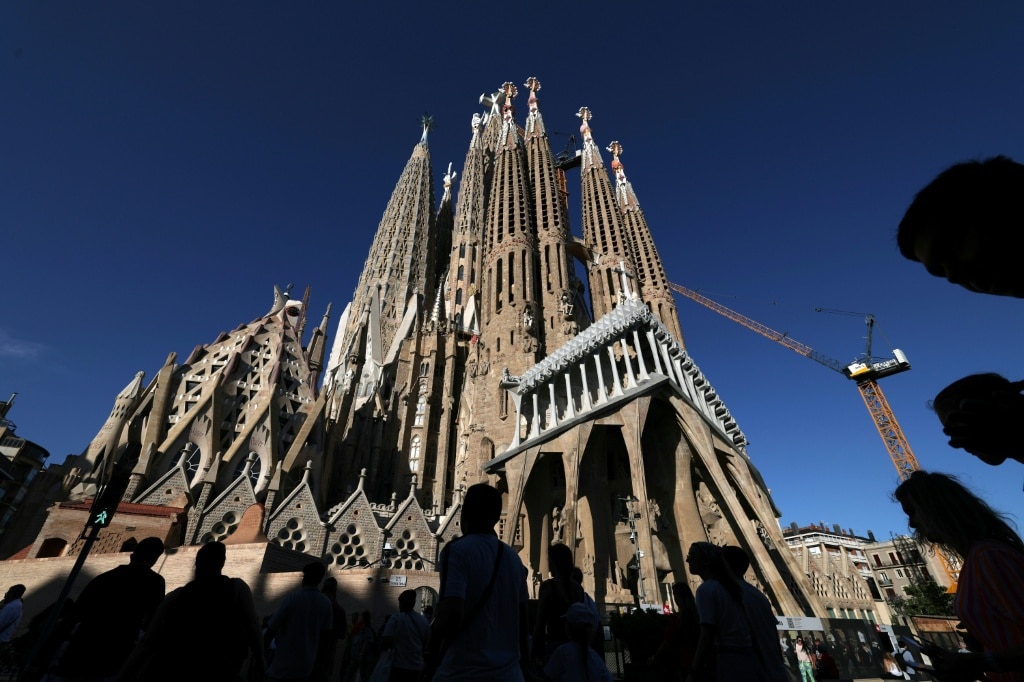
One hundred years to the day after the death of legendary Catalan architect Antoni Gaudí, Pope Leo XIV will travel to Barcelona this Wednesday to bestow a papal blessing on the newly completed central tower of the iconic Sagrada Familia Basilica, now officially recognized as the tallest church on Earth.
The visit to Barcelona marks the third major stop of the pontiff’s week-long apostolic journey across Spain, which launched Saturday when he landed in the Spanish capital Madrid. During his opening days in Madrid, Pope Leo made history as he became the first pope to address the Spanish parliament, drawing a crowd of 1.5 million worshippers for an open-air Mass held in the city’s central public space.
For the global Catholic community, the papal trip carries layered symbolic weight: it aligns exactly with the 100th anniversary of Gaudí’s 1926 death, a milestone that arrives as the architect’s sainthood cause moves forward through Vatican processes. A deeply devout Catholic, Gaudí died after being struck by a city tram while traveling to a prayer service in 1926.
Throughout his time in Spain so far, Pope Leo, the first American-born leader of the world’s 1.4 billion Catholics, has focused his addresses on pressing global and domestic issues. He has repeatedly denounced rising political polarization across societies, called for “patient dialogue” as an alternative to armed conflict and global rearmament, and pushed to revitalize Catholic participation in what was once one of the Church’s strongest traditional strongholds. Religious observance in Spain has fallen sharply over recent decades, a shift the Vatican is working to reverse. The pontiff has also reaffirmed the Church’s commitment to addressing what he has called the “scourge” of clergy sexual violence, promising expanded action to hold abusive clergy accountable and support survivors.
Before Wednesday’s blessing and Mass inside Sagrada Familia, the Pope will schedule two additional stops in the Barcelona region: a visit to a local prison and a meeting with religious leaders at an ancient abbey tucked in the Montserrat mountain range that overlooks the city. After wrapping up his time in Catalonia, he will travel to the Canary Islands for two days of engagements focused exclusively on the global migration crisis. The Atlantic archipelago is one of the most common entry points for irregular migrants seeking to reach European Union territory.
The Sagrada Familia, Gaudí’s unfinished magnum opus, welcomed nearly 5 million visitors in 2025, drawing pilgrims and architecture enthusiasts from across the globe. Its soaring central tower, dedicated to Jesus Christ, was only completed in February of this year, pushing the basilica to its full planned height of 172.5 meters (566 feet). In a deliberate choice designed to honor Gaudí’s deeply held religious beliefs, the tower’s peak was built 4.5 meters lower than nearby Montjuïc Hill – a decision the architect insisted on, arguing that the hill was a creation of God that should not be surpassed by any human-made structure.
Construction on Sagrada Familia first began in 1882, and for decades, organizers targeted 2026 – the centenary of Gaudí’s death – as the project’s completion date. But the global COVID-19 pandemic upended those plans: when international tourism collapsed, the basilica lost its primary source of funding, which comes from entry ticket sales to visitors. While tourism has rebounded strongly in recent years, with international travelers returning in large numbers to refill the project’s coffers alongside ongoing private donations, the project’s governing board, a private canonical foundation, has declined to set a new firm completion date for the remaining work.
Unfinished elements include the controversial Glory Façade and its four accompanying bell towers. The board’s current plans for the entrance of the basilica include building a large public square and sweeping set of stairs in front of the main entrance, a project that would require demolishing two full city blocks of existing residential homes. Local residents have organized a years-long campaign to block the plan, creating a persistent point of tension around the iconic landmark’s final construction phase. Full completion is now estimated to take roughly another 10 years, if current work timelines hold.