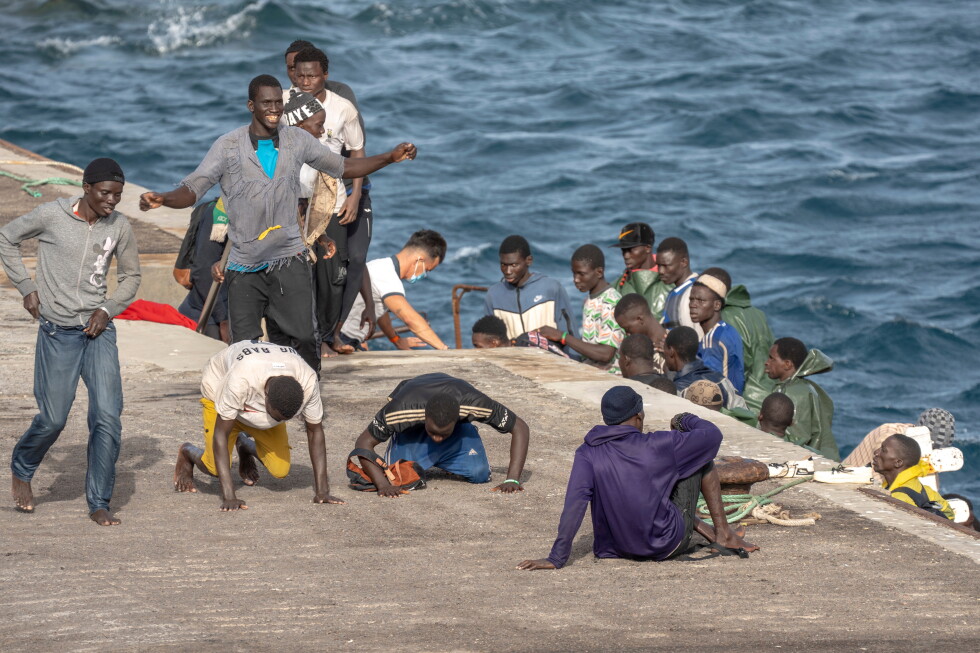
Early in his papacy, Pope Leo XIV is stepping into one of Europe’s most polarizing policy debates by planning back-to-back visits to two frontline migration hubs: Spain’s Atlantic Canary Islands next month, followed by Italy’s Mediterranean island of Lampedusa in early July. For years, these small, remote European outposts have borne the brunt of massive migration flows, with tens of thousands of mostly African migrants crossing one of the world’s deadliest migration routes to reach European shores. While overall arrival numbers have dropped this year, particularly in the Canaries, the issue continues to upend domestic politics in both Spain and Italy, two historically Catholic nations grappling with deep ideological divides over migration policy.
Many faith leaders, aid workers and even the migrants themselves hope the papal visits will shift public conversation away from partisan fighting that has split right-wing factions and pitted them against progressive parties, and refocus the debate on human solidarity and compassionate support for new arrivals. “Stuck in the middle are the migrants,” explained Most Rev. José Mazuelos, bishop of the Canarias diocese that covers multiple islands in the archipelago. “So the church says, ‘Let’s give them a face, because we’re talking about people, not numbers.’”
One such person is Eslim Jallow, a 27-year-old migrant who left Gambia with his younger brother in 2023, chasing the promise of a more stable, prosperous future before landing in the Canaries. After an initial difficult period of adaptation, Jallow mastered Spanish, completed professional coursework and now works full-time as a programmer and web developer based in Las Palmas de Gran Canaria. “Perhaps the pope will change the way in which people here look at immigrants,” Jallow said. “Immigrants should be treated with dignity and respect, not ignored.” Though Jallow is not Catholic, like the majority of migrants arriving in the islands, he says he believes Pope Leo will amplify the voices of migrants and remind the global community that they are people first, not political talking points.
Advocacy for just and humane migration policy has long been a core priority for the Catholic Church, dating back to the papacy of Pope Francis. Just one year into his tenure, Pope Francis made his first pastoral trip outside of Rome to Lampedusa in 2013 to honor migrants who died at sea, and three years later brought 12 Syrian Muslim refugees back to Vatican City with him from a visit to Lesbos, Greece. Pope Leo has carried on this legacy, repeatedly calling for dignified treatment of migrants across the globe – most notably decrying mass deportation policies in his home country, the United States.
Michele Pistone, a Villanova University professor who leads the institution’s new research center on migration, notes that staging these two visits so early in Pope Leo’s papacy sends a clear signal about how high of a priority migration is for the new pontiff. During his June 11 stop in the Canaries, Pope Leo will first visit the port of Arguineguín on Gran Canaria to hold a memorial for thousands of migrants who have died or gone missing while crossing the Atlantic. The following day, he will meet with migrants staying at a reception camp on Tenerife.
In 2024 alone, the Canary Islands emerged as the epicenter of a major humanitarian crisis, with nearly 47,000 migrants from North and West Africa arriving on its shores, including thousands of unaccompanied minor migrants. Most Rev. Eloy Santiago, bishop of Tenerife whose diocese covers the small island of El Hierro, explained that half of all 2024 arrivals landed on El Hierro – a number nearly triple the island’s permanent resident population. Even though most migrants only stay for a few days before being transferred elsewhere, the influx pushed the island’s already limited public resources to a breaking point. “If a boat arrives, the couple of local doctors have to go out running to take care of them, and then the local residents who had their medical appointments can’t have them,” Santiago said.
Catholic organizations and charities have been on the ground aiding migrants from the moment they step off the overcrowded, unseaworthy boats that carry them across the ocean. While stricter coastal controls along the African coast have cut arrival numbers dramatically this year, a long-term, unresolved challenge remains: supporting unaccompanied minor migrants who, after being placed in state care, are forced out into the streets with no job prospects or social support once they turn 18.
For Jallow, this challenge hits close to home: his younger brother, who was paralyzed from the neck down in an accident shortly after arriving in the Canaries and currently lives in a Catholic hospital in Las Palmas, will turn 18 next year, and Jallow says he fears what will happen to him after that. Caya Suárez, secretary general for Caritas, the Catholic charity operating in the Canaries, has seen firsthand how this coming-of-age transition leaves young migrants disproportionately vulnerable. “That’s a very bad moment, even though they’d been waiting for it with hope, because they see they are still stuck without alternatives,” she explained. Caritas works to connect these young adults with housing and employment opportunities, and has even relocated a small number to mainland Spain, including Madrid and small rural communities in Galicia, even as many regional governments have refused to accept additional underage migrants.
Many long-term Canary Islands residents report feeling abandoned by national and European institutions, left to manage a crisis they did not create as they struggle to stretch already limited resources to support new arrivals. Migrants themselves often come to the islands believing they will soon be able to travel to mainland Europe to build new lives, only to find themselves stuck on the outer edge of the EU, struggling to make ends meet, send money home to their families, or move onward. Compounded by the widespread perception that national and EU policymakers frame this as an “island problem” that local authorities must solve alone, the ongoing strain has eroded morale even among long-time island residents who are historically accustomed to migration flows between the Canaries and Latin America. Bishops across the islands say they hope the pope’s visit will renew energy for local residents who have poured years into supporting migrants. “The pope’s word can help so that in the middle of this fatigue, people can buck up again because they see they are supported,” said Santiago, who was born and ordained as a priest on the islands.
At the national level, Spain’s Catholic Church has publicly thrown its support behind a new government measure that would grant temporary residency permits to more than half a million undocumented migrants currently living and working in the country, many of whom come from Latin America. The socialist government of Prime Minister Pedro Sánchez and the church both note that these undocumented migrants often fill critical labor gaps in hospitality, agriculture and elder care, boosting Spain’s overall economy.
Pablo Simón, a political science professor at Madrid’s University Carlos III, explains that the church’s pro-migration stance has put it in direct opposition to Spain’s right-wing and far-right political parties. This has created an open rift between the Catholic Church and far-right groups such as Vox, which often frames its anti-migration rhetoric in religious language but has repeatedly criticized the church’s welcoming stance. The Rev. Fernando Redondo, who leads the migration department of the Spanish bishops’ conference, says the church’s position follows the core Christian mandate to welcome strangers, but acknowledges that the church faces an uphill battle changing perspectives among many faithful who believe migrants take native jobs and rely on public welfare. “We have a big challenge, which is raising awareness among our faithful … that from the viewpoint of faith, to welcome a migrant person is to welcome Christ himself,” Redondo said. “Then, of course, there needs to be ways, proper social and political ways, so that migration doesn’t become a total mess.”
Across the Canaries, ordinary residents have long been on the front lines of the crisis: local fishermen who hand out fresh water to migrants on flimsy rafts, vacationing sunbathers who run into the surf to help migrants who have reached shore, and volunteers who greet new arrivals in more than a dozen languages. Residents have also seen successful integration in action: one small, depopulating mountain village saw its population, local economy and school revitalized after a reception center for 36 migrant children opened there, even reviving participation in the local church’s annual feast procession.
It is for this reason that many on the islands are hoping Pope Leo will bring a simple, deeply needed message of reconciliation that centers the human experience of migration rather than partisan politics. “The pope doesn’t support this slogan of ‘let’s go, open doors for the whole world here.’ Nobody supports that,” Mazuelos said. “When here comes a gentleman in a wooden boat after five days in the Atlantic, what are we supposed to do, kick him back? We’ve got to find a way to welcome him.”
This reporting was contributed by Dell’Orto from Minneapolis, and is part of Associated Press religion coverage supported through a collaboration with The Conversation US, with funding from Lilly Endowment Inc. The AP holds sole responsibility for the content of this report.