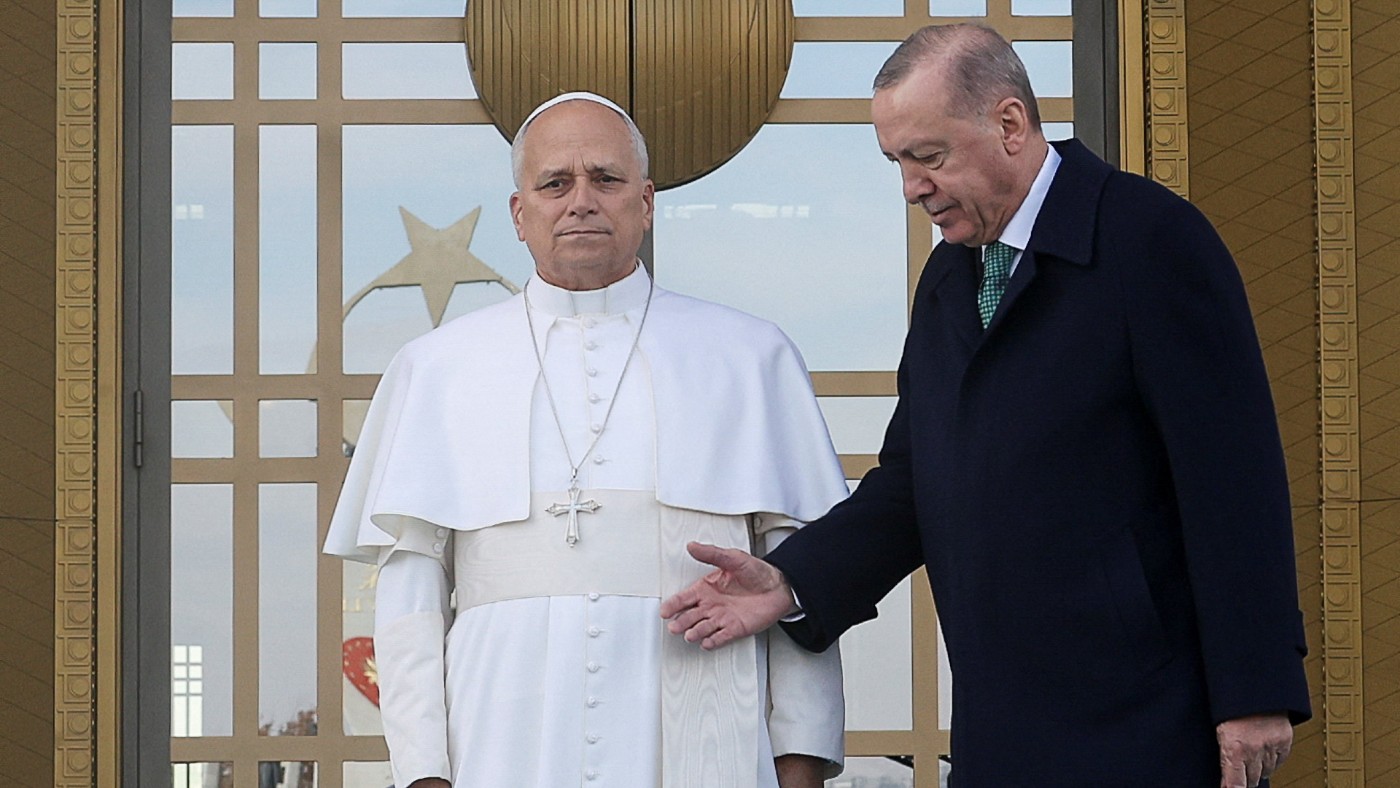
Pope Leo’s historic visit to Turkey for the 1,700th anniversary of the Council of Nicaea has ignited a firestorm of controversy, with Turkish nationalists and secularists accusing the Catholic leader of hidden political agendas and attempting to revive Crusader-era ambitions. The pontiff’s first foreign trip included a solemn tour of the submerged ancient basilica in Lake Iznik, identified as the original site where Christian bishops convened in 325 CE to establish foundational religious doctrines. Joined by Ecumenical Patriarch Bartholomew of the Greek Orthodox Church, the leaders held joint prayers commemorating one of early Christianity’s most significant gatherings.
The diplomatic gesture, however, triggered an intense backlash across Turkish media and social platforms. A historically inaccurate map depicting western Turkey annexed by Greece circulated widely on social media platform X, originally sourced from Greek news outlet Pentapostagma in 2022. The viral image portrayed Istanbul as an ‘independent ecumenicity,’ referencing the patriarchate based in the city.
Criticism emerged from various public figures including retired military officer Gokhan Avci, who called the Pope’s military honor reception ‘utterly disgraceful,’ and folk singer Sabahat Akkiraz who questioned whether Iznik had ‘become the Vatican without us knowing.’ Former Admiral Cihat Yayci claimed the visit represented a ‘political-religious project aimed at re-establishing Rome’ deliberately timed with the anniversary of the Crusades’ launch against Islamic lands.
Journalist Erdem Atay escalated concerns by suggesting the visit might lead Christians to demand territory from Turkey, specifically mentioning Heybeli Island, Imbros, Tenedos, and Iznik as potential claims. Both Yayci and Atay referenced historical rejections of ‘Vatican demands’ by Ottoman sultans and modern Turkey’s founder Mustafa Kemal Ataturk.
Official sources familiar with Vatican affairs dismissed these claims as unfounded, noting the Catholic and Orthodox churches have been formally divided since the Great Schism of 1054 and only began reconciliation efforts in the 1960s. The Turkish Orthodox Church’s spokesperson objected to the Pope using the title ‘ecumenical,’ considering it disrespectful to Turkey’s constitutional integrity.
Turkish officials remain divided on the visit’s implications, with some viewing it as an opportunity to showcase religious freedom and shared heritage preservation, while others worry about conspiracy theories spreading among nationalist and conservative groups. The last-minute cancellation of US Vice President JD Vance’s participation reportedly eased concerns among Turkish officials about further speculation.