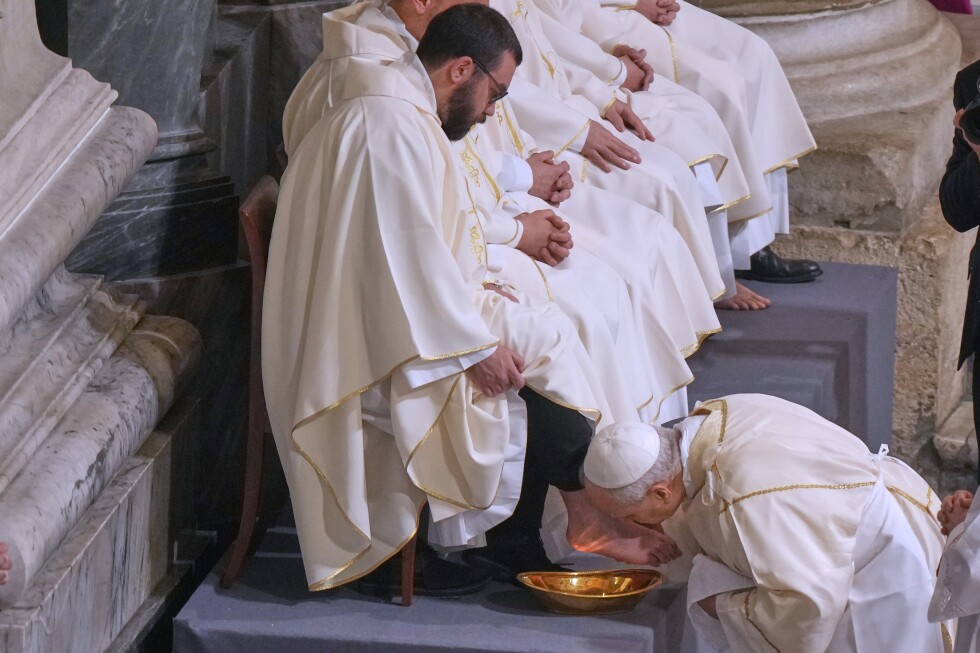
VATICAN CITY, ROME — In a deliberate departure from the progressive reforms of his predecessor Pope Francis, Pope Leo XIV has revived a centuries-old tradition for the Holy Thursday foot-washing ritual, washing the feet of 12 priests this year in a ceremony held at Rome’s Archbasilica of St. John Lateran, the official episcopal seat of the Bishop of Rome.
Among the 12 participants, 11 were ordained by Leo himself just last year, and the group was rounded out by Rev. Renzo Chiesa, head of the Rome Diocese’s main seminary. Following the long-standing script for the ritual, Leo poured water over each priest’s feet from a ornate golden pitcher, dried them with a plain white linen cloth, and finished with a ceremonial kiss. In his homily delivered during the service, the pontiff framed the humble act as a reflection of divine power, calling it a “gratuitous and humble gesture” that reveals “the true omnipotence of God.”
“Through this act, Jesus purifies not only our image of God – from the idolatry and blasphemy that have distorted it – but also our image of humanity,” Leo told attendees. The pope, who has already established a pattern of outspoken public opposition to global armed conflict, added that modern conceptions of power stand in stark contrast to Christ’s example: “For we tend to consider ourselves powerful when we dominate, victorious when we destroy our equals, great when we are feared. In contrast, as true God and true man, Christ offers us the example of self-giving, service and love.”
The foot-washing rite is a central tradition of Christian Holy Week, commemorating the act of Jesus washing the feet of his 12 apostles during the Last Supper, ahead of his crucifixion. For decades before Francis’ papacy, popes exclusively performed the ritual on Catholic men within the walls of a Rome basilica. But when Francis took office in 2013, he revolutionized the ceremony, expanding it to include laypeople, women, and even non-Christians, often holding services in unconventional settings including prisons, youth detention facilities, and refugee asylum centers. Francis framed this shift as a rejection of the “clerical culture” that elevates priests above lay followers, an attitude he blamed for enabling the systemic clergy sexual abuse crisis that has shaken the global Catholic Church for decades.
Leo’s decision to roll back this reform and restore the ritual’s exclusive focus on priests is not an arbitrary change, but a deliberate step aligned with his broader papal priorities. The new pontiff has made supporting and protecting clergy a core focus of his early tenure, highlighting the struggles many priests face in modern ministry. Just this week, the Vatican released Leo’s monthly prayer intentions for April, which are dedicated to priests experiencing crisis, burnout, loneliness, and spiritual doubt. In that message, Leo pushed back against the idea that priests are mere ecclesiastical functionaries, asking: “Let them feel they are not mere functionaries or lonely heroes, but beloved sons, humble and cherished disciples, and pastors sustained by the prayer of their people.” He called on lay Catholic faithful to support their clergy, urging them “to listen without judging, to give thanks without demanding perfection,” and walk alongside priests through persistent prayer.
This shift in the Holy Thursday ritual is the latest in a series of early moves by Pope Leo that signal a return to more traditional Vatican practices, paired with a renewed focus on lifting up the Catholic clergy. It comes alongside other recent high-profile actions from the new pontiff, including carrying the cross during the entire Good Friday procession (the first pope to do so in decades) and delivering repeated calls for global peace in his first Easter celebrations as head of the Catholic Church.