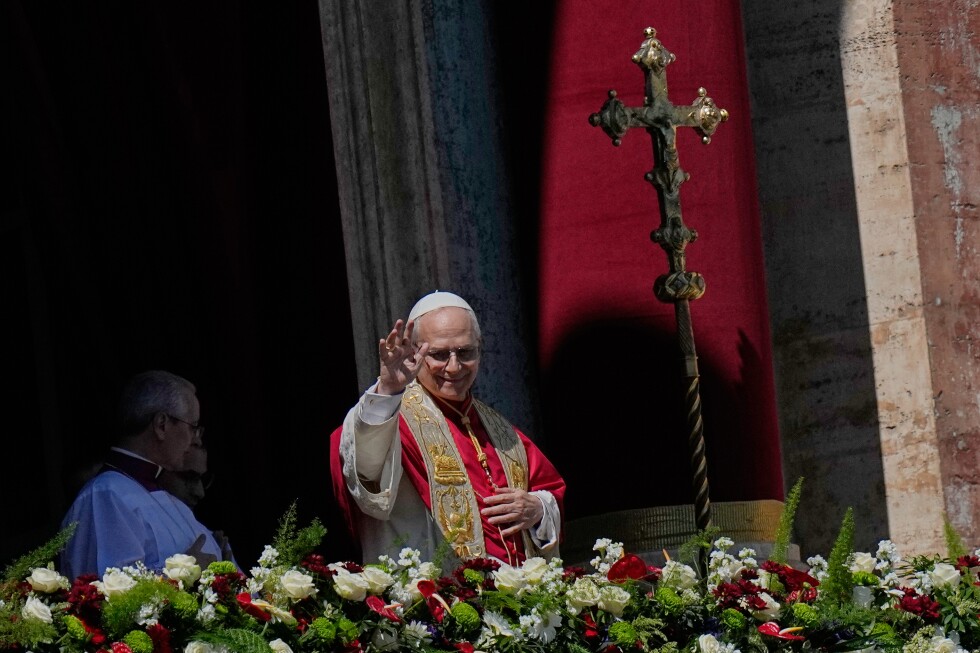
VATICAN CITY – In his inaugural Easter Mass as head of the Catholic Church, Pope Leo XIV delivered a impassioned plea for global disarmament and peacebuilding through dialogue on Sunday, marking a notable departure from longstanding papal tradition during his iconic Urbi et Orbi blessing from St. Peter’s Basilica’s central loggia. The first American-born pontiff centered his celebration on Easter’s core message of hope tied to the Christian belief in Jesus Christ’s resurrection following crucifixion.
“Let us allow our hearts to be transformed by his immense love for us! Let those who have weapons lay them down! Let those who have the power to unleash wars choose peace! Not a peace imposed by force, but through dialogue! Not with the desire to dominate others, but to encounter them!” Leo urged the crowd of roughly 50,000 faithful gathered in St. Peter’s Square. The open-air altar where he spoke was flanked by white roses, with spring perennials lining the steps leading to the piazza, a visual echo of the renewal at the heart of his message.
Against the backdrop of two active major global conflicts – the second month of U.S.-Israeli military operations in Iran and Russia’s continued invasion of Ukraine – Leo called out widespread global indifference to human suffering caused by war. “We have grown indifferent to the deaths of thousands of people … to the repercussions of hatred and division that conflicts sow … to the economic and social consequences they produce,” he said. He drew on the words of his late predecessor, Pope Francis, who from the same loggia a year prior warned of a “great thirst for death, for killing, we witness each day.” Francis, who had been weakened by prolonged illness, died just one day after that 2024 Easter appearance, on Easter Monday.
Unlike traditional Urbi et Orbi blessings – which have long included a named list of global conflicts and crises – Leo did not explicitly name the wars at the center of global attention. He had followed the traditional naming practice during his Christmas blessing just months earlier, and no official explanation for the shift was offered immediately after the address. From the loggia, the pope announced a special prayer vigil for peace will be held in St. Peter’s Basilica on April 11.
Alongside the break from naming conflicts, Leo has already signaled small but noticeable shifts in papal tradition early in his tenure. He revived the practice of greeting the global faithful in 10 languages, including Arabic, Chinese, and Latin – a custom Francis had allowed to lapse. After his blessing, he stepped out of the loggia’s shadow to wave directly to the cheering crowd before departing via popemobile, traveling all the way down Via della Conciliazione to the Tiber River and back to greet attendees in the piazza. On Holy Thursday, he reclaimed the tradition of washing only priests’ feet, a gesture of encouragement for clergy, after Francis expanded the practice to include women, non-Christians, and prisoners during visits to prisons and care facilities for disabled people. The 70-year-old pontiff also became the first pope in decades to carry a light wooden cross for the entire 14-station Good Friday Way of the Cross procession.
Beyond the Vatican, Easter celebrations across conflict zones were shaped by ongoing violence and uncertainty this year. In the Holy Land, traditional ceremonies at the Church of the Holy Sepulchre – revered as the site of Jesus’ crucifixion and resurrection – were scaled back under an agreement with Israeli police, who imposed crowd size limits due to ongoing missile attacks. The restrictions have also disrupted the Muslim holy month of Ramadan and Eid al-Fitr, as well as the ongoing Jewish Passover festival: the annual priestly blessing at the Western Wall, which usually draws tens of thousands, was capped at just 50 attendees on Sunday. Tensions between Israeli authorities and Christian leaders have escalated in recent days, after police blocked two senior church leaders, including Latin Patriarch Pierbattista Pizzaballa, from entering the Church of the Holy Sepulchre for Palm Sunday celebrations last week.
In Gaza, the tiny Palestinian Christian community held its first Easter celebrations following a recent ceasefire, bringing a long-awaited sense of relief after years of conflict. At Gaza City’s Holy Family Church, Catholics of all ages gathered for traditional Mass, forming a line to kiss a sketch of Jesus held by clergy, with the glass frame cleaned between each visitor. “There is great joy, especially after the ceasefire and after nearly three years of suffering and being unable to celebrate all the holy holidays,” said George Anton of Gaza City. “People are somewhat relieved and more stable.”
In Iran, five weeks into the U.S.-Israeli military campaign, Armenian Christians gathered in the capital Tehran to celebrate Easter, working to maintain a sense of normalcy for their community amid daily airstrikes. At St. Sarkis Cathedral in central Tehran, families hugged and children exchanged hand-painted Easter eggs. “Whether we like it or not, we have young children who do not understand what’s going on,” said 40-year-old English teacher Juanita Arakel. “They just need to feel normal.” Iran is home to roughly 300,000 Christians, most of whom are Armenian, and three seats in the country’s parliament are reserved for Christian representatives. “Our calls and prayers are that we will be able to end this war,” said Sepuh Sargsyan, archbishop of the Armenian Diocese of Tehran, repeating the plea to emphasize the community’s longing for peace.
This report was contributed by Barry reporting from Milan, with additional reporting from Associated Press journalists Josef Federman in Jerusalem, Wafaa Shurafa in Deir al-Balah, Gaza Strip, and Bassem Mroue in Tehran, Iran.