Nearly a month into the Israel-Hamas conflict, Iran’s strategic control over the Strait of Hormuz has sent global energy markets into extreme volatility, prompting regional players to scramble for alternative supply routes to bypass the critical chokepoint. Turkey, a longstanding regional energy crossroads, is positioning the ongoing crisis as a pivotal opportunity to advance a slate of long-proposed energy infrastructure projects that would redirect Middle Eastern oil and gas to European and global markets away from the Strait of Hormuz.
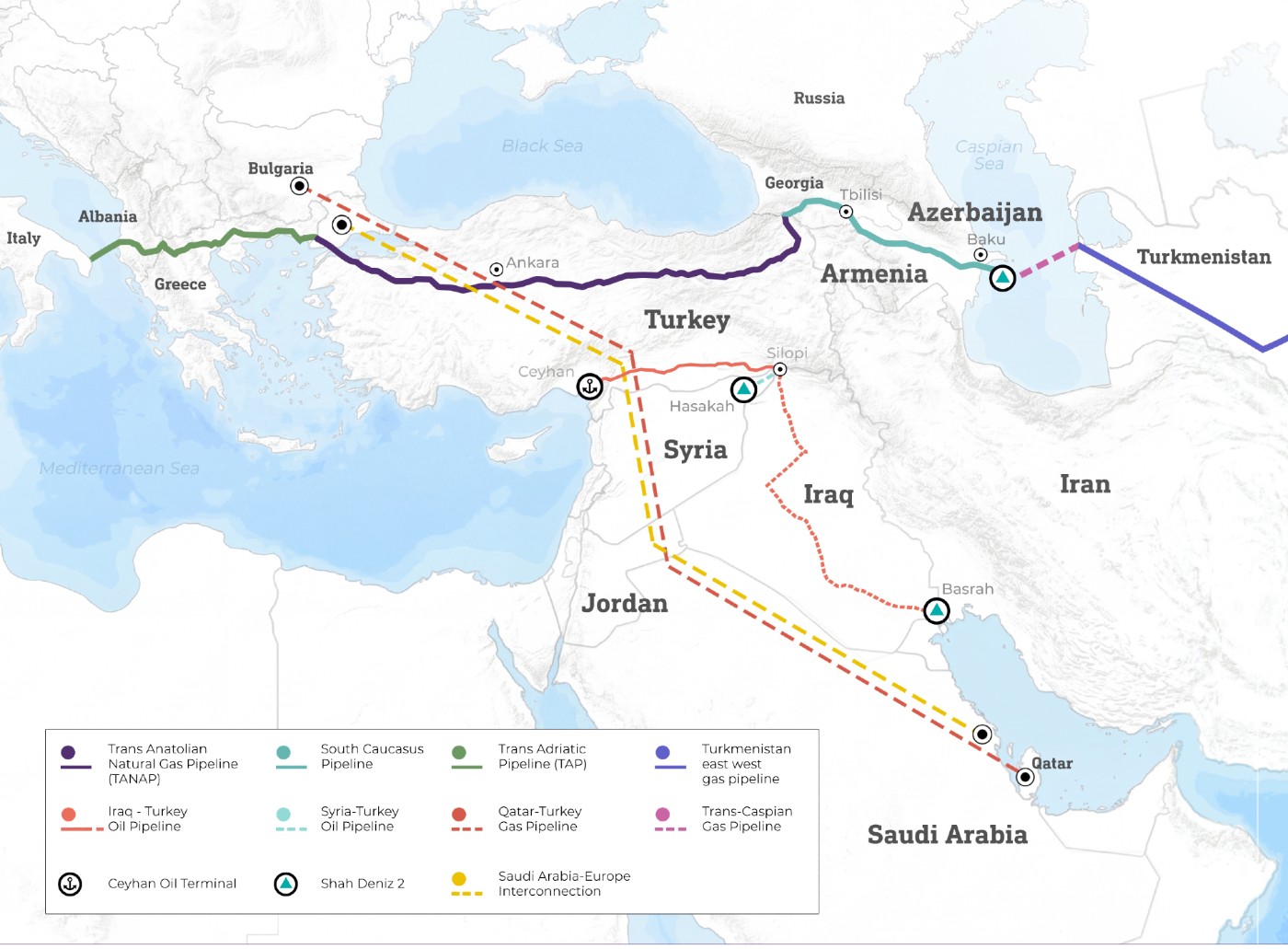
During a live interview with Anadolu Agency last week, Turkish Energy Minister Alparslan Bayraktar laid out his full vision for these alternative routes, highlighting multiple projects that have sat dormant for years for political and economic reasons. Top of his list is connecting Iraq’s oil-rich southern Basra region to the existing underutilized Iraq-Turkey pipeline, which currently carries 1.5 million barrels of crude per day from Iraq’s northern Kirkuk field to Turkey’s Mediterranean export terminal at Ceyhan. Bayraktar also revived plans for a massive overland gas pipeline that would link Qatar’s giant North Field to Turkey, transiting Saudi Arabia, Jordan and Syria, before sending supplies onward to European markets. He also pushed for progress on the long-discussed Trans-Caspian Gas Pipeline, which would carry 80 billion cubic meters annually of Turkmen natural gas across the Caspian Sea to Azerbaijan, then through Georgia to Turkey and European markets. Additional proposals include connecting Syrian oil fields to the existing Iraq-Turkey pipeline network and building a high-voltage electricity interconnector linking Saudi Arabia to Turkey via Jordan and Syria, aligning with a broader Saudi plan to connect Gulf power grids to Europe.
Bayraktar emphasized that these projects would create stable alternative export routes for producers struggling with Hormuz-related disruptions, noting that the ongoing crisis has underscored the urgent need for diversified supply chains. “We are opening an alternative export route for you,” he said, adding that he hopes the current market volatility will push global and regional stakeholders to take the long-stalled proposals seriously. “But unfortunately, what we have been saying has not found a response up to now. Hopefully, this crisis will lead everyone into a process where they pause, think more seriously, and we can implement these projects.”
Already, neighboring producer Saudi Arabia has leveraged its domestic East-West Pipeline to move crude through the Red Sea, bypassing the Strait of Hormuz entirely, while Iraq has begun exploring overland export options. The urgency for alternative routes grew after QatarEnergy declared force majeure on multiple long-term LNG supply contracts to customers across Europe and Asia last month, following Iranian targeting of Qatari energy facilities near the strait.
However, energy experts have cast doubt on the feasibility of many of Turkey’s proposed projects, painting a mixed outlook that sees some schemes as relatively actionable while others face steep political, economic and security barriers. The Trans-Caspian Gas Pipeline, for example, is now more politically viable than it has been in decades following improved relations between Azerbaijan and Turkmenistan, but it still faces significant unresolved hurdles. The project requires a 300-kilometer subsea pipeline across the Caspian Sea, connecting the Turkmen port of Turkmenbashi to Azerbaijan’s capital Baku, where it could link to existing export infrastructure including the South Caucasus Pipeline and Trans-Anatolian Pipeline. Experts estimate the subsea segment alone would cost roughly $2 billion, and scaling the pipeline to a commercially viable 20-30 billion cubic meters per year would require billions more in upstream development, compression upgrades and downstream expansion. Securing financing has also proven difficult, as European markets are increasingly shifting to LNG imports, and the project lacks long-term purchase commitments that would de-risk investment. While Azerbaijan and Turkmenistan have improved ties, both have yet to formally ratify the 2018 Convention on the Legal Status of the Caspian Sea, which would clear legal barriers for the pipeline and reduce opportunities for Russia and Iran to block the project.
The proposed Qatar-Turkey gas pipeline, first floated as early as 2009, faces even steeper challenges. After the fall of Bashar al-Assad’s regime, which blocked the project for years under Russian pressure, Turkey has pushed to revive it, but Qatar has repeatedly signaled it has no interest in moving forward. A Qatari foreign ministry statement in January 2025 confirmed the country remains committed to its existing LNG export model, which offers greater market flexibility than a fixed pipeline route. Justin Dargin, a senior fellow at the Doha-based Middle East Council on Global Affairs, noted that the project was originally estimated to cost $10-12 billion, but current inflation, security risks and political uncertainty would push the total price tag to $15 billion or more. The 1,500-kilometer pipeline crosses multiple national borders, requiring decades of sustained political alignment between Saudi Arabia, Jordan, Syria and Turkey – a high bar in the volatile current regional environment. It would also expose Qatar to political transit risks that the country has spent decades avoiding, while its existing LNG infrastructure allows it to sell to global spot markets and diversify its customer base. “A multi-country pipeline would expose Qatar to exactly the kind of political leverage it has spent decades minimising,” Dargin explained. He added that while Gulf producers are increasingly expanding domestic bypass capacity like Saudi Arabia’s East-West Pipeline and the UAE’s Habshan-Fujairah pipeline, the Qatar-Tur project would not operate within a single country, leaving it vulnerable to disruption from state and non-state actors aligned with Iran.
Some of Turkey’s smaller proposals, however, are viewed as far more feasible. The plan to connect Syrian oil fields to the existing Iraq-Turkey pipeline, which currently has massive unused capacity, is seen as a relatively achievable near-term fix. Syria currently produces 100,000 to 120,000 barrels of crude per day, down from nearly 400,000 bpd before the 2011 civil war, so connecting existing output to the Turkey route would require relatively modest infrastructure investment. Wael Alzayat, executive director of the US-Syria Business Council, noted that while both Syrian and Turkish officials back the idea, obstacles remain: key oil producing areas are still controlled by the Syrian Democratic Forces, with no complete handover to the new Damascus government, and armed groups including PKK elements and remaining Islamic State cells pose ongoing security threats. Alzayat added that developing Syrian production to increase output would require a few billion dollars in outside investment, which Damascus cannot currently afford, but connecting existing fields to the pipeline is technically straightforward. “It is more feasible and realistic than a Qatar-Turkey pipeline crossing Syria,” he said.
In Iraq, the proposal to extend the existing Iraq-Turkey pipeline from Kirkuk down to Basra has also gained new urgency amid the Hormuz crisis. The Iraqi government needs $6.3 billion in monthly oil revenue to cover public expenditures, and lost more than $5.5 billion in March alone, highlighting the urgent need for additional export capacity. Currently, Iraq exports only 200,000 barrels per day through the Kirkuk-Ceyhan route, far less than the 3.5 million barrels per day it needs to cover monthly costs. Iraqi energy expert Salam Jabbar Shahab noted that political willingness to move forward with the Basra extension has grown substantially since the Hormuz crisis began, as the route would open a new outlet for southern Iraqi crude to European and Asian markets that bypasses the strait entirely. The biggest barriers, he added, are financing and security: the project is estimated to cost between $6 billion and $10 billion, which Iraq cannot cover on its own and would require loans from international financial institutions, and the pipeline would run from southern to northern Iraq through multiple restive regions, leaving it vulnerable to attacks from armed groups and political bargaining amid Iraq’s fragmented political landscape. Still, Shahab noted that the current crisis has given Iraqi policymakers a strong pragmatic incentive to move the project forward quickly.