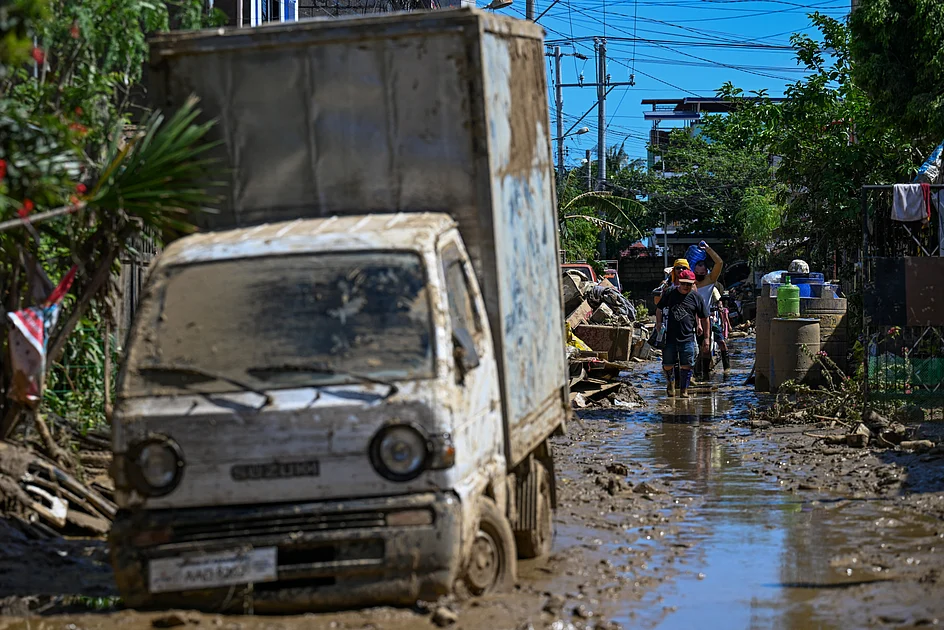
The Philippines is on high alert as Typhoon Fung-wong, rapidly intensifying toward super typhoon status, approaches the country’s eastern coast. The Philippine Atmospheric, Geophysical, and Astronomical Services Administration (PAGASA) has issued dire warnings of life-threatening storm surges reaching up to five meters and destructive winds capable of widespread devastation. The typhoon, locally named Uwan, is expected to make landfall on Sunday night, with its massive 1,500-kilometer circulation already unleashing heavy rains and strong winds across eastern regions. PAGASA forecaster Benison Estareja emphasized the storm’s potential to cover nearly the entire country, with maximum sustained winds of 140 kph and gusts up to 170 kph, possibly intensifying to 185 kph upon landfall. Such force could obliterate homes, uproot trees, and flatten structures. Eastern provinces, particularly the Bicol region and parts of Samar, are forecast to receive up to 200 mm of rainfall, heightening risks of severe flooding and landslides. Northern and central Luzon may also experience 100-200 mm of rain. Authorities have urged residents in low-lying and coastal areas to evacuate immediately and halt all marine activities. In preparation, several local governments have suspended classes for Monday, and the national flag carrier has canceled multiple flights. The looming threat follows the devastation caused by Typhoon Kalmaegi, which recently claimed 204 lives in the Philippines and five in Vietnam, displaced hundreds of thousands, and caused extensive damage to infrastructure. Both nations, situated along the Pacific typhoon belt, remain highly vulnerable to such extreme weather events. Scientists attribute the increasing intensity of storms like Kalmaegi and Fung-wong to rising global temperatures, underscoring the escalating impact of climate change.