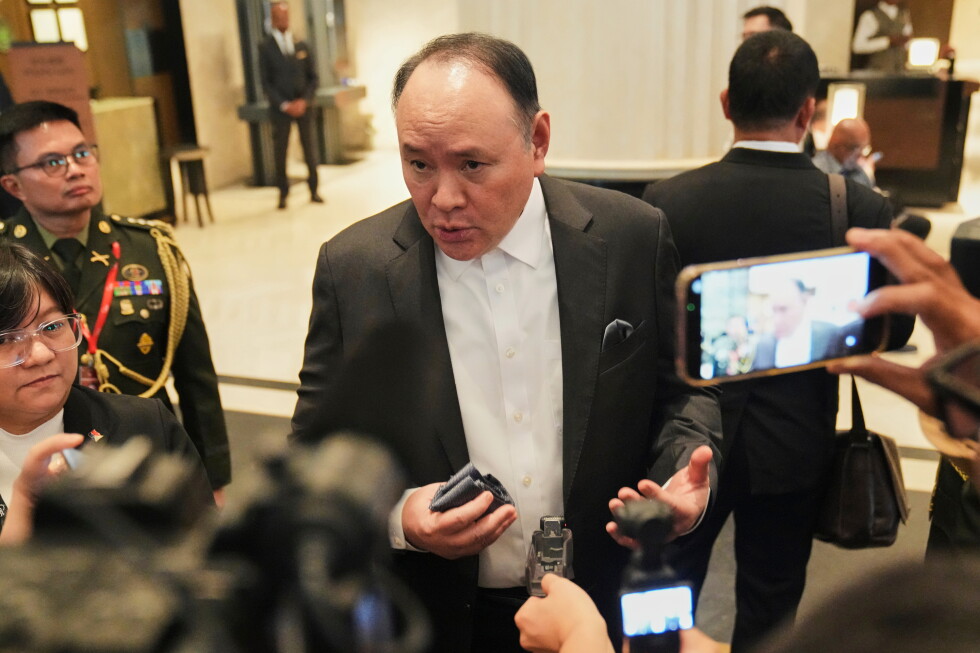
Diplomatic friction between the Philippines and China has escalated sharply after Beijing imposed targeted sanctions, including a full entry ban, on Manila’s top defense official over his public criticism of Chinese sovereignty claims in the disputed South China Sea. The development, announced by both sides this week, has cast further uncertainty over already fraught bilateral relations.
Beijing’s Ministry of Foreign Affairs confirmed Thursday that Defense Secretary Gilberto Teodoro Jr. and his immediate family are barred from entering mainland China, as well as the special administrative regions of Hong Kong and Macao. The sanctions also extend to a commercial ban, prohibiting all Chinese individuals and entities from conducting any form of business or transaction with Teodoro and his family. Beijing justified the measures as a necessary step to safeguard its core sovereignty, security and development interests, citing what it calls Teodoro’s repeated “irresponsible remarks” that have undermined Chinese interests.
Appointed to the defense portfolio by Philippine President Ferdinand Marcos Jr. in June 2023, Teodoro has emerged as one of the most outspoken critics of China’s geopolitical actions, both in the South China Sea and regarding the Taiwan question. Last year, he drew particular condemnation from Beijing when he publicly labeled China’s expansive claims to nearly the entire South China Sea “the biggest fiction and lie”, and made critical remarks targeting Chinese President Xi Jinping over what he called Beijing’s “aggressive and illegal” regional policies.
Beyond rhetoric, Teodoro has led major policy shifts to expand the Philippines’ security partnerships to counter Chinese assertiveness. He has overseen a deepening of defense cooperation with the United States, the Philippines’ longstanding treaty ally, including expanding annual joint combat exercises to incorporate joint naval patrols and training drills directly in the disputed South China Sea. He has also spearheaded negotiations for new visiting forces agreements with other like-minded nations including Japan, France, Canada and New Zealand, initiatives he has framed as key to boosting regional deterrence against Chinese expansion.
In response to the sanctions, the Philippine Department of Foreign Affairs acknowledged Friday that Beijing holds the prerogative to impose such measures, but made clear Manila’s strong condemnation of the move. The department called the sanctions “an unfriendly act that further complicates the bilateral relations” between the two neighboring nations, adding that punitive steps of this kind do nothing to foster mutual trust, support responsible management of existing differences, or create a positive foundation for future constructive diplomatic engagement.
For his part, Teodoro has pushed back against the sanctions and vowed to continue advancing Philippine national interests in the face of Beijing’s actions. In an official statement released after the announcement, Teodoro said he would remain unwavering in carrying out his duties to the Philippines, and argued that the sanctions themselves underscore the nature of Beijing’s approach to anyone who challenges its narrative. “This underscores what they do to those who speak the truth against their deception,” he said.
This is not the first time Beijing has used targeted sanctions against Philippine officials over disputes related to the South China Sea. Last year, China imposed similar measures on former Philippine senator Francis Tolentino, who authored two landmark bills that reaffirmed the Philippines’ sovereign maritime territorial claims and resource rights across its claimed exclusive economic zone, including areas of the South China Sea disputed with China. Those bills were ultimately signed into law by President Marcos Jr. Beijing has also previously imposed sanctions on U.S. and European officials over policy positions it deemed contrary to Chinese interests, including on issues related to human rights.